866-972-5373
 Account Login
 866-972-5373
 Account Login

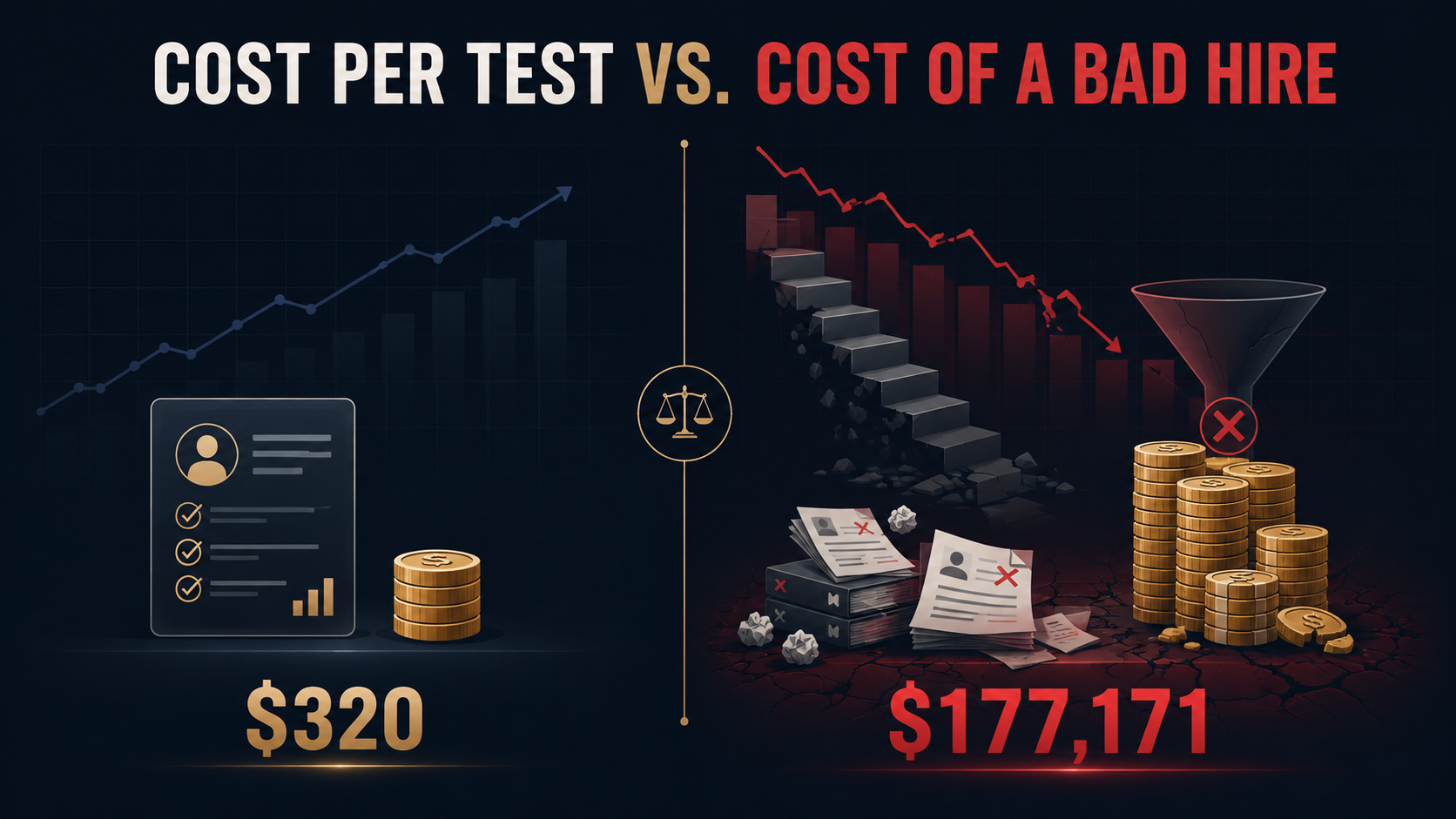
Quick answer: Sales assessment pricing can range from free to about $500 per candidate, or $1,800 to $50,000+ per year for subscription plans. A validated, sales-specific assessment typically runs $150 to $350 per candidate. But the per-test price can be insignificant if you aren’t looking at the bigger picture.
I’ve been asked “what cost the assessment cost?” for 20+ years. It is almost always the first question, and it is almost never the right one. Not because cost doesn’t matter. It matters enormously. But because the way most buyers frame the question – per test – leads them to compare a $50 personality quiz against a robust, $300 validated sales assessment as though they were the exact same tool. They are not. Each tool is designed for a different purpose and comparing pricing without comparing what the assessment actually measures is a mistake.
When elevating assessment options, you must determine what hiring problem you are trying to solve to understand real value.
But for now, let’s look at how much a sales assessment may cost you. Below is the full landscape, the real drivers of cost, our own pricing published openly, and a budgeting benchmark I’ve never see anyone else publish.
Sales Assessment Pricing Ranges for 2026
Here’s what the market actually looks like. I’ve grouped by category rather than by vendor because the category is what drives the price point.
| Assessment Category | Typical Price Range | Pricing Model | What you are usually buying | Best suited for |
| Free personality quizzes (i.e. online DiSC, 16-type tests) | $0 per candidate | Free/freemium | Limited test access, basic scores or a short behavioral profile with no validation | Early research, low-stakes screening or trying a platform |
| Entry-level skills platforms (i.e. TestGorilla, Equip, Xobin) | $1-$50 per candidate ~$1,500-$4,800 per year | Credits or annual tier | Broad test libraries across all roles. Sales is one of hundreds of options. | Companies hiring across many job categories |
| Commercial DiSC profiles (i.e. Everything DiSC and similar) | $25-$100+ per candidate | Per profile or credits | Behavioral communication style. Built for team development, not hiring predictions | Training, coaching and team development |
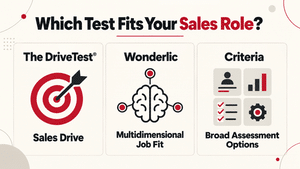
| General psychometric platforms (i.e. Predictive Index, Criteria) | $5,000-$50,000+ per year | Priced by company headcount | Validated behavioral and cognitive data across all roles, not just sales | Companies hiring, training and developing across many job categories |
| Sales-specific, validated assessments (i.e. The DriveTest®, Caliper, OMG) | $150-$400 per candidate | Per test, packages or subscriptions | Sales-specific traits, competencies, hiring reports and interview guidance | Hiring SDRs, BDRs, account executives and new-business salespeople |
| Consultant-led assessments + advisory | $500-$2,500+ per candidate | Engagement-based | Assessment plus a human interpreting it with you | Complex or high-risk hires |
These are planning ranges, not universal price limits. A vendor may combine per-candidate fees with an annual platform charge, charge separately for implementation or require a minimum contract.
It is also important to think beyond just per-candidate pricing. SalesFuel’s 2026 Voice of the Sales Manager research put the average cost of a bad B2B sales hire at $177,171. So, while some assessments may appear ‘expensive,’ the financial risk of hiring a bad salesperson is even greater.
Additionally, this table should not be read as a ranking. Everything DiSC, for example, can be useful for understanding how a salesperson approaches customers, but that is different from evaluating whether a candidate has the underlying traits needed to prospect consistently.
Likewise, TestGorilla offers hundreds of tests across multiple job categories. That breadth may be valuable for an HR department hiring engineers, marketers, support employees and salespeople. A company hiring only new-business salespeople may prefer a narrower tool.
The right comparison is purpose against purpose – not price against price.
What Drives the Cost of a Sales Assessment?
When an assessment vendor provides you with a quote, seven things are typically fueling that number:
- Research and Validation. Developing a serious employment assessment requires the developer to define the characteristics being measured, create appropriate questions, collect data, examine scoring consistency and determine whether results relate to meaningful job outcomes. While running a real validation study means administering the assessment to working salespeople, tracking their actual production over time, and statistically confirming the test predicts performance. These processes cost a lot. Tests that skip it are cheaper for an obvious reason. But it’s also important to note that a high-price does not prove the assessment is valid. Be sure to obtain appropriate documentation from your vendor shortlist.
- Sales-specific norms. Scoring a candidate against the general population tells you nothing. Scoring them again a sales population (i.e. working salespeople) makes the results more relevant to sales-specific hiring decisions.
- Faking and social desirability controls. Salespeople, by nature and training, are often very persuasive. An assessment that can be gamed by a competent candidate is worthless at any price. Building distortion detection into the tool is expensive but necessary to understand true potential. Not just how the salesperson wants to be seen.
- Report depth and usability. A score is not a decision. Reports that include role-fit guidance and candidate-specific interview questions cost more to produce. However, more pages does not automatically mean more value. A 40-page report that managers cannot interpret is less useful than a concise report that changes how they interview.
- Support, training and consulting. Some tools are almost entirely self-service. Others may include onboarding, report interpretation, strategy sessions, certification or access to a consultant. Human support increases price, but it can also prevent managers from misreading results. Before paying for it, determine whether support is included or sold separately.
- Integrations and enterprise requirements. Expenses unrelated to the assessment are sometimes quoted in enterprise pricing. Things like ATS integrations, API access, multiple admin accounts, custom permissions, etc. A company hiring five salespeople probably does not need to pay for enterprise infrastructure. A multinational employer may consider it mandatory.
- Volume and contract commitments. The individual assessment price usually falls as testing volume increases. The tradeoff is commitment. A package may offer a lower price per candidate but require upfront payment. An annual subscription can make sense for frequent hiring, but it becomes expensive if testing slows down.
Why Are Some Sales Tests So Cheap?
A cheap sales test is not automatically a bad test. They were built for a different job. Most inexpensive assessments are general personality tests – developed and sold at scale across every role. Their reports may be brief, have limited validation and are typically intended for development rather than selection. The flaw is assuming that any test with “sales” in its name can support a sales hiring decision.
That isn’t a jab at these tools. A cheap test that measures communication preferences may be perfectly adequate when that is what you need. It is a poor bargain if you expect it to identify who will generate new business in a demanding sales role. A DiSC profile, for example, is genuinely useful for onboarding and team communication. But it’s not a hiring predictor and pricing reflects development cost not usefulness.
I’ve broken down that specific distinction in The DriveTest® vs DiSC.
Why Are Some Sales Assessments So Expensive?
Higher-priced assessments may reflect substantial investment in research and validation, specialized scoring or sales-specific norming, and human expertise attached to the output. Enterprise tools may also include software and services extending far beyond candidate testing.
When you see $300 instead of $30, you are likely paying for the studies that prove the tool works and the norm group that makes the score mean something. But…
Expensive does not mean predictive or valid.
Price is a signal, not proof. Ask any vendor charging a premium price for their validation data. If they cannot produce a validation study, the price is marketing and not science-driven. A premium price is justified only when the additional features improve the hiring decision you are trying to make.
The Hidden Costs Nobody Puts in the Quote
This is where budgets actually break. In my experience, the sticker price is rarely the problem – the model is. Be mindful of these additional cost drivers.
- Headcount-based pricing. Some companies use total employee count, not your hiring volume to determine pricing. If you grow from 200 to 500 employees’ mid-contract, your bill grows even if your hiring slowed. Unlimited usage is genuinely valuable – but only if you’re actively hiring.
- Credit or package expiration. Most packages or credits expire within 12 months. If you buy 50 tests or credits for a hiring push that gets postponed, and you’ve bought 50 tests.
- Certification fees. Some companies require a certified practitioner to interpret results. Be sure to understand this requirement and include it as an additional expense because this is separate from the per-profile price.
- Seat or user fees. If five, ten or twenty hiring managers or recruiters need dashboard access, check whether that’s included or billed per seat.
- Annual lock-in. Several major assessment platforms sell annual contracts only, with no packages or per-assessment option. This is fine for steady hiring. Painful if your hiring cycle is only one quarter.
- Interpretation time. A 40-page report per candidate that nobody on your team has time to read has a cost, and it’s paid in manager hours.
The single most expensive mistake I see is mismatching the pricing model to the hiring pattern. Companies that hire in bursts sign annual subscriptions. Companies hiring steadily all year buy one-off tests at full retail price. Match the pricing model that truly fits your exact hiring needs.
The Number that Actually Matters: Assessment Spend as a Percentage of First Year Cost
Here is the framing I wish more finance teams used, because it ends the argument in about 30 seconds. Stop asking what the test costs. Ask what the test costs as a percentage of the hiring decision.
| Role | Typical First Year OTE | Fully Loaded First-Year Cost | Assessment at $320 | Assessment as % of Cost |
| SDR / BDR | $70,000 | ~$95,000 | $320 | 0.34% |
| Mid-Market AE | $150,000 | ~200,000 | $320 | 0.16% |
| Enterprise AE | $300,000 | ~$400,000 | $320 | 0.08% |
Fully loaded cost includes base, expected commissions, benefits, taxes, tooling and recruiting cost. Excludes ramp time and opportunity cost, which are larger still.
You are deciding whether to commit somewhere between $95,000 and $400,000 to a salesperson you’ve known for a few hours across a couple interviews. A validated sales assessment that informs that decision costs less than one percent.
No CFO would approve a $200,000 capital expenditure on the strength of a good conversation. Yet that is precisely how most sales hires get made.
Put another way, if you are debating $50 versus $320, you are optimizing a variable that represents 0.1% of the outcome while leaving the other 99.9% of the decision making up to intuition. The Department of Labor conservatively puts a bad hire at 30% of first-year earnings, and SHRM’s range runs from 50% to 200% of salary. Those are the numbers your assessment budget should be compared against.
I walk through the full return calculation in The ROI of Using a Sales Aptitude Test Before You Hire.
Cost Per Test vs Cost Per Qualified Hire
One more reframing consideration, that is under-discussed.
You don’t test one candidate. You test a pool of candidates. And in my experience, roughly one in five people has the Drive to consistency generate new business. So, your real unit cost is:
Formula: Cost per qualified hire = (price per test x candidates tested) / hires made
Test ten candidates at $280 to make one confident hire and your true cost is $2,800 per hire – against a $4,700 average cost-per-hire for sales roles and a $177,171 average cost of hiring a bad salesperson. The assessment line is still the smallest number on the page.
But this math also tells you: a cheap test with poor predicative power raises your cost per qualified hire because it sends you bad finalists. The assessment that costs $20 and passes everyone isn’t cheap. It’s just deferred.
How Much Does The DriveTest Cost?
It’s only fair that I include our numbers in a pricing piece. Here is what The DriveTest costs, as of 2026:
| SalesDrive Plan | Price | Per Test Cost | Best For |
| Starter | $320 per completed assessment | $320 | Occasional or one-off sales hiring |
| Growth: 10 tests | $2,800 upfront | $280 | A focused hiring push. Valid for 12 months. |
| Growth: 20 tests | $5,000 upfront | $250 | Growing teams filling several roles. Valid for 12 months. |
| Growth: 50 tests | $10,000 upfront | $200 | Larger hiring cycles. Valid for 12 months. |
| Scale | $21,600 annually, billed at $1,800 per month for 12 months | Varies with usage | Consistent, year-round hiring. 12-month commitment required. |
Every plan noted above includes the full system – dashboard access, unlimited users with no seat fees and two reports per completed assessment. No setup fees, no feature gating, no hidden charges. Full details are on our pricing page and FAQ page.
The DriveTest is built around a specific question: Does this candidate possess the Drive required to consistently develop new business?
It measures Need for Achievement, Competitiveness and Optimism, along with Confidence, Persuasiveness, Relationship Skills and Organization. It is most relevant when hiring hunter-style salespeople such as SDRs, BDRs, account executives and business-development representatives.
And we’re not the right choice if you want a team communication profile rather than a hiring screen. DiSC is cheaper and better suited for this need. If you need to test coding or technical skills, we don’t do that either. And if you’re not prepared to actually act on a low score when a charming candidate produces one, no assessment at any price will help you.
Bottom Line: Is a Sales Assessment Worth the Cost?
A sales assessment is worth buying when it provides job-relevant information that improves how you screen, interview or compare candidates. It is not worth buying simply because it produces an attractive report.
A sales assessment can cost between nothing and a few hundred dollars per candidate, and that range is wide because the development required for each tool is fundamentally different.
I hope you’ve learned that the per-test price is the least informative number in the decision. What matters is the pricing model relative to how you actually hire, the hidden costs not always readily available and the assessment’s cost as a fraction of the fix-figure hiring decision you are making when hiring a salesperson.
Your next step is not to find the cheapest test. It’s to shortlist two or three tools that publish validity data, ask each one for their technical manual and price them against your actual annual hiring volume rather than your headcount. If you’d like a head start with shortlisting, our comparison of sales assessment tools lays out the categories side by side without pretending one tool wins every scenario.
If you want to see The DriveTest in action before spending anything, we offer one free assessment per company – a real test, real results, no obligation. Run it on a current top producer and see whether the report describes the person you know. That’s a far better way to evaluate cost than another pricing table, including mine.
Frequently Asked Questions
Sales assessments generally range from $0 to $500 per candidate. Specialized sales hiring assessments commonly cost $200 to $500 per completed assessment.
Cheap assessments are often self-service, automatically scored and limited in scope. They may provide general personality, behavioral or skills information without sales-specific validation, consulting or detailed hiring guidance. A low price does not necessarily mean low quality, but buyers must confirm what the test was designed to measure.
Expensive assessments may include specialized validation, detailed reports, consulting, training, integrations, custom benchmarking and enterprise security features. Some also carry higher prices because of branding or a consultant-delivered model. Price alone does not demonstrate predictive value.
No. The best assessment is the one that measures characteristics relevant to the job and provides data supporting its intended use. An expensive general assessment may be less useful for hiring a hunter salesperson than a less expensive sales-specific tool.
Pay-per-assessment pricing is usually better for occasional or unpredictable hiring. Packages work well when you can estimate your testing volume. A subscription can reduce the effective cost per candidate when you hire consistently, but it wastes money when usage is low.
They are worth it when the price differential is trivial relative to the decision. At a 0.1%-0.35% of a rep’s first-year loaded cost, the question isn’t whether you can afford the test – it’s whether you can afford to be wrong. That said, price alone proves nothing. Ask for the technical manual and validity data before paying premium rates.
About the Author: Dr. Chris Croner is a clinical psychologist and Principal at SalesDrive, LLC. He developed The DriveTest® sales assessment and is co-author of Never Hire a Bad Salesperson Again. He has helped more than 1,500 companies worldwide identify and hire top-performing salespeople. Connect with him on LinkedIn.
**Pricing note: The prices and ranges below were reviewed in August 2026. Vendors can change pricing, packaging and features, so confirm current terms before purchasing.