 866-972-5373
 Account Login

 866-972-5373
 Account Login

The Best Sales Assessment Tool Depends on What You Need to Measure
Most companies do not fail at sales hiring because they use no assessment at all. They fail because they choose an assessment without first asking the harder question:
What exactly are we trying to measure?
A salesperson hired to generate new pipeline does not need the same evaluation as someone hired to manage existing accounts. A sales manager does not need the same assessment as an SDR. A relationship-driven account manager may succeed with a very different profile than a high-intensity new business hunter.
And while many platforms sound similar on the surface, they often measure different things. Some sales assessment tools measure communication style. Some measure behavioral tendencies. Others measure cognitive ability and there are some that evaluate sales skills or coaching needs.
Those are not minor differences. They are different hiring questions and a sales assessment is only useful if it measures something that matters in the role.
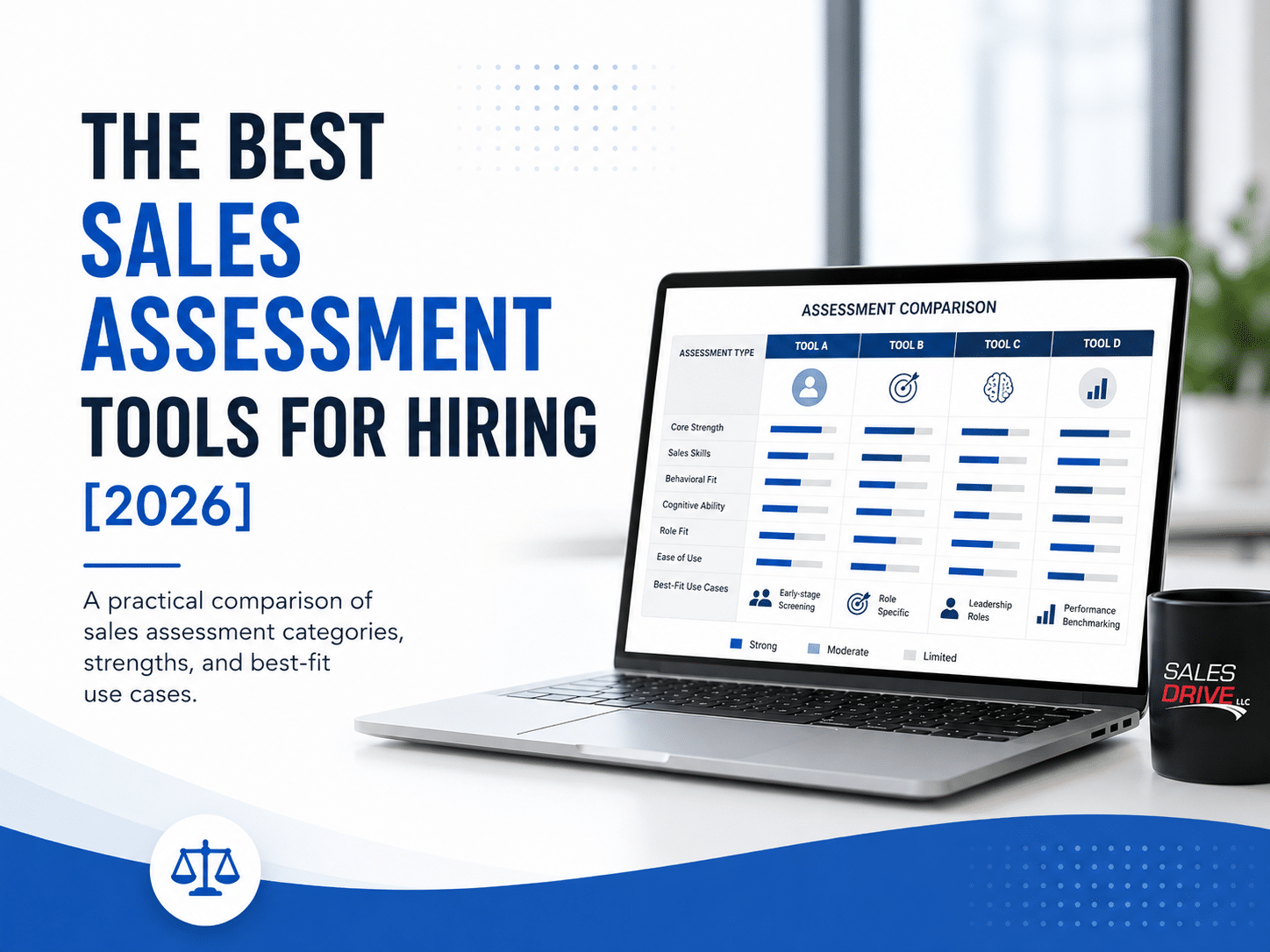
Below is a practical comparison of several major sales assessment platforms, including where each one tends to fit best, what it measures well, and where companies should be careful.
TL;DR — What Are the Best Sales Assessment Tools?
The best sales assessment tool depends on the hiring problem you need to solve.
- SalesDrive — Best for identifying true sales hunters and motivational Drive
- DISC — Best for communication style awareness and sales coaching conversations
- The Predictive Index — Best for behavioral alignment and role fit
- TestGorilla — Best for custom hiring workflows and multi-test screening
- Objective Management Group (OMG) — Best for sales-specific behavior and coaching diagnostic
- Talogy/Caliper — Best for enterprise sales assessment programs and talent analytics
No single assessment should make the hiring decision by itself. The right assessment should strengthen the process by giving hiring managers objective insight they cannot reliably get from resumes and interviews alone.
Sales Assessment Tools Comparison Table
| Sales Assessment Tool | Best For | What It Primarily Measures | Ideal Use Case | Potential Limitation |
| The DriveTest® by SalesDrive | Hiring sales hunters | Drive, achievement orientation, competitiveness, optimism, persuasiveness, confidence | Companies hiring for outbound sales, prospecting, new business development, and revenue-generating roles | Does not provide product knowledge, industry expertise or culture fit. Not designed for roles without direct revenue responsibility. |
| DISC | Communication style awareness | Observable communication and behavioral style | Coaching, management communication, leadership development, and team dynamics | Should not be used alone as the main predictor of sales performance |
| The Predictive Index | Behavioral alignment | Workplace behavior, motivation, role fit, and team dynamics | Matching candidate tendencies to role demands and improving retention | Strong role definition is required; poor role calibration weakens the insight |
| TestGorilla | Custom assessment workflows | Skills tests, cognitive tests, writing exercises, sales scenarios, software proficiency | Companies hiring across multiple sales roles that need flexible screening workflows | A poor test mix creates noise instead of clarity |
| Objective Management Group | Sales-specific behavior and coaching insight | Sales competencies, selling behaviors, sales execution tendencies, coaching gaps | Candidate evaluation, sales team diagnostics, coaching, and sales management development | Can be more extensive than some smaller companies need for a single hire |
| Talogy/Caliper | Enterprise talent systems | Personality, cognitive ability, workplace tendencies, leadership potential, analytics | Large organizations with multi-location hiring, leadership development, and structured HR systems | May be more complex than necessary for small or mid-sized companies |
How to Choose the Right Sales Assessment Tool
Before comparing platforms, define the sales role with precision. Not all sales roles are the same. Just think about how different a new business development role is from a customer service role.
That is where companies often make the first mistake. They buy an assessment before deciding what success in the role actually requires.
Use these selection criteria before choosing a tool.
1. What kind of sales role are you hiring for?
If the role requires heavy outbound prospecting, cold outreach, rejection tolerance, and new pipeline creation, you need to evaluate traits tied to sustained sales Drive.
If the role depends more on relationship management, account expansion, internal coordination, or consultative service, behavioral style and communication fit may matter more.
2. Does the assessment measure sales performance drivers or general workplace traits?
Sales performance depends on several forces working together: motivation, resilience, competitiveness, persuasion, discipline, coachability, and role fit. If a tool measures only communication style, it may help a manager understand how to coach the person, but it may not tell you whether that person will consistently generate pipeline.
That does not make communication tools useless. It means they should be used for the right purpose.
3. Is the tool validated for hiring decisions?
This matters more than most companies realize.
A sales assessment used for hiring should be structured, consistent, and job-relevant. It should add objective information to the process, not simply confirm the interviewer’s first impression.
A weak assessment can create false confidence. That is worse than no assessment because it makes the hiring team believe the decision is more scientific than it really is.
4. Does the assessment reduce interview bias?
Interviews reward presentation. Sales performance is consistent behavior over time.
Those are not the same thing.
Some candidates are exceptional at interviewing. They know how to sound energetic, polished, strategic, and hungry for the role. But once hired, they may avoid prospecting, struggle with rejection, or need constant managerial pressure to maintain activity.
The right assessment should help expose the gap between interview polish and likely field behavior.
5. Can managers use the results after the hire?
A hiring assessment becomes more valuable when the results also support onboarding, coaching, and performance management.
The best tools do not just help you decide whom to hire. They help you manage the person more effectively after the hire.
No assessment replaces management judgment, structured interviewing, onboarding, training, compensation, or market conditions.
The best assessments improve hiring consistency. They do not make the entire hiring decision by themselves.
Top Sales Assessment Tools
The DriveTest® by SalesDrive: Best for Hiring True Sales Hunters
The DriveTest by SalesDrive is best suited for companies trying to identify salespeople with the internal Drive required for hunter roles.
That means roles where success depends on consistent prospecting, new business development, rejection recovery, urgency, competitiveness, and sustained effort over long periods.
The DriveTest focuses heavily on motivational characteristics associated with sales Drive. The assessment was designed around factors such as achievement orientation, competitiveness, optimism, persuasiveness, and confidence.
Those traits matter enormously in outbound sales environments.
The hardest part of sales usually is not talking. It is maintaining activity and emotional consistency under rejection and quota pressure.
That is where many bad sales hires become expensive.
A candidate may interview well, say the right things, and look strong on paper. But once the daily prospecting grind begins, performance depends on something deeper than presentation.
In many sales roles, the hardest part of the job is not knowing what to say. It is doing the uncomfortable work repeatedly: making calls, creating opportunities, following up, competing for the deal, and staying emotionally steady when prospects say no.
Strengths
The DriveTest is especially useful for companies that need to evaluate motivational characteristics tied to prospecting persistence and sales Drive.
It helps hiring teams look beyond whether a candidate sounds good in the interview and focus more closely on the internal characteristics that support sales activity over time.
Ideal Use Case
The DriveTest is a strong fit for companies hiring:
- Outbound salespeople
- Sales hunters
- SDRs and BDRs
- New business developers
- Quota-carrying salespeople
- Salespeople responsible for pipeline generation
It is especially relevant when the company’s growth depends on hiring people who can create opportunities rather than wait for them.
Potential Limitation
No assessment predicts sales success perfectly. The DriveTest does not measure product knowledge, industry expertise, or culture fit. Management quality, compensation, market conditions, onboarding, sales process, and product-market fit also influence performance.
The assessment is designed for roles with direct revenue responsibility. If the position primarily involves account support, customer service, or relationship maintenance, a different tool—or a broader assessment mix—may be more appropriate.
DISC: Best for Communication Style Awareness
DISC remains one of the most recognized behavioral frameworks in business.
Its appeal is easy to understand. It is simple, memorable, and useful for helping people understand communication differences.
DISC can help sales managers understand whether someone tends to be more direct, more collaborative, faster-paced, more cautious, more people-oriented, or more task-oriented. Those insights can improve coaching conversations, team communication, leadership development, and conflict management.
Strengths
DISC is useful because managers can understand it quickly and apply it immediately.
It can help answer questions like:
- How does this salesperson prefer to communicate?
- How might this person respond to pressure?
- What kind of coaching style may work best?
- How might this person interact with teammates or prospects?
- Where could communication friction occur?
For sales teams, that can be helpful after the hire.
Ideal Use Case
DISC is best used for communication awareness, coaching, leadership development, and team dynamics.
It can also support onboarding by helping managers adjust their communication style to the salesperson’s preferences.
Potential Limitation
DISC is generally not positioned as a direct predictor of sales performance.
A candidate may be articulate, confident, warm, and highly polished but still lack the internal motivation to prospect consistently. Another candidate may be rougher around the edges in an interview but far more persistent in the field.
DISC can help you understand how a person communicates. It should not be the only tool used to decide whether that person will sell.
The Predictive Index: Best for Behavioral Alignment and Role Fit
The Predictive Index is often used by organizations that want better alignment between a person’s behavioral tendencies and the demands of the job.
That is a real issue in sales hiring.
A salesperson may not fail because they lack intelligence or talent. They may fail because the role is wrong for them.
For example, a highly relationship-oriented salesperson may struggle in a cold outbound role where they face rejection every day. A highly competitive hunter may thrive in new business development but become frustrated in a slow-moving account management position.
Strengths
The Predictive Index helps companies think more carefully about behavioral fit.
It can help hiring teams define the behavioral requirements of the role and compare candidates against those expectations. That can reduce vague hiring conversations like “I liked her energy” or “He seemed like a good fit.”
Better role definition usually leads to better hiring discussions.
Ideal Use Case
The Predictive Index is a good fit for organizations that want to improve role alignment, team design, and retention.
It is especially useful when sales turnover appears to be caused by expectation mismatch rather than raw lack of talent.
Potential Limitation
Behavioral alignment depends heavily on how well the company defines the role.
If the hiring team has not clearly defined the actual demands of the sales position, the assessment has less to align against. A vague role profile creates vague hiring insight.
For sales teams, PI can be useful, but the company still needs to determine whether the role requires hunting, farming, account expansion, relationship management, technical selling, or some combination.
TestGorilla: Best for Custom Sales Hiring Workflows
TestGorilla is useful for companies that want flexibility.
Unlike tools focused mainly on personality or behavior, TestGorilla allows companies to combine different evaluation methods into a broader hiring workflow. That may include skills tests, cognitive tests, writing samples, sales scenarios, software proficiency tests, and role-specific exercises.
That flexibility can be helpful when a company hires across several sales positions.
An SDR, account executive, sales engineer, customer success manager, and channel manager should not all be evaluated the same way. Different roles require different evidence.
Strengths
TestGorilla gives companies control over the structure of the evaluation process.
It can help assess:
- Role-specific knowledge
- Written communication
- Problem-solving
- Sales judgment
- Software familiarity
- Scenario-based thinking
- Cognitive ability
- Basic job skills
For companies that need a more customized screening process, that can be useful.
Ideal Use Case
TestGorilla is a good fit for organizations hiring across multiple sales-related roles that require different combinations of skills.
It may be especially helpful when the hiring team wants to evaluate practical ability before advancing candidates to later interview stages.
Potential Limitation
Flexibility cuts both ways.
A well-designed workflow can improve hiring discipline. A poorly designed workflow can create noise, frustrate strong candidates, and measure things that do not actually predict success in the role.
The tool gives you options. It does not automatically build a strong sales hiring process for you.
Objective Management Group: Best for Sales-Specific Behavior and Coaching Diagnostics
Objective Management Group, often called OMG, is one of the more established sales-specific assessment companies.
Its value is that it was built around sales behavior and sales execution rather than adapting a general personality framework to sales after the fact.
OMG is commonly used for sales candidate evaluation, team assessment, coaching diagnostics, sales management development, and identifying sales-specific skill gaps.
That makes it a serious option for organizations that want deeper insight into how salespeople are likely to perform.
Strengths
OMG can help companies look beyond interview polish and examine sales-related behaviors.
A candidate may interview well but struggle with:
- Qualifying
- Consultative selling
- Handling resistance
- Pipeline discipline
- Prospecting consistency
- Sales process execution
Those are not always obvious in a standard interview.
For existing teams, OMG can also support coaching and sales management development by identifying gaps that affect execution.
Ideal Use Case
OMG is a good fit for companies that want sales-specific diagnostics for both hiring and coaching.
It may be especially useful for organizations evaluating not just individual candidates, but the broader sales team and management system.
Potential Limitation
OMG may be more extensive than some smaller companies need for a single hire.
If you’re asking — “Where are our sales execution gaps across candidates, reps, and managers?” — OMG may be a good option to consider.
Caliper by Talogy: Best for Enterprise Sales Assessment Programs
Caliper — now part of Talogy — is best suited for larger organizations that need depth, structure, scalability, and analytics across a broader talent system.
Enterprise hiring is different from small-company hiring. When a company hires across regions, divisions, leadership layers, and sales functions, consistency becomes critical.
Inconsistent hiring decisions create downstream costs: turnover, management burden, poor territory performance, weak succession planning, and uneven leadership pipelines.
Talogy/Caliper is often used in environments where assessment data needs to support not only hiring, but also leadership development, talent planning, and long-term workforce analytics.
Strengths
Talogy/Caliper offers enterprise-level structure. It can support organizations managing:
- Large recruiting operations
- Multi-location sales hiring
- Leadership assessment
- Employee selection
- Succession planning
- Talent analytics
- Broader HR infrastructure
For large companies, that structure can be valuable.
Ideal Use Case
Talogy/Caliper is a strong fit for enterprise organizations that need assessment consistency across many roles, locations, and decision-makers.
It is not just about filling one sales seat. It is about building a more systematic talent decision process.
Potential Limitation
For smaller companies, enterprise platforms may provide more complexity than necessary.
A small business hiring two sales hunters does not necessarily need a sophisticated enterprise talent analytics platform. It needs a practical way to avoid hiring someone who interviews well but will not prospect.
Side-by-Side Comparison Guide
| Platform | Primary Strength | Best-Fit Sales Hiring Scenario | Where It Can Help Most | Watch-Out |
| The DriveTest® by SalesDrive | Identifying sales Drive and hunter traits | Hiring outbound reps, SDRs, BDRs, and new business salespeople | Reducing costly mis-hires in roles requiring prospecting persistence | Not for all roles. Best when the role truly depends on hunting and self-motivation |
| DISC | Communication style clarity | Improving coaching, communication, and team interaction | Helping managers understand how salespeople prefer to communicate | Communication style alone does not prove sales performance potential |
| The Predictive Index | Behavioral role alignment | Matching candidates to role demands | Reducing turnover caused by poor role fit | Requires clear role definition before interpretation |
| TestGorilla | Flexible assessment workflows | Building custom screening processes for different sales roles | Testing practical skills, scenarios, writing, and software ability | Poor workflow design leads to weak hiring signals |
| Objective Management Group | Sales-specific diagnostics | Evaluating sales behaviors, skills, and coaching needs | Understanding sales execution gaps before and after hire | May be broader than needed for a simple hunter-screening process |
| Talogy/Caliper | Enterprise assessment infrastructure | Large-scale hiring and leadership talent systems | Standardizing assessment data across locations and teams | May be too complex for smaller sales organizations |
Which Sales Assessment Tool Should You Choose?
Not all sales assessment tools measure the same things. And they are not trying to.
The right answer to which sales assessment to use, depends on the sales problem at hand.
>> Choose SalesDrive if your main problem is hiring sales hunters.
If your company needs people who will prospect, compete, handle rejection, and build pipeline consistently, focus on Drive. Do not mistake interview polish for sales motivation.
>> Choose DISC if your main problem is communication and coaching.
DISC can help managers understand how people communicate and how to adjust their coaching approach. It is useful after the hire, but it should not be the only hiring filter.
>> Choose The Predictive Index if your main problem is behavioral fit.
PI can help companies clarify whether a candidate’s natural tendencies align with the demands of the role. It is particularly useful when turnover comes from mismatch rather than lack of ability.
>> Choose TestGorilla if your main problem is workflow flexibility.
If you need to test different skills for different sales roles, TestGorilla gives you a flexible framework. Just be disciplined about what you include.
>> Choose Objective Management Group if your main problem is sales execution insight.
OMG can help companies evaluate sales-specific tendencies and coaching needs. It is useful when hiring and development are both part of the goal.
>> Choose Talogy/Caliper if your main problem is enterprise consistency.
Large organizations need scalable systems, analytics, and consistency across many hiring decisions. Talogy/Caliper fits that environment better than a small-company hiring process.
The Biggest Mistake: Comparing Tools Without Defining the Hiring Problem
The wrong question is: “What is the best sales assessment tool?”
The better question is: “What do we need this assessment to reveal that our interviews are missing?”
Do not pretend that all the sales assessment tools answer the same question.
They do not.
The best sales assessment tools improve hiring decisions because they add objective insight where interviews are weakest. They help separate candidates who sound good from candidates who are more likely to perform.
Great salespeople create momentum. Bad sales hires create drag.
And the right assessment helps you know the difference before the offer letter goes out.
FAQs About the Best Sales Assessment Tools
The best sales assessment tools include SalesDrive, DISC, The Predictive Index, TestGorilla, Objective Management Group, and Talogy/Caliper. Each tool serves a different purpose. SalesDrive focuses on Drive and hunter traits. DISC focuses on communication style. The Predictive Index focuses on behavioral fit. TestGorilla supports custom skills-based workflows. Objective Management Group evaluates sales-specific behavior and coaching needs. Talogy/Caliper supports enterprise assessment programs.
A sales assessment should measure traits, behaviors, or skills that are directly relevant to the sales role. For outbound sales roles, that often includes Drive, competitiveness, optimism, resilience, prospecting consistency, persuasion, and goal orientation. For account management or customer success roles, relationship skills, communication style, organization, and behavioral fit may carry more weight.
No. No assessment predicts performance perfectly. Sales success also depends on management, onboarding, compensation, market conditions, product-market fit, sales process, and territory quality. A strong assessment improves hiring consistency by adding objective evidence, but it should be used alongside structured interviews, reference checks, and clear role expectations.
DISC can be useful for communication awareness, coaching, and team dynamics. It helps managers understand how people prefer to communicate and interact. However, DISC should not be used alone as the primary predictor of sales performance because communication style is not the same as Drive, prospecting consistency, or quota performance.
For sales hunter roles, the best assessment is one that evaluates Drive, competitiveness, optimism, persistence, and motivation to generate new business. Hunter roles require sustained activity under pressure, so the assessment should help identify whether a candidate has the internal traits needed to prospect consistently and recover from rejection.
Sometimes. Many of these tools are complimentary. A company may use one tool to evaluate Drive, another to understand communication style, and another to test role-specific skills. The key is not to overload the process. Every assessment should answer a specific hiring question. If an assessment does not clarify the decision, it adds friction without adding value.


