866-972-5373
 Account Login
 866-972-5373
 Account Login

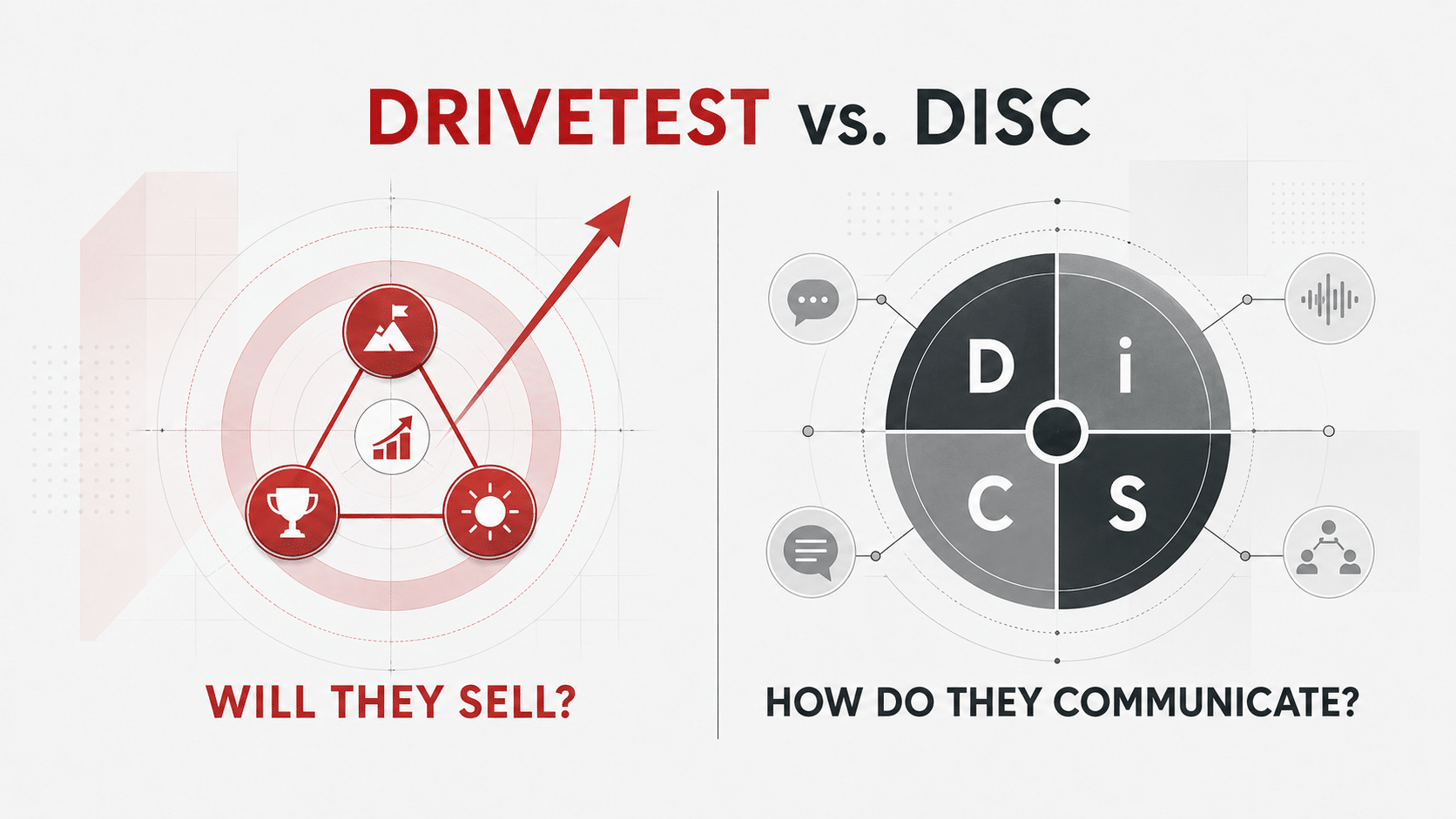
If you’re comparing DiSC and SalesDrive’s DriveTest® for sales hiring, here’s the short answer: DISC tells you how a candidate communicates. The DriveTest tells you whether they’ll consistently generate new revenue. They’re not competing for the same job — they’re built to answer two different questions, and only one of them was built specifically for sales hiring.
A lot of sales teams run candidates through DISC because it’s familiar, well-known, and already part of the company’s hiring stack — and then wonder, six months later, why a candidate who tested as a confident, sociable communicator can’t build a pipeline from scratch.
This isn’t DISC failing at its job. It’s that DISC was never designed to predict who will prospect, sell, and close.
Let’s break down what each assessment actually measures, where each one earns its reputation, and how to decide which one — or whether both — belong in your hiring process.
What Are You Actually Trying to Predict?
Before comparing features, it helps to ask a more basic question: what decision are you trying to make?
If you’re trying to understand how someone communicates, resolves conflict, or fits into a team, you’re asking a behavioral style question. If you’re trying to decide whether a candidate will succeed in a revenue-producing sales role, you’re asking a performance prediction question.
Those two very different questions, and no single assessment answers both equally well.
The biggest mistake isn’t choosing the wrong assessment. It’s expecting the right assessment to answer the wrong question.
What DISC Measures
DISC has one of the longest track records of any workplace assessment in use today. The model traces back to psychologist William Moulton Marston’s 1928 book Emotions of Normal People, and the modern version — Everything DiSC, published by Wiley — is used by millions of people every year.
DISC organizes behavioral tendencies into four styles:
- D (Dominance) — direct, results-driven, assertive
- i (Influence) — outgoing, enthusiastic, relationship-oriented
- S (Steadiness) — steady, supportive, patient
- C (Conscientiousness) — analytical, precise, detail-focused
In plain terms, DISC answers: How does this person tend to communicate and work with others?
That’s a genuinely useful question, and DISC is one of the most respected tools available for answering it.
Sales managers use it to coach reps more effectively. Leadership teams use it to reduce friction and improve communication. HR teams use it to strengthen onboarding and team dynamics. If your goal is helping people work better together, DISC has earned its reputation.
Where companies run into trouble is expecting DISC to answer a question it was never built to answer: will this person succeed in sales? Communication style, on its own, doesn’t reliably predict who will prospect consistently, recover from rejection, or chase a difficult quota month after month.
A candidate can test as highly sociable and outgoing on DISC and still struggle to generate new business. Another candidate can score as far less outgoing — quieter, more reserved — and outperform everyone else on the team because of what’s driving them internally, not how they present in a conversation.
What The DriveTest Measures
The DriveTest® was built to answer: does this person have the internal Drive associated with consistently generating new revenue?
Rather than measuring communication style, The DriveTest measures three motivational traits that combine to form what I call Drive:
- Need for Achievement — an internal push to accomplish more, independent of outside recognition
- Competitiveness — a genuine need to win, whether against a competitor, a quota, or last month’s number
- Optimism — the ability to absorb rejection, recover quickly, and stay productive instead of internalizing every “no”
These aren’t behavioral styles. They’re the motivational characteristics tied to whether someone keeps prospecting when no one is watching, keeps pushing after the fourth unanswered email, and keeps competing for a deal that isn’t guaranteed.
A candidate can be warm, well-spoken, and easy to talk to — the exact profile many hiring managers gravitate toward — and still lack the Drive to do the unglamorous, repetitive work sales performance actually requires.
For a deeper look at why broad personality traits and Drive aren’t the same thing, see our full breakdown of why personality tests often fail at sales hiring.
Sales-Specific vs. General Personality Tests
This is really the core distinction, and it’s the one most comparisons of DISC skip entirely.
General behavioral assessments (like DISC) are built to answer:
- How does this person communicate and prefer to work?
- How do they respond to conflict or pressure day to day?
- How will they fit into our team and culture?
- Where might friction show up in collaboration?
Sales-specific assessments (like The DriveTest) are built to answer:
- Will this person prospect consistently without being told to?
- Can they absorb sustained rejection without losing momentum?
- Do they have the internal drive to chase difficult targets?
- Will performance hold up once the interview polish wears off?
Neither list is more “correct” than the other — they’re just different jobs. The mistake is using a tool built for the first list to make a decision that depends on the second.
DISC vs. The DriveTest: Side-by-Side Comparison
| DISC | The DriveTest® | |
| Primary purpose | Understand behavioral style and communication preferences | Predict Drive and performance in revenue-producing sales roles |
| Core model | Four styles: Dominance, Influence, Steadiness, Conscientiousness | Three traits: Need for Achievement, Competitiveness, Optimism, collectively: Drive |
| Question it answers | How does this person communicate and work with others? | How likely is this person to produce revenue? |
| Built specifically for sales hiring? | No — general-purpose behavioral tool | Yes — designed and validated for sales hiring |
| Format | Self-report rating scale | Forced-choice format designed to resist faking |
| Best suited for | Team building, coaching, leadership development, communication training | Screening BDR, AE, outside sales, and other hunter roles |
| Typical use case | Understanding an existing employee’s working style | Evaluating a sales candidate before or alongside interviews |
DISC Alternatives for Sales Hiring: Where The DriveTest Fits
If you’re searching for DISC alternatives for sales hiring specifically, it helps to understand what you’re actually replacing. You’re not necessarily looking to replace DISC across your whole organization — you’re looking for a tool that answers the one question DISC wasn’t built to answer: will this candidate sell?
That’s a narrower, more specific need, and it’s exactly the gap sales-specific assessments like The DriveTest were built to fill. Unlike DISC, which applies the same four-style framework across every role in a company, The DriveTest is purpose-built around a single job: identifying whether a candidate has the non-teachable traits — Need for Achievement, Competitiveness, and Optimism — needed to be a top sales producer.
That doesn’t make DISC obsolete. It makes it a different tool for a different stage of the employee lifecycle. Many companies keep DISC in place for onboarding and team development, and layer The DriveTest into the front end of their sales-specific hiring process. The two aren’t fighting for the same seat.
‘Best Use For’ Conclusion
- Best use for DISC: Coaching conversations, leadership development, communication training, and understanding how an existing employee or team functions day to day.
- Best use for The DriveTest: Screening candidates for quota-carrying, revenue-producing sales roles — BDR, SDR, account executive, outside sales — before or alongside interviews.
- Best for using both: Companies that want to hire the right salesperson first (DriveTest) and then coach and communicate with them effectively after they’re hired (DISC). These tools solve different problems at different stages, so there’s no conflict in running both.
Compare More Assessment Options
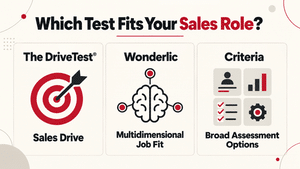
DISC and The DriveTest are two of several tools companies use somewhere in their hiring and development processes. If you’re evaluating your options more broadly, our full guide compares the major assessment platforms — what each one measures, where it fits best, and which roles it’s suited for.
Read the full sales assessment comparison guide →
You might also want to see how The DriveTest compares to Caliper Profile, Predictive Index, and Objective Management Group (OMG), three other assessments frequently shortlisted alongside DISC.
Frequently Asked Questions
DISC measures behavioral style — how a person communicates, responds to challenges, and works with others. The DriveTest measures Drive: Need for Achievement, Competitiveness, and Optimism, the motivational traits most closely tied to sales performance. DISC explains how someone tends to behave; The DriveTest identifies whether someone has what it takes to consistently generate revenue.
Not reliably on its own. DISC was designed to describe communication style and behavioral tendencies, not to forecast job performance in a specific, revenue-producing role. A candidate can score as highly sociable and confident on DISC and still fail to build a pipeline, while a quieter, less outwardly assertive candidate can outperform the team because of internal Drive that DISC isn’t built to capture.
If your goal is specifically predicting sales performance rather than understanding communication style, a sales-specific assessment, like The DriveTest, is a more direct fit. It was built around the three traits — Need for Achievement, Competitiveness, and Optimism — most consistently associated with top sales producers, using a forced-choice format designed to make results harder to game than a standard rating-scale personality test.
Yes, if you want the full picture. Many organizations use DISC for coaching, onboarding, and team communication, and use The DriveTest specifically when hiring for sales roles. Since the two tools answer different questions, there’s no overlap or conflict in running both.
Hiring Salespeople?
If your priority is filling a quota-carrying sales role, start with an assessment built specifically for that role.
About the Author: Dr. Chris Croner is a clinical psychologist and Principal at SalesDrive, LLC. He developed The DriveTest® sales assessment and is co-author of Never Hire a Bad Salesperson Again. He has helped more than 1,500 companies worldwide identify and hire top-performing salespeople. Connect with him on LinkedIn.