866-972-5373
 Account Login
 866-972-5373
 Account Login

Why do some salespeople close deal after deal, while others — who looked just as sharp in the interview — never build a real pipeline?
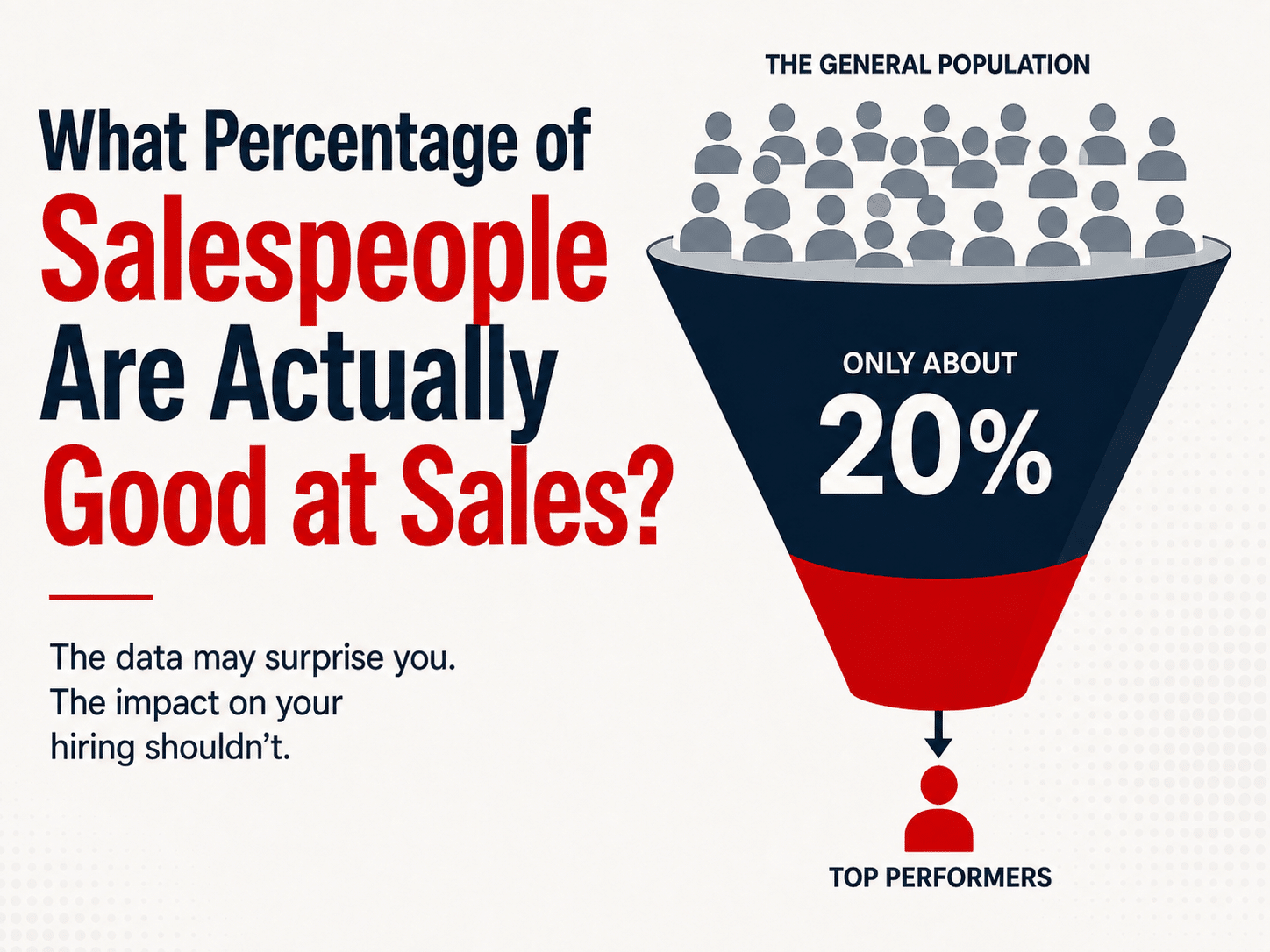
If you’ve ever asked yourself what percentage of salespeople are actually good at sales, the honest answer is lower than most hiring managers assume, and it has almost nothing to do with experience or interview polish.
Only About 20% Are Naturally Cut Out For It
Across the general population, our research shows that only around 20% of people naturally operate with the level of Drive required to consistently create new business. The other 80% aren’t bad people or bad employees. Most of them can follow a process, manage existing relationships, and perform well in structured roles.
But generating new revenue from scratch — cold outreach, prospecting, absorbing rejection and going right back out — requires something more specific: consistent initiative, persistence, and the ability to keep pushing without immediate reinforcement.
That combination isn’t a skill you can train into someone in a workshop. It’s a personality-level trait we call Drive, and it isn’t evenly distributed.
The Number Gets Smaller the More Specific You Get
Twenty percent is just the starting point. Not everyone with high Drive chooses sales as a career — some become surgeons, attorneys, entrepreneurs, or engineers. And not every high-Drive salesperson is suited to every kind of selling; a candidate who could dominate at outbound SaaS sales isn’t automatically a fit for complex capital equipment or regulated pharmaceutical sales.
Here’s roughly how that funnel narrows:
| Stage | Approximate Percentage |
| General population who are high in Drive | ~20% |
| Of those, interested in a sales career | ~10% |
| Of those, suited to your specific type of selling | ~5% or fewer |
In other words, out of every 100 people who respond to your job posting, maybe five have real potential to become a top producer in your specific role.
That’s the dilemma. It’s also the opportunity, because most of your competitors are still hiring as if the odds were much better than that.
Three Reasons High-Drive Salespeople Are Hard to Spot
1. The Underlying Traits Aren’t Evenly Distributed
High-Drive individuals tend to be more achievement-oriented, more competitive, and more internally motivated than the average person. This idea traces back to psychologist David McClelland’s research on “need for achievement,” which grouped individuals into high and low achievers based on their consistent concern with setting and meeting demanding personal standards. Those tendencies cluster in a relatively small slice of the population — they don’t show up evenly across every résumé that lands in your inbox.
2. Rejection Tolerance Separates the 20% From Everyone Else
In new business development, rejection isn’t the exception — it’s the job. Most people will naturally slow down or avoid activities that generate repeated “no’s.” A smaller group won’t. That difference shows up directly in call volume, prospecting consistency, and pipeline activity, and it’s almost impossible to fully assess in a 45-minute interview.
3. Most Hiring Processes Evaluate the Wrong Thing
Interviews primarily capture how someone presents themselves in the moment — not how they behave over time, under pressure, without a script. That gap makes it entirely possible to hire someone who communicates beautifully but never consistently produces.
What This Means for How You Source Candidates
Because high-Drive candidates make up a narrow slice of any applicant pool, a purely random pipeline works against you. I’ve worked with clients who consistently land near the top of the Drive curve with their new hires, and they tend to filter for three things before a candidate ever reaches an interview:
- They prioritize passive candidates over active job seekers. If someone has been searching for a new position for a long stretch, there’s often a reason worth understanding before you invest further.
- They look for tenure, not job-hopping. Some early-career movement is normal as people find their footing. But a resume built entirely on 6-to-12-month stints is a strong signal, since past behavior remains one of the better predictors of future behavior.
- They look for evidence of past production — commission statements, President’s Club recognition, or other performance markers. (Check your state’s laws on what you can request during hiring.)
Why Filtering for Drive Directly Still Matters
Even with better sourcing, you’re still evaluating candidates who all “seem motivated” on paper. If you’re not measuring Drive directly, you’re making inferences from indirect signals — energy in the room, confidence, eye contact — and that introduces variability into your hiring decisions that eventually shows up as variability in your revenue.
“You can’t train Need for Achievement, Competitiveness, or Optimism into someone. You can only find out whether they’re already there — and most hiring processes were never built to check.” — Dr. Chris Croner
So, What Next?
With only about one in five people naturally having the Drive that new-business selling requires, and that number narrows further once you factor in career interest and role fit, what you measure — and how early in the process you measure it — directly shapes your odds of hiring someone who produces.
Improving both candidate flow and how you evaluate for Drive is usually what separates companies with predictable pipeline growth from companies stuck re-hiring the same role every year.
If you want to see how this plays out with your own candidates, try The DriveTest® free. See for yourself how a candidate’s Drive score compares to what your interview process alone would have told you.
And if you want to continue learning about Drive and its importance for revenue-generating roles, check out our articles: The Personality Trait That Predicts Sales Performance and Can You Train a Low-Drive Salesperson to “Hunt” Successfully?
FAQs
Only about 20% of the general population naturally has the level of Drive needed to consistently create new business. That number narrows further once you account for who’s interested in a sales career and who’s suited to your specific type of selling.
Not directly. Skills like persuasion, organization, and relationship-building are teachable. Drive — the combination of Need for Achievement, Competitiveness, and Optimism — is a personality-level trait that’s hardwired by adulthood.
Interviews mostly capture how someone presents themselves in the moment, not how they behave over time and under pressure. That’s why candidates can interview well and still underperform once hired.
Behavioral interview questions can help, but a validated sales-specific assessment is the most reliable way to measure Drive directly instead of inferring it from indirect signals like confidence or charisma.
About the Author: Dr. Chris Croner is a clinical psychologist and Principal at SalesDrive, LLC. He developed The DriveTest® sales assessment and is co-author of Never Hire a Bad Salesperson Again. He has helped more than 1,500 companies worldwide identify and hire top-performing salespeople. Connect with him on LinkedIn.