 866-972-5373
 Account Login


 866-972-5373
 Account Login


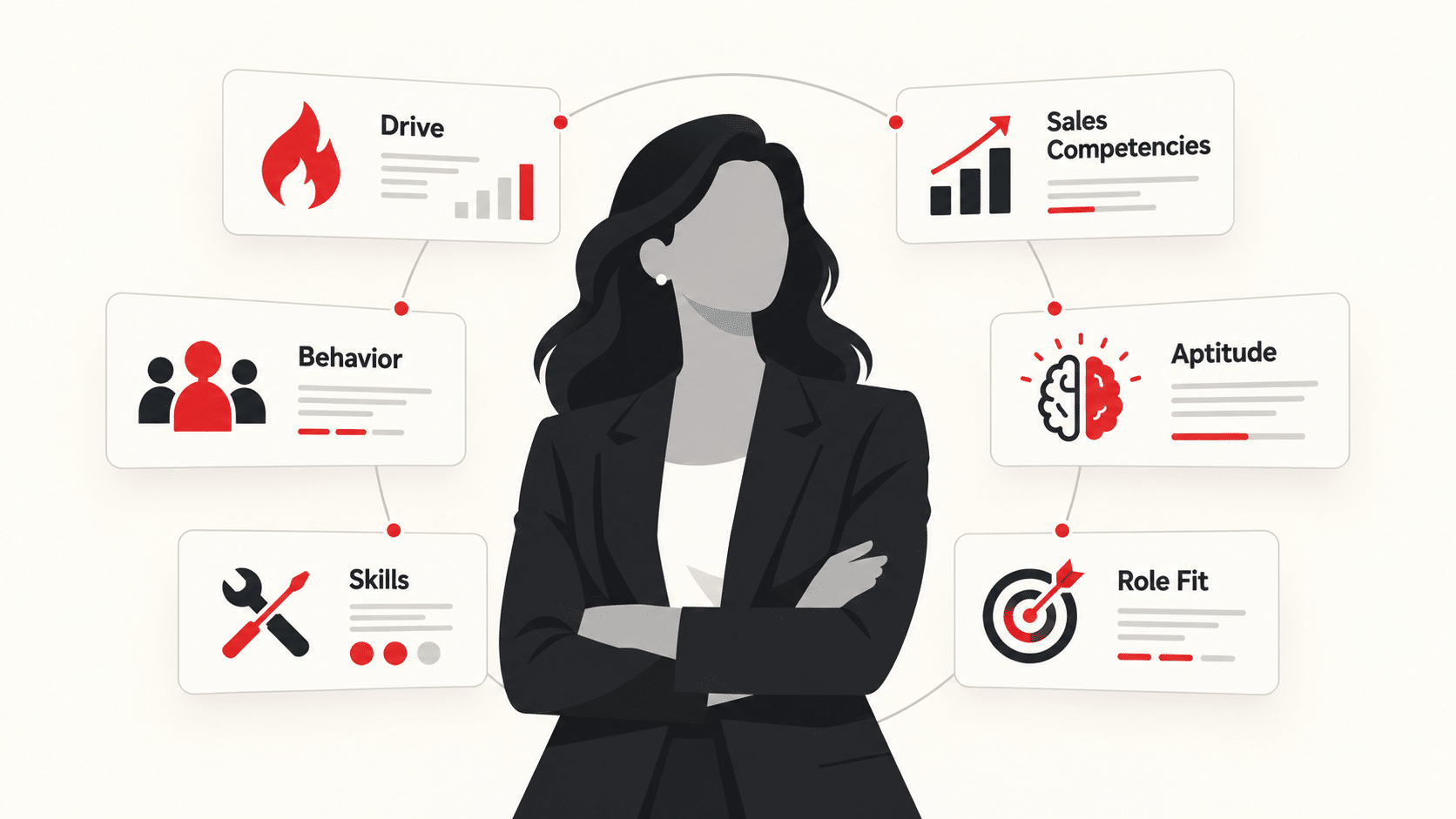
If you are researching Caliper assessment alternatives for sales hiring, six options worth comparing are SalesDrive, Objective Management Group, Predictive Index, Criteria, TestGorilla, and Wonderlic. Each offers a different reason to join your shortlist: motivational Drive, sales competencies, behavioral fit, a broader testing portfolio, customizable screening, or an integrated job-specific assessment.
But before you replace Caliper, identify the information you need that you are not already getting.
Perhaps your candidates interview confidently but avoid prospecting. Perhaps they generate meetings but struggle to qualify opportunities. Or perhaps HR needs one assessment approach for sales, operations, and management. Those are different buying situations and may warrant a different assessment stack.
I developed The DriveTest®, so I have a direct connection to one of the options below. My goal here is to help you compare the approaches fairly, including when keeping Caliper makes sense.
What does the Caliper assessment already offer sales hiring teams?
Caliper, now part of Talogy, should not be dismissed as a personality test with no sales application. It has a long history in sales selection and combines personality and cognitive information with job-related interpretation.
Talogy lists validated sales job models for roles including Hunters, New Business Development, Producers, and Consultative Selling. Its Caliper assessment also supports broader talent decisions beyond sales hiring.
That changes the comparison. “We assess salespeople” is not, by itself, a reason to choose another provider. You need to understand how the alternative measures the qualities you care about, interprets results for your role, and helps you make a decision.
A key question to ask yourself is: “What does this alternative give me that I’m not already getting from Caliper?”
How these Caliper assessment alternatives are ranked
This is a ranked research shortlist for a company prioritizing new-business sales hiring, not a ranking of proven predictive superiority. I put focused sales motivation first, broader sales diagnostics second, and then compare approaches that address behavioral fit, assessment breadth, customization, and company-wide hiring.
The criteria are relevance to the hiring question, the information each approach emphasizes, and the practical reason to compare it with Caliper. These are editorial judgments based on provider materials and the intended use cases, not results from a controlled head-to-head study. If your priority is an organization-wide assessment system, your order should change.
Caliper assessment alternatives at a glance
| Rank and option | Main assessment focus | Best reason to compare with Caliper | Question to resolve |
| Baseline: Talogy Caliper | Personality, cognitive ability, and job models | Sales hiring plus broader talent decisions | Does your selected sales model address the actual job? |
| 1. SalesDrive | Need for Achievement, Competitiveness, and Optimism | Focused evaluation of Drive for new-business selling | What additional evidence will you gather on selling skills? |
| 2. Objective Management Group | Will to Sell, Sales DNA, and Tactical Selling | A broader sales competency diagnostic | Which findings will change selection or coaching? |
| 3. Predictive Index | Behavioral drives and needs; separate cognitive assessment | Behavioral role fit across departments | Are you comparing behavior alone or behavior plus cognition? |
| 4. Criteria | SalesAP plus a broader assessment portfolio | A dedicated sales test with other testing options | Which specific tests belong in your sales hiring process? |
| 5. TestGorilla | A configurable combination of tests | Screening for several job requirements | Does each test add useful, job-relevant information? |
| 6. Wonderlic Select | Cognitive ability, personality, and motivation | Integrated job-specific assessment across roles | What does the sales job profile emphasize? |
1. SalesDrive — Best for a focused look at sales Drive (motivation)
The DriveTest® centers on three motivational characteristics: Need for Achievement, Competitiveness, and Optimism. Its report also includes measures related to Confidence, Persuasion, Relationship, and Organization.
The reason to compare it with Caliper is its emphasis on Drive. If your recurring problem is hiring people who make a strong impression during the interview but do not sustain new-business activity once hired, that focus is relevant.
Imagine a candidate who can explain your sales process convincingly and has the charisma to make you like them. You still need evidence about their motivation to initiate contact, pursue demanding goals, and recover when prospects say no, over and over again. The DriveTest gives you a structured way to look “under the hood” of candidates and understand their real motivations.
Best for: Teams hiring hunters, SDRs, BDRs, or other salespeople whose work requires sustained prospecting and new-business pursuit.
Tradeoff: A Drive-focused assessment does not establish product knowledge, technical proficiency, or demonstrated selling skill. Use behavioral interviews, references, and a relevant work sample to investigate those areas. A strong Drive result is just one piece of data.
2. Objective Management Group — Best for broader sales competency diagnostics
Objective Management Group (OMG), evaluates 21 sales competencies across Will to Sell, Sales DNA, and Tactical Selling. Its evaluation methodology considers motivation, beliefs, and selling capabilities, including areas such as qualifying and consultative selling.
Compare OMG with Caliper when you want a more extensive sales-specific diagnostic that can inform both selection and development. The buying question is broader than whether a candidate is motivated, its “where might the person struggle to execute the sales process?”
Best for: Sales leaders who want detailed information about selling competencies and potential coaching priorities.
Tradeoff: More diagnostic detail requires an interpretation plan. Ask which findings should affect the hiring decision and which identify trainable development needs. Do not treat every weakness as equally consequential, and verify assessed capabilities through actual selling exercises.
3. Predictive Index — Best for behavioral role fit across the company
The PI Behavioral Assessment measures behavioral drives and needs. Predictive Index also offers a separate Cognitive Assessment addressing learning, adaptation, and problem-solving.
PI belongs on the shortlist when your comparison with Caliper extends beyond sales. You may want an approach that supports hiring conversations across departments while helping managers understand how people approach work.
Best for: Organizations prioritizing behavioral alignment with job demands and a shared approach to understanding employees across roles.
Tradeoff: Be explicit about the assessment combination. Comparing PI behavior alone with a Caliper package containing personality and cognitive information is not a like-for-like comparison. Also ask how the proposed job target reflects your actual sales work, rather than a generic idea of a salesperson. Our guide to Predictive Index alternatives for sales hiring compares these approaches in more detail.
4. Criteria — Best for a dedicated sales test within a broader portfolio
Criteria deserves more precise treatment than simply calling it a general testing company. Its Sales Achievement Predictor (SalesAP), measures traits relevant to sales, including achievement, competitiveness, cold-calling initiative, closing, and sales disposition. Criteria publishes validation information relating SalesAP results to sales performance.
The broader portfolio also offers other assessment types, making Criteria relevant when you want to evaluate several dimensions of a candidate through selected tests.
Best for: Hiring teams seeking a sales-focused assessment alongside access to cognitive aptitude, personality, skills, and other testing options.
Tradeoff: Compare the proposed test battery, not the entire catalog. Ask how much each selected test adds, whether measures overlap, and how the results will inform one hiring decision. A longer list of available tests does not automatically create a better screening process.
For a closer look at these differences, see our DriveTest, Wonderlic, and Criteria comparison.
5. TestGorilla — Best for building a customized screening process
TestGorilla lets employers combine tests to address different job requirements. Its B2B Sales Account Executive test is one example of a sales-related option within a wider testing platform.
The reason to compare TestGorilla with Caliper is flexibility. You may need a screening process that investigates sales knowledge alongside communication, reasoning, or another role-specific requirement.
Best for: Teams that want to assemble a test combination around several defined hiring requirements.
Tradeoff: You must decide what belongs in that combination. A candidate’s performance on a skills test and their likely persistence in outbound prospecting answer different questions. Check that the tests you select cover the risk that prompted your search, without adding unnecessary candidate workload. For a closer comparison of skills screening and sales motivation, see The DriveTest vs. TestGorilla.
6. Wonderlic Select — Best for an integrated job-specific assessment
Wonderlic is best known historically for cognitive testing, but its current Wonderlic Select assessment combines cognitive ability, personality, and motivation into one job-specific hiring assessment.
Wonderlic looks at the types of work a person prefers to do. SalesDrive’s Drive and OMG’s Will to Sell examine different aspects of sales motivation. Although all three assess motivation, they define and measure it differently, so their scores do not mean the same thing.
Best for: Companies wanting an integrated assessment approach that can support hiring across multiple kinds of positions.
Tradeoff: Ask how the selected sales profile interprets the components and what evidence supports its use for your job. Similar labels across providers do not establish that they measure the same thing.
How to decide whether to replace Caliper or keep it
The most useful comparison begins with a failure you want to prevent.
If new hires avoid outbound activity, investigate how each tool addresses the motivation and tendencies associated with prospecting. If they struggle to understand a complex solution, investigate learning demands. If they run weak discovery calls, add a structured discovery exercise rather than assume another personality score will settle the issue.
A different report is valuable only if it improves the evidence behind your decision. Before switching, use this checklist with Caliper and each shortlisted provider:
- Define the outcome: Are you trying to predict new accounts, qualified pipeline, account expansion, or another result?
- Specify the role: How much work is self-generated prospecting versus responding to inbound demand?
- Ask for relevant evidence: What research connects the proposed assessment to performance in comparable sales work?
- Review a sample report: Which results would change your interview questions, reference checks, or decision?
- Separate potential from demonstrated skill: What still needs to be observed in a work sample?
- Compare the whole purchase: Include required tests, interpretation support, candidate time, training, and contract commitments.
Do not compare vendors’ accuracy claims as though they all use the same definition of success. Ask what was measured, who was studied, and whether the findings apply to your intended use. Our guide to sales assessment validity and accuracy explains these questions in plain language.
Keep Caliper on the shortlist if its sales model, reporting, and support already answer your hiring questions. A new provider may offer a different emphasis without solving a meaningful gap. Adding another assessment can also duplicate information. Ask what the additional tool contributes before increasing cost and candidate workload.
Choosing the right Caliper alternative for your sales team
Choose two or three assessments that address your main hiring problem. Ask each provider to explain how its product would change your next sales hiring decision, then compare the answers with what Caliper already provides.
For a wider view of the market, use our sales assessment tools comparison guide. Bring the checklist above to those comparisons so you can evaluate each option against the same requirements.
The goal is to gather the information you need to make a better-supported hiring decision—and then verify it through a disciplined interview and reference process.
Frequently asked questions about Caliper alternatives
Compare SalesDrive for Drive, OMG for broader sales competencies, Predictive Index for behavioral role fit, Criteria for SalesAP and a wider testing portfolio, TestGorilla for customizable screening, and Wonderlic Select for integrated cognitive, personality, and motivation assessment. Prioritize the options that address your specific hiring concern.
Yes. Caliper has sales-specific job models, including hunter and new-business applications. Its use across other departments does not erase that sales relevance. Evaluate the model proposed for your role before assuming you need a replacement.
SalesDrive merits consideration when motivational Drive is the central concern. OMG offers a broader sales diagnostic, while Caliper itself has a hunter model. Compare the reports and supporting evidence against the demands of your particular role; there is no universal winner.
You cannot determine that from product categories alone. Obtain comparable quotes for the same hiring volume, test combination, support, and contract period. A low per-test price can be misleading if the package does not cover what you need. Use our sales assessment cost guide to structure the comparison.
About the Author: Dr. Chris Croner is a clinical psychologist and Principal at SalesDrive, LLC. He developed The DriveTest® sales assessment and is co-author of Never Hire a Bad Salesperson Again. He has helped more than 1,500 companies worldwide identify and hire top-performing salespeople. Connect with him on LinkedIn.


