866-972-5373
 Account Login
 866-972-5373
 Account Login

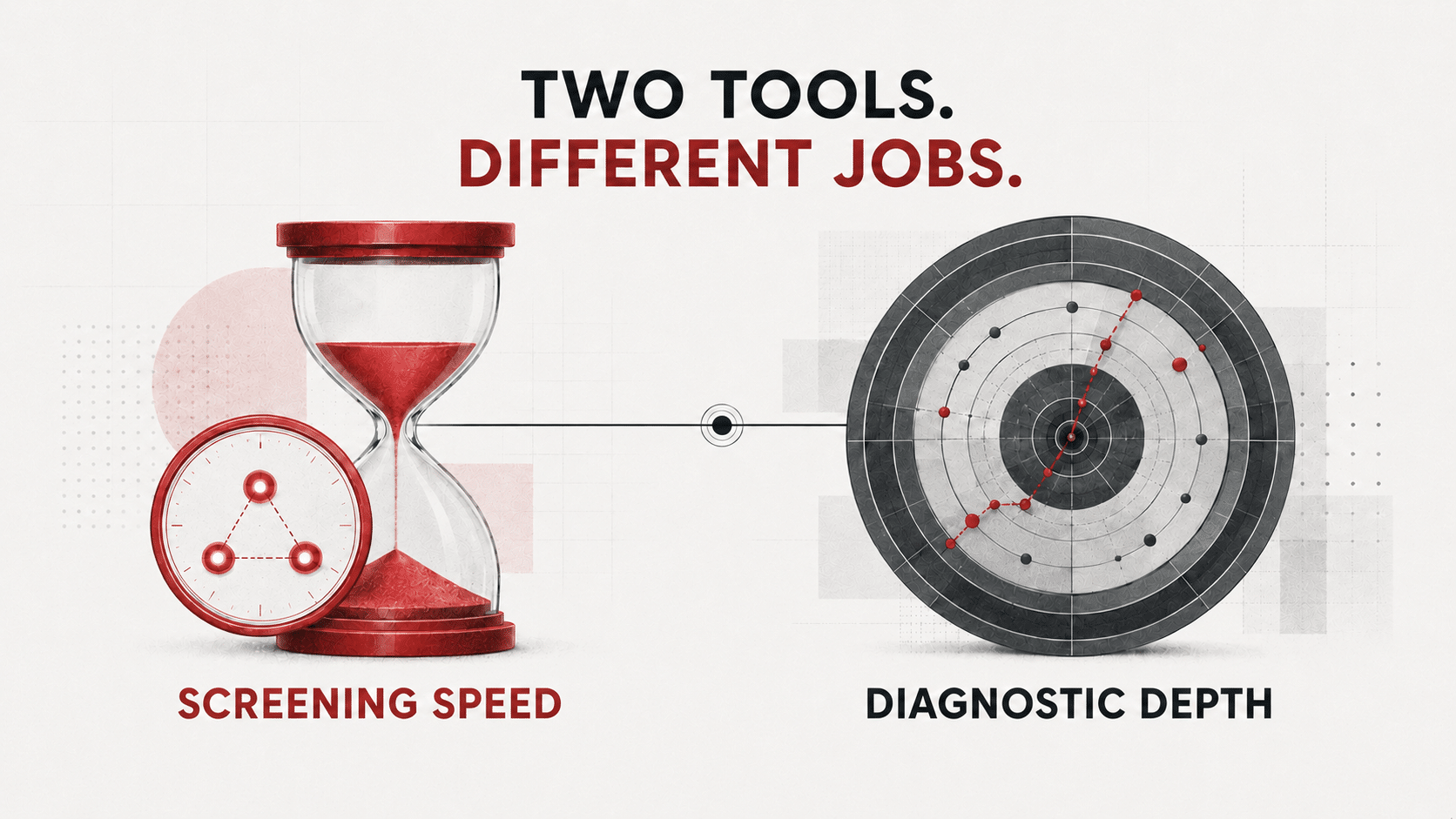
The DriveTest and OMG’s sales assessment aren’t really competing for the same job. The DriveTest is a fast, 20-minute pre-interview screen that isolates the three non-teachable psychological traits behind sales success — Need for Achievement, Competitiveness, and Optimism. OMG is a much deeper, multi-layer evaluation of 21 sales-specific competencies covering skills, process execution, and mindset, built for both candidate screening and post-hire coaching.
Most companies don’t have to pick one forever — many use a trait screen like the DriveTest to narrow the funnel early, then bring in a competency-based tool like OMG for a fuller diagnostic on finalists or existing reps.
If you’re building or refining a sales hiring process, you’ve probably run into both names. I get asked about this comparison constantly, so I want to walk through it honestly — including where OMG genuinely does something The DriveTest doesn’t try to do.
Who I Am and Why I’m Writing This
I’m Dr. Chris Croner, Principal of SalesDrive and co-author of Never Hire a Bad Salesperson Again. I hold a Ph.D. in Clinical Psychology from Southern Illinois University at Carbondale, and I’ve spent the better part of my career studying one narrow question: what separates a salesperson who consistently hits quota from one who doesn’t, regardless of training, product, or market? That research led me to develop The DriveTest®, which I built specifically to isolate the psychological traits that can’t be taught in a sales training class.
I’m obviously not a neutral party — I built one of the two tools in this comparison. But I’ve spent 20+ years referring clients to other assessments, including OMG, when it was the better fit for what they were trying to solve.
This article is my honest attempt to lay out what each platform actually does well, so you can match the tool to your problem instead of your budget or a sales pitch.
What Is Objective Management Group (OMG)?
Objective Management Group (OMG) is one of the most established names in sales-specific evaluation. Founded in 1990, OMG’s assessment is organized around 21 Sales Core Competencies, grouped into three categories:
- Will to Sell — the competencies that determine whether a salesperson can sell versus whether they will sell (motivation and grit).
- Sales DNA — underlying strengths and beliefs that support (or sabotage) a salesperson’s ability to execute process, strategy, and tactics.
- Tactical Selling — the learned, observable skills involved in actually running a sales process: prospecting, qualifying, presenting, handling objections, closing, and following a defined methodology.
That structure is what makes OMG’s evaluation so thorough. Instead of measuring one layer of a salesperson, it integrates skill, behavior, and mindset into a single framework, which is why OMG describes its own reports as functioning like an MRI — surfacing root causes of a performance gap rather than just the surface symptom.
Where OMG really distinguishes itself is diagnostic depth. It doesn’t just tell you whether a candidate or rep can sell — it tells you how they sell, where their process breaks down, and specifically which of the 21 competencies need development. That level of granularity is genuinely valuable for two very different use cases:
- Pre-hire screening — an exhaustive, multi-layered audit of a candidate’s tactical mechanics, Sales DNA, and Will to Sell before they ever sit for an interview.
- Post-hire coaching and development — a roadmap for sales managers to see exactly where an existing rep is strong, where they’re weak, and what to coach.
If your goal is to evaluate sales competencies, diagnose why a team is underperforming, or build a structured coaching plan, OMG is built for that. That’s not my opinion — it’s the honest use case their own methodology supports, and it’s a different job than the one I built The DriveTest to do.
What Is The DriveTest®?
The DriveTest® takes a narrower, sharper approach. Rather than evaluating the full sales competency stack, it isolates three specific, research-based personality traits that I’ve found are the foundation everything else gets built on:
- Need for Achievement — an internal, largely insatiable desire to hit and exceed goals.
- Competitiveness — the desire to win, specifically relative to other people, not just against a quota.
- Optimism — the resilience to interpret rejection as temporary rather than personal, which determines whether someone keeps prospecting after the fifth “no” of the day.
Collectively, we call this combination Drive. The premise behind The DriveTest is simple: these three traits are largely hardwired by adulthood. You can teach someone a sales process. You cannot teach them to want it badly enough to survive the rejection that comes with a hunting role.
The assessment itself is a 42-question, forced-choice test that takes about 20 minutes to complete. Candidates choose between statements that all sound equally positive, which is deliberate — it’s what makes the test difficult to fake compared to straightforward self-report questionnaires, and it includes a built-in Consistency scale that flags inconsistent or socially-desirable answer patterns. It’s also designed to meet EEOC requirements for bias-free assessment across age, gender, and ethnicity.
The DriveTest isn’t trying to replace a full competency evaluation. It’s built to sit at the very top of your hiring funnel — before the first interview — so you’re not spending interview time on candidates who don’t have the underlying psychological raw material for a high-rejection, quota-driven role.
The Core Difference: Depth vs. Speed
If you strip away the marketing language from both companies, the real distinction is this:
OMG measures the full sales competency stack. It tells you whether someone can execute a sales process, whether their mindset supports that execution, and whether they have the underlying grit to sustain it — all in one integrated, deeply diagnostic report. That depth is a genuine strength for coaching, development, and a thorough pre-interview audit.
The DriveTest measures the psychological engine underneath all of it. It isolates the three traits that are hardest to change and easiest to fake in an interview, and it does so in about a third of the time it takes to complete a full competency evaluation.
Neither approach is “wrong.” They’re solving different problems at different points in the process. A company drowning in resumes and needing to cut a stack of 150 applicants down to 15 qualified interviews has a speed problem. A company trying to figure out why five tenured reps are missing quota has a depth problem.
OMG is built for the second problem and doubles as a strong option for the first. The DriveTest is built specifically for the first.
DriveTest vs. OMG: Side-by-Side Comparison
| The DriveTest (SalesDrive) | OMG (Objective Management Group) | |
| Core question it answers | Does this person have the non-teachable Drive to survive and thrive in a high-rejection sales role? | How capable is this person across the full range of sales skills, process, and mindset — and where specifically do they need to improve? |
| What it measures | 3 non-teachable Drive traits: Need for Achievement, Competitiveness, Optimism, 4 sales skills: Persuasion, Confidence, Organization and Relationship skills, plus Hunter vs Farmer role fit | 21 Sales Core Competencies across Will to Sell, Sales DNA, and Tactical Selling |
| Format | 42 forced-choice questions | Multi-part, sales-specific competency evaluation |
| Time to complete | ~20 minutes | Longer, more comprehensive (varies by report type) |
| Best point in the process | Top of funnel, before the first interview | Pre-hire audit of finalists, or ongoing team evaluation |
| Primary strength | Speed, resistance to faking, candidate experience | Diagnostic depth and breadth of sales-specific competencies |
| Post-hire coaching use | Limited — a coaching and developmental report is included but does not dig as deep. Main focus is as a hiring tool. | Strong — built for identifying specific coaching and development priorities |
| Sales skills/process evaluation | Not the focus | Core strength (prospecting, qualifying, presenting, closing, process adherence) |
| Underlying psychology/mindset evaluation | Core strength (Drive) | Included within Sales DNA and Will to Sell |
| Best for | High-volume, high-efficiency candidate screening | Comprehensive candidate audits and sales team development |
Best For: Which One Fits Your Situation
Choose The DriveTest if:
- You’re hiring for a hunter role where prospecting and handling rejection are central to the job.
- You’re screening a large volume of applicants and need to protect interviewer time.
- You want a fast, hard-to-fake signal on motivation before you invest in a deeper evaluation.
- Your primary pain point is who to hire, not how your current team should be coached.
Choose OMG if:
- You want a comprehensive, multi-layer audit of a candidate’s tactical selling skills, mindset, and process execution before an interview.
- Your objective is diagnosing performance gaps on an existing sales team and building specific coaching plans.
- You need detailed sales process analysis to understand exactly where deals are breaking down.
- You’re evaluating sales management or leadership roles where competency breadth matters as much as raw drive.
Choose both if:
- You want to protect the top of your funnel with a fast trait screen, then get a full competency and coaching picture on the candidates who make it through.
Can You Use Both? (Yes — Here’s How)
These tools are not direct replacements for one another, and in practice, plenty of companies use them together rather than picking a side. A common sequence looks like this:
- Screen early with a Drive-based test to identify candidates who possess the non-teachable traits associated with sustained sales success, before you spend interview hours on people who lack the underlying motivation for the role.
- Evaluate finalists with a full competency assessment like OMG’s to get a complete picture of sales skills, process execution, and development needs — both for the hiring decision and for onboarding once they’re hired.
Think of it as funnel logic: use the fast, hard-to-fake trait screen to narrow the pool, then use the deep diagnostic to make your final decision and set a coaching baseline.
The right combination — and the right order — ultimately depends on the specific problem you’re trying to solve: volume and speed at the top of the funnel, or depth and coaching insight further down it.
Compare More Assessment Options
OMG and The DriveTest are two of many tools used in sales hiring today, and this comparison is part of a broader guide covering the major assessment options — what each one measures, where it fits best, and which roles it’s suited for.
[Read the full assessment comparison guide →]
It’ll help you make a more informed decision about which assessment best fits your hiring needs.
Related reading: why sales personality tests fail at predicting sales performance.
Frequently Asked Questions
The DriveTest measures three non-teachable psychological traits (Need for Achievement, Competitiveness, Optimism) in about 20 minutes as an early-stage hiring screen. OMG evaluates 21 sales-specific competencies covering skills, process, and mindset in a more comprehensive, diagnostic report used for both pre-hire screening and post-hire coaching.
It depends on where in your process you need help. If you need to quickly narrow a large candidate pool before interviews, The DriveTest is built for that. If you need an exhaustive, multi-layered audit of a finalist’s sales competencies before extending an offer, OMG’s depth is the better fit.
Yes. Many organizations use a trait-based screen like The DriveTest at the top of the funnel to identify candidates with the underlying Drive to succeed, then use a competency-based tool like OMG to evaluate finalists more thoroughly or to build coaching plans for the team.
These traits are considered core personality characteristics that are typically hardwired by the age of 21-22, which is why we treat them as “non-teachable” for hiring purposes. Sales skills and process can absolutely be taught. The underlying drive to apply those skills consistently, especially through rejection, is much harder to instill.
About the Author: Dr. Chris Croner is a clinical psychologist and Principal at SalesDrive, LLC. He developed The DriveTest® sales assessment and is co-author of Never Hire a Bad Salesperson Again. He has helped more than 1,500 companies worldwide identify and hire top-performing salespeople. Connect with him on LinkedIn.