 866-972-5373
 Account Login

 866-972-5373
 Account Login

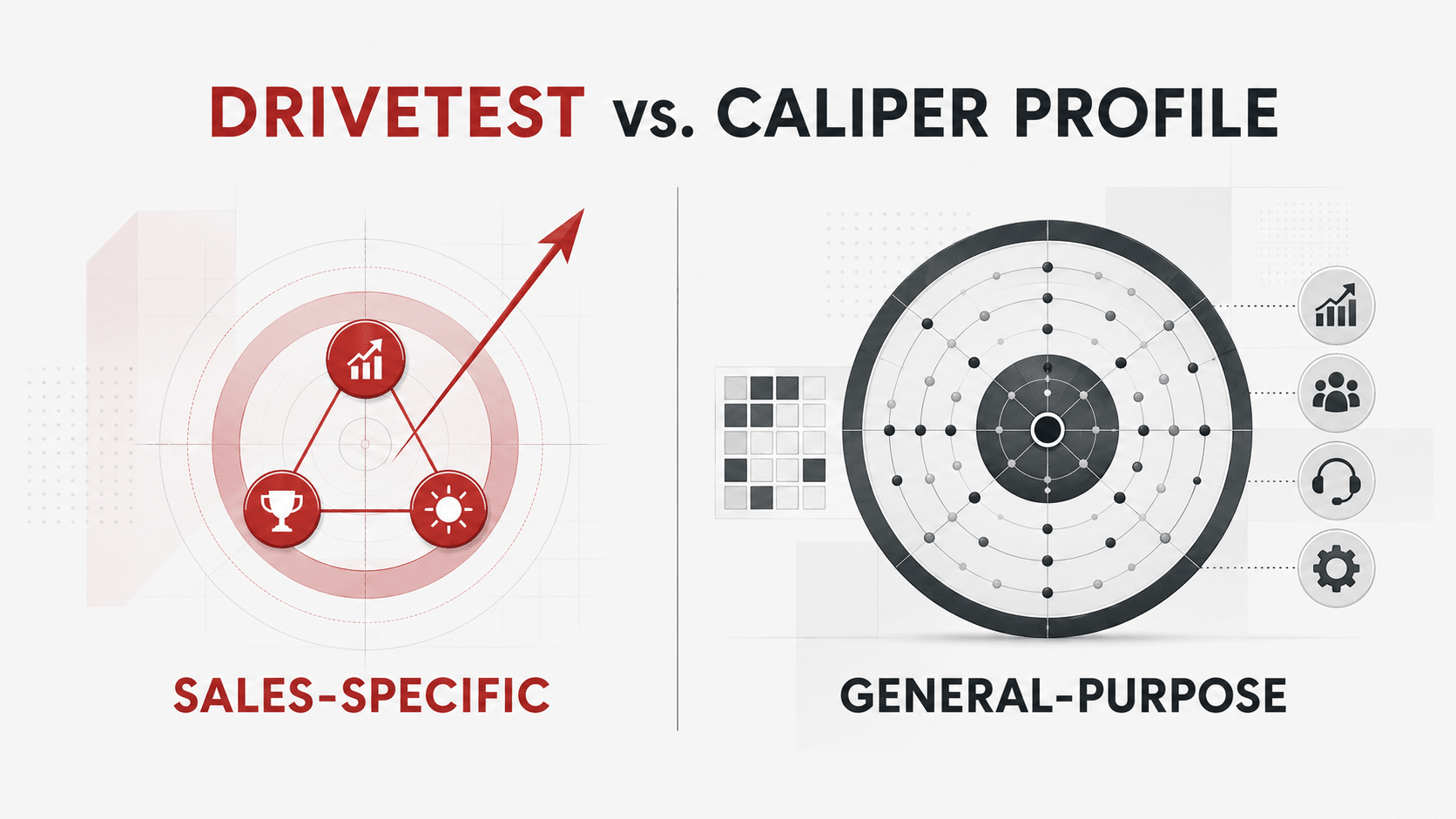
If you’ve searched for a caliper assessment review, or you’re weighing Caliper alternatives before your next sales hire, you’ve probably noticed that most comparison articles only talk about Caliper — as if it’s the only established name in the room. It isn’t. The DriveTest and the Caliper Profile are two of the most experienced tools in sales hiring, and they solve the problem in very different ways.
Quick answer: The Caliper Profile is a broad, general-purpose personality and cognitive assessment used across sales, leadership, and operations roles. The DriveTest is a sales-specific assessment built around the three non-teachable traits — Need for Achievement, Competitiveness, and Optimism — that predict success in demanding hunter sales roles. Caliper is the better fit for large, multi-department talent programs. The DriveTest is the better fit for companies whose main problem is hiring salespeople who will actually prospect, compete, and produce revenue.
What Is the Caliper Profile?
The Caliper Profile is one of the most established assessments in talent management. Developed by psychologist Herb Greenberg and first used in the 1960s, it’s now owned by Talogy and remains widely used across sales, leadership, customer service, and operations roles.
Caliper’s biggest strength is breadth. According to Caliper’s own FAQ, the full assessment measures 21 behavioral traits plus abstract reasoning and takes about 60 minutes to complete — other sources, including Talogy’s own support documentation, put the average closer to 60–75 minutes. Organizations use the resulting profile not just for hiring, but for coaching, leadership development, and succession planning.
Because Caliper has deep roots in sales assessment, it also offers sales-specific job models for hunter, new business development, consultative sales, and account management roles. For companies that want one platform to support hiring across many departments, that versatility is a real advantage.
What Is The DriveTest®?
The DriveTest was built around a simple observation: most sales skills can be taught, but the traits that separate top producers from everyone else generally cannot.
Product knowledge, sales methodology and CRM systems can all be taught. What’s much harder to teach is the internal push that keeps someone prospecting after ten rejections in a row.
SalesDrive calls that push Drive, and it’s made up of three components:
- Need for Achievement — an internal drive to reach and exceed goals
- Competitiveness — a desire to win, not just perform
- Optimism — the ability to bounce back from rejection without losing motivation
The DriveTest also measures teachable skills like Confidence, Persuasiveness, Relationship Skills, and Organization, but Drive is the core focus the assessment was built to identify.
The Real Difference: What Each Assessment Is Trying to Predict
Here’s the distinction that most comparison articles miss: the difference between these two tools isn’t whether they can be used in sales hiring. Both can. The difference is what question each one is designed to answer.
Caliper begins with the whole person. It asks: Who is this individual? How are they likely to perform across a range of behaviors?
The DriveTest begins with the demands of the role. It asks: Can this person prospect? Can they handle rejection? Can they stay motivated when quotas get hard? Can they generate revenue?
As I put it when comparing the two tools directly:
“The difference isn’t that one assesses salespeople and the other doesn’t. Both do. The difference is what they’re trying to predict.”
Neither approach is inherently right or wrong. They’re built to answer different questions, and that’s exactly why the right choice depends on your hiring problem, not on which tool is more well-known.
The DriveTest vs. Caliper Profile: Side-by-Side Comparison
| The DriveTest® (SalesDrive) | Caliper Profile (Talogy) | |
| Primary focus | Sales-specific: Drive, achievement orientation, competitiveness, optimism | General personality and cognitive ability, applied across many job families |
| Built for | Hunter sales roles: SDRs, BDRs, new business development, quota carriers | Sales, leadership, customer service, operations, and executive roles |
| Time to complete | About 20 minutes | About 60–75 minutes |
| Reports included | DriveTest Report + Production Builder coaching report | Interpretive and job-model-specific reports |
| Pricing model | Published, transparent pricing on the website | Custom quote; not published |
| Ideal for | Companies whose main hiring problem is identifying true sales hunters | Enterprises that need one assessment platform across many departments |
| Best used for | Pre-interview candidate screening for revenue-producing roles | Hiring, coaching, leadership development, and succession planning |
| Not designed for | Leadership development, succession planning, or non-sales roles | Isolating the specific traits tied to hunter-role sales performance |
Time to Complete: Why Speed Actually Matters
A 60–75-minute assessment doesn’t just cost the candidate time — it costs you candidates. Every extra minute a sales candidate has to spend before they even talk to a human is a minute where a competing offer, a schedule conflict, or plain assessment fatigue can cause them to drop out of your pipeline.
At about 20 minutes, The DriveTest is designed to sit early in the hiring process — often before the first interview — so you can screen for Drive without adding friction that costs you strong candidates.
Caliper’s greater length reflects its broader scope: it’s measuring more behavioral dimensions because it’s built to serve more use cases beyond a single sales hire.
Where Caliper Might Be the Better Fit
To be fair to Caliper: it’s not a weaker tool, it’s a differently-scoped one. Caliper may be the stronger choice if:
- You need one assessment platform to support hiring across sales, leadership, customer service, and operations
- Your priority is standardizing talent data across multiple departments, regions, or business units
- You plan to use the same tool for coaching, succession planning, and long-term workforce analytics — not just candidate screening
- Your organization already has HR infrastructure built around Caliper’s job models
If consistency across a broad talent system matters more to you than sales-specific precision, Caliper’s versatility is a legitimate advantage.
Where The DriveTest Might Be the Better Fit
The DriveTest is worth considering when your primary problem is narrower and more urgent: you need to know whether a candidate has what it takes to hunt.
- You’re hiring for outbound, quota-carrying, or new-business-development roles
- You want a fast, transparent-cost tool to screen candidates before you invest hours interviewing them
- You’ve been burned before by candidates who interviewed well but never prospected consistently once hired
- You want a report built specifically around Drive — not a general behavioral profile you have to interpret for sales relevance yourself
Caliper Alternatives: How The DriveTest Fits In
If you’re comparing Caliper alternatives generally — not just The DriveTest — the same principle applies across the board: broad, general-purpose assessments (Caliper, DISC, Predictive Index) answer different questions than sales-specific tools (The DriveTest, OMG). We’ve broken down several of the leading sales assessment tools side by side, including how each one stacks up for different hiring scenarios.
If you want the deeper case for why general personality tests often struggle to predict sales performance specifically, that’s covered in Why Personality Tests Often Fail at Sales Hiring.
The Verdict
Both The DriveTest and the Caliper Profile have helped organizations make better hiring decisions for decades. Neither is objectively “better” — they were built to solve different problems.
Choose Caliper if you’re building a talent assessment infrastructure that needs to serve sales, leadership, and operations hiring under one roof, and depth and versatility matter more than speed or sales-specific precision.
Choose The DriveTest if your immediate, practical problem is that you need to hire salespeople who will actually prospect, compete, and produce — quickly, affordably, and with a report built for that exact question.
The real question to ask yourself isn’t “which assessment is more established?” It’s: Are you looking for a broad talent platform, or a specialized tool built around the Drive associated with hunter sales success?
Where This Leaves You
By now, you should have a clearer picture: this was never really a question of which tool is “better.” It’s a question of which problem you’re actually trying to solve.
If your hiring challenge spans multiple departments and you need one platform to support it all, Caliper’s breadth is a real asset. If your hiring challenge is narrower and more urgent — you need to know whether a candidate has the Drive to hunt — that’s exactly what The DriveTest was built to answer.
If you want to see how it works before you commit to anything, you can try a free DriveTest assessment and review the results for yourself.
Frequently Asked Questions
Yes, for companies whose primary need is screening candidates for hunter, new business development, or quota-carrying sales roles. The DriveTest is built specifically around Drive — Need for Achievement, Competitiveness, and Optimism — rather than general workplace personality traits.
The DriveTest takes about 20 minutes. The Caliper Profile takes roughly 60–75 minutes, according to Talogy’s own support documentation.
Not directly. Caliper measures a broad set of behavioral traits and cognitive ability, and some of those traits — like assertiveness or ego drive — overlap loosely with what SalesDrive calls Drive. But Caliper wasn’t built to isolate Need for Achievement, Competitiveness, and Optimism as a specific, combined predictor of hunter-role success. The DriveTest was designed around exactly that combination.
Yes, and some companies do. They’re not mutually exclusive — Caliper’s broader behavioral and cognitive data can support coaching and development after the hire, while The DriveTest’s speed and sales-specific focus make it useful earlier in the process to screen for hunter traits before you invest interview time. If you’re already using Caliper across other departments, adding The DriveTest as a pre-interview sales screen is a reasonable way to get sales-specific signal without replacing your existing system.
About the Author: Dr. Chris Croner is a clinical psychologist and Principal at SalesDrive, LLC. He developed The DriveTest® sales assessment and is co-author of Never Hire a Bad Salesperson Again. He has helped more than 1,500 companies worldwide identify and hire top-performing salespeople. Connect with him on LinkedIn.


