 866-972-5373
 Account Login

 866-972-5373
 Account Login

Some sales assessment tests work, and some don’t. A sales assessment works when it is validated against real job outcomes, measures characteristics relevant to the sales role you’re hiring for, and is used for the decision it was designed to inform.
No assessment can tell you with certainty who will become a top salesperson. A good one improves your odds and helps you make a more informed choice.
Yet, nearly every vendor will tell you their test is “validated.” What does that mean and how can you tell whether the research is useful to your hiring needs?
You do not need a background in psychology to ask the right questions. This article outlines what the research means, what it cannot tell you and five questions to ask before you trust using any assessment within your hiring process.
First, Define What Success Means for Your Sales Role
Before you ask whether an assessment works, decide what you want it to help you uncover. Do you need someone who can open new accounts? Grow existing customers? Learn a complex product? These jobs overlap, but they are not the same.
A test may help you understand a person’s work style without showing whether that person is likely to bring in new business. Another may check product knowledge without showing how someone responds to repeated rejection.
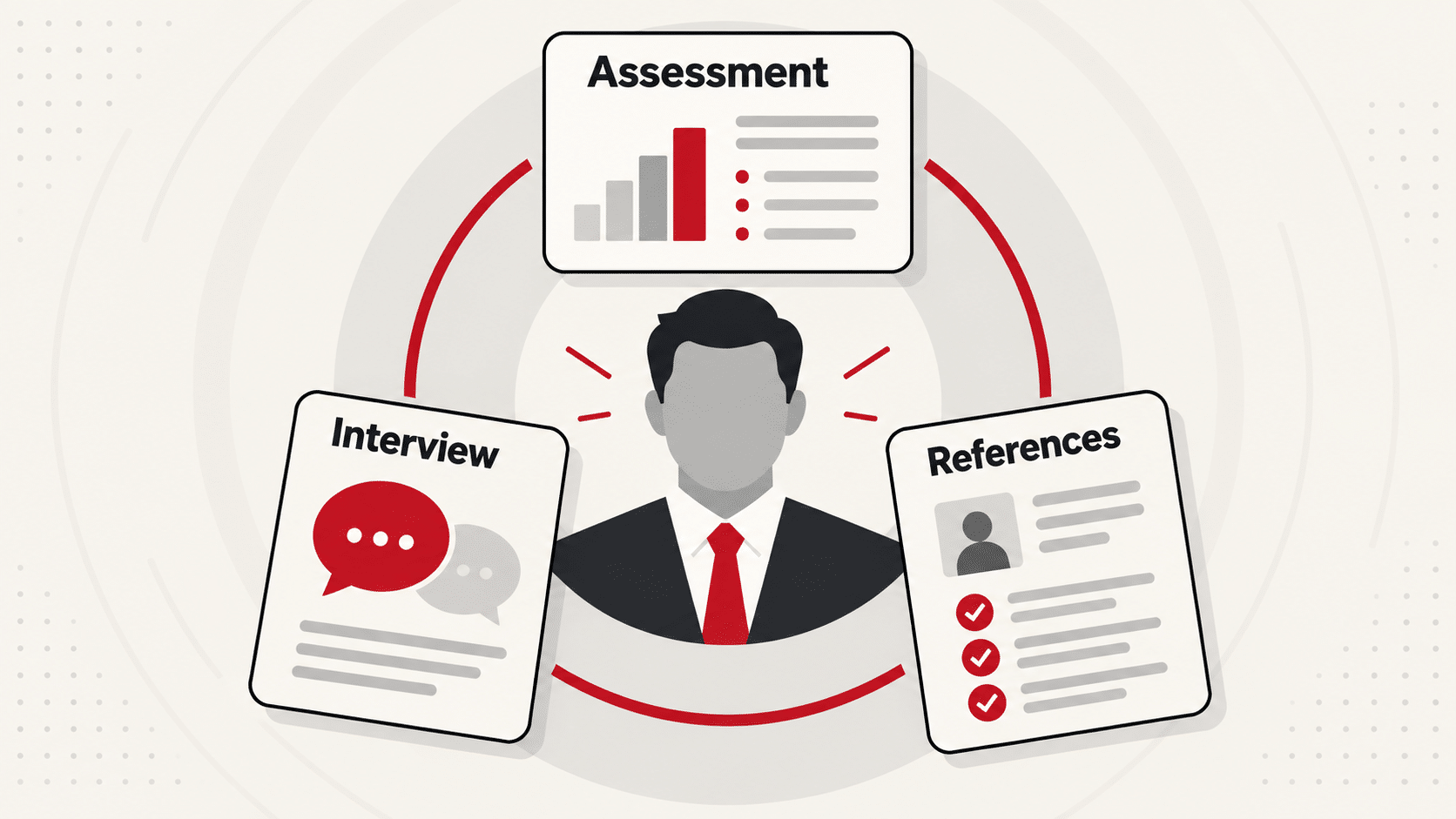
Most companies already use resumes, interviews and references. Those sources have value. But sales candidates are often particularly good at interviewing, because persuasion and presentation are part of what they do for a living. Sometimes the best sale you ever see from a candidate is the one in your interview room.
An assessment adds another piece of objective information. It shouldn’t replace your judgment. It should sharpen it. And its value depends on whether that information helps you judge the work the person will actually do.
What “Validated” Actually Means
In plain English, validation asks two questions:
- Does this assessment measure something meaningful?
- Are the results related to the job outcomes we care about?
When a company calls its sales assessment “validated,” ask: What evidence shows this test can help me make a better hiring decision?
For example, researchers might give an assessment to a group of salespeople, then compare their scores with their sales results. Do people with higher scores tend to perform better?
If they do, that provides evidence that the assessment may help identify stronger candidates. It does not mean every high scorer will succeed or every low scorer will struggle.
The details matter. A study might compare scores with actual revenue, a manager’s rating, or how long someone stays in a job. Those are different outcomes.
Look for research that matches the job you are filling and the result you need. Evidence about keeping existing customers may not tell you much about winning new ones.
Two Ways Assessments Are Validated
- Study current employees. Researchers test people already doing the job and compare scores with their performance. This is called a concurrent study.
- Follow people after hiring. Researchers test people before they start, then check their performance later. This is called a predictive study.
Both approaches can provide useful evidence. Ask who was studied and how performance was measured to determine if the research aligns with your hiring needs.
What the Research Numbers Actually Mean
Validation studies often include a number called a correlation. It describes how closely two things are related, such as test scores and performance ratings.
A positive correlation means that people with higher test scores tend to receive higher performance scores. The pattern does not have to hold for every person to be useful.
A correlation of .40 does not mean a test is 40% accurate. It also does not mean a candidate has a 40% chance of succeeding. A .40 correlation means higher assessment scores tend to go along with better job performance—but there are plenty of exceptions. That is why an assessment should be one part of the hiring decision.
For a hiring manager, the more useful question is: “Did people with higher scores tend to perform better in roles like ours?”
What the Research Says About Sales Hiring
The following studies help explain why assessments and structured interviews can be useful. But research on a trait does not, by itself, prove that every test measuring that trait works. A vendor should show evidence for its own assessment.
Achievement is linked with sales performance
Vinchur and colleagues reviewed earlier sales research and found that achievement-related traits were linked with both actual sales results and managers’ ratings. The practical point is that a person’s desire to accomplish goals can tell you something useful about sales performance. It still does not explain every difference between salespeople.
Read Vinchur and colleagues’ 1998 research review
Responses to setbacks can matter
Seligman and Schulman studied how life insurance agents explained setbacks. In a study of 94 experienced agents, those in the more optimistic half sold 37% more insurance over their first two years than those in the less optimistic half.
A separate study following newly hired agents also linked optimism with remaining in the job. The researchers checked whether agents were still employed at follow-up, rather than how many years each person stayed. The findings concern particular groups of insurance agents, not a promised sales increase in every industry.
Read Seligman and Schulman’s 1986 study
An interview does not reveal every important trait
Barrick and colleagues found that interviewers had difficulty judging conscientiousness and emotional stability. In everyday terms, those traits include being dependable and persistent, and staying calm under pressure.
This supports a narrower lesson: you should not assume a strong interview gives you a complete view of someone’s personality.
Read Barrick and colleagues’ 2000 study
Structured interviews add useful information
Cortina and colleagues found that highly structured interviews added useful information beyond ability and conscientiousness test scores. A structured interview uses consistent, job-related questions and a common method for scoring answers.
For your hiring process, that means using assessment results as one input and asking every candidate a planned set of questions about the work. Behavioral interview questions are much stronger at revealing candidate potential than situational or hypothetical questions.
Read Cortina and colleagues’ 2000 research
Hiring tools are less certain than some claims suggest
Sackett and colleagues revisited earlier research and found that some statistical adjustments had made many hiring methods look more predictive than they were. Structured interviews ranked highest in their revised comparison.
This does not make every older study wrong. It does mean buyers should question claims that any hiring method can predict success with near certainty.
Read Sackett and colleagues’ 2022 research review
Why Sales-Specific Validation Matters
Many buyers don’t realize an assessment can be a legitimate, well-researched workplace tool and still be designed to answer a different question than the one they need answered. Broadly, tools fall into three groups:
| Type of assessment | Designed to answer | Valuable when | Ask the vendor |
| Personality / behavior | How does this person typically behave or prefer to work? | You need to understand work style, team fit or development needs | Is there evidence linking scores to sales outcomes? |
| Skills / competency | What can this person do or know today? | You need to confirm specific sales skills or product knowledge | Do skills scores predict revenue, or only current ability? |
| Sales-specific / trait-based | Who has the characteristics associated with new-business success? | You’re hiring hunters expected to generate new revenue | Which roles and outcomes were in the research? |
Neither approach is inherently better. Each is valuable when it matches the decision in front of you. Roles differ too: a hunter who opens new accounts, a farmer who grows existing ones, a short-cycle transactional seller and a long-cycle strategic seller will each require different skills.
If your goal is salespeople who consistently win new customers, check whether the supporting research includes roles comparable to yours.
Five Questions to Ask Any Assessment Vendor
You don’t need to become an industrial psychologist to evaluate an assessment. But the company selling it should explain its validation clearly. Use these five questions when you compare providers:
- Who was studied? Were actual salespeople included, and were their roles similar to the one you need to fill?
- What counted as success? Did researchers look at revenue production, quota attainment, manager ratings, retention or something else? The outcome should match the business result you need.
- What is the assessment designed to measure or predict? Does it check traits, current skills or work preferences? How does that help with your open role?
- What research supports the assessment? Ask for the study, its limits and whether the evidence supports your type of sales role.
- How should I use the results? A report can usefully describe personality or skills. Ask what decisions the report can help you make and what other evidence you should gather.
A vendor should be able to answer these questions with ease. And one who can’t answer plainly is also telling you something.
SalesDrive’s Answers: What Our DriveTest® Study Found
Since I’m asking you to hold vendors to a standard, that standard should apply to SalesDrive too. So, let’s answer the five vendor questions for The DriveTest®, our sales assessment.
| Question | DriveTest® Technical Evidence |
| 1. Sample | 223 salespeople took the assessment; 175 had both assessment data and supervisor performance ratings. Participating companies spanned information technology, convenience store wholesale, building restoration supplies, real estate services and transportation solutions. Roles were similar to the O*NET occupation Sales Representatives, Wholesale and Manufacturing (41-4012.00). Our team characterized the sample as mostly hunters with a small minority of farmers. |
| 2. Outcomes | Supervisors rated each salesperson on a 5-point scale relative to peers with similar experience: overall performance, 2014 sales revenue, goal achievement, new-lead development, closing new accounts, account retention and growth. 212 supervisors participated, with ratings kept confidential and held by an external research vendor. |
| 3. Designed to Predict | Characteristics tied to new-business success: need for achievement, competitiveness and optimism (combined as Drive), plus confidence, persuasion, relationship and organization. |
| 4. Research | A concurrent criterion-related validation study; convergent validity against the OPQr (n = 163); and two adverse-impact analyses (n = 223 and n = 1,275). Score norms were checked against 13,595 earlier candidates. |
| 5. Decision | Whether a candidate earns an interview. The manual states the assessment is not intended as a pass/fail measure and should be combined with interviews, references and other job-related data. |
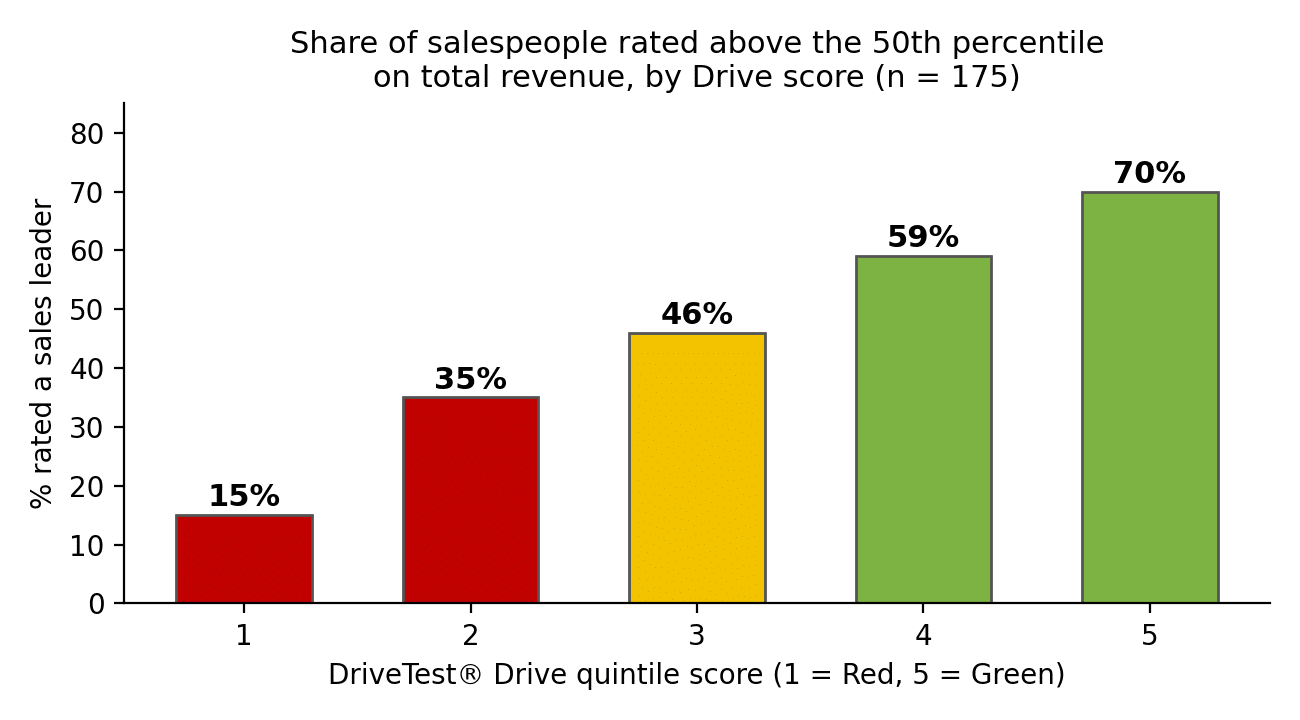
The data above comes from the DriveTest® Development and Validation Technical Manual. The study compared assessment scores with managers’ performance ratings for 175 salespeople. It was designed with external assessment consulting firm Quintela Group.
Researchers checked whether higher scores went along with stronger ratings for sales revenue and activities such as developing leads and closing new accounts.
In this study, salespeople in the ‘Green Drive’ range were almost twice as likely as those in the ‘Red Drive’ range to be rated as sales leaders.
“Sales leader” had a specific meaning: the person’s manager-rated revenue performance was above the study’s midpoint. It did not mean the person was a sales manager or the company’s top seller.
This finding shows a connection between Drive scores and performance ratings in this group. It does not promise the same result for every future hire.
Higher Hunter scores—which combine Drive, Confidence and Persuasion—also went along with stronger manager ratings for developing new business and closing new accounts.
The Farmer score results were less clear. This study did not establish a reliable link between that score and managers’ ratings of account growth and follow-up. Most participants worked in hunter-style roles, which limits what we can conclude about farmers.
What you should know about the study
- It studied current salespeople. It did not follow applicants from testing through their first year on the job, making it a concurrent study.
- Managers rated performance. The revenue measure was a manager’s rating, rather than sales dollars taken from company records.
- It covered a limited group. Findings from 175 salespeople cannot represent every sales role or industry.
That is why I recommend using results alongside a structured interview, references and other job-related evidence. The technical manual also says the assessment is not intended to be a stand-alone pass/fail measure.
View a sample DriveTest report
When Sales Assessments Don’t Work
Even a well-researched assessment can disappoint when it is used for the wrong purpose. Watch for these problems:
- The research does not match the job. Evidence for one kind of work may not apply to another.
- Success was never defined. A detailed report is not enough if no one can explain how it relates to the results you need.
- The score becomes the whole decision. You still need to investigate experience, skills and evidence from past work.
- Answers are easy to shape. Candidates may choose responses they think an employer wants. Ask how the test addresses that risk and what evidence supports its approach.
- The work environment gets ignored. Poor onboarding, unclear expectations or a weak territory can affect results. An assessment cannot fix those problems.
The DriveTest uses a forced-choice format: candidates choose which of several statements is most and least like them. It is designed to make the preferred answer less obvious. It also includes a consistency score to flag those candidates who try to show themselves in a favorable light.
Conclusion: So, Do They Work?
The honest answer is that the right sales assessment can help improve your hiring process when its purpose and research match the sales role you need to fill. Your goal should be to learn something useful about the candidate before making a costly commitment.
Start with the five vendor questions. Then decide how you will combine the results with interviews, references and evidence of relevant skills.
Build your process with our guide to assessing sales candidates before hiring.
If you are hiring salespeople who must generate new business, include SalesDrive in your comparison. Evaluate our evidence with the same questions you ask any other provider.
And get started with a free DriveTest for your sales candidate.
FAQs
Some can help. Look for evidence that scores relate to performance in a relevant sales role. Use the results alongside interviews, references and other job-related information.
It means there is research supporting a particular use of the assessment. Ask who was studied, what outcome was measured and how closely the study matches your hiring needs.
There is no single accuracy percentage that applies to every test or role. Ask the vendor what its number measures. A correlation describes a relationship between scores and performance; it is not the percentage of hires who will succeed.
In its technical study, higher Drive scores were linked with stronger manager-rated revenue performance. Green-range scorers were almost twice as likely as Red-range scorers to be rated sales leaders. These were findings among current employees, not guaranteed results for future hires.
The categories can overlap. Some personality assessments have evidence supporting hiring uses. What matters is what the tool measures and whether its research supports the sales decision you need to make. See our complete guide to sales assessment tests.
No. Use it as one source of evidence to decide who earns an interview. Then conduct a structured interview, reference checks and confirm the candidate has the relevant skills needed for the role. If you need help creating a consistent sales hiring process, our step-by-step guide provides the foundation to get you started.
Use the five questions above, then see our sales assessment tools comparison.
About the Author: Dr. Chris Croner is a clinical psychologist and Principal at SalesDrive, LLC. He developed The DriveTest® sales assessment and is co-author of Never Hire a Bad Salesperson Again. He has helped more than 1,500 companies worldwide identify and hire top-performing salespeople. Connect with him on LinkedIn.


