866-972-5373
 Account Login

 866-972-5373
 Account Login

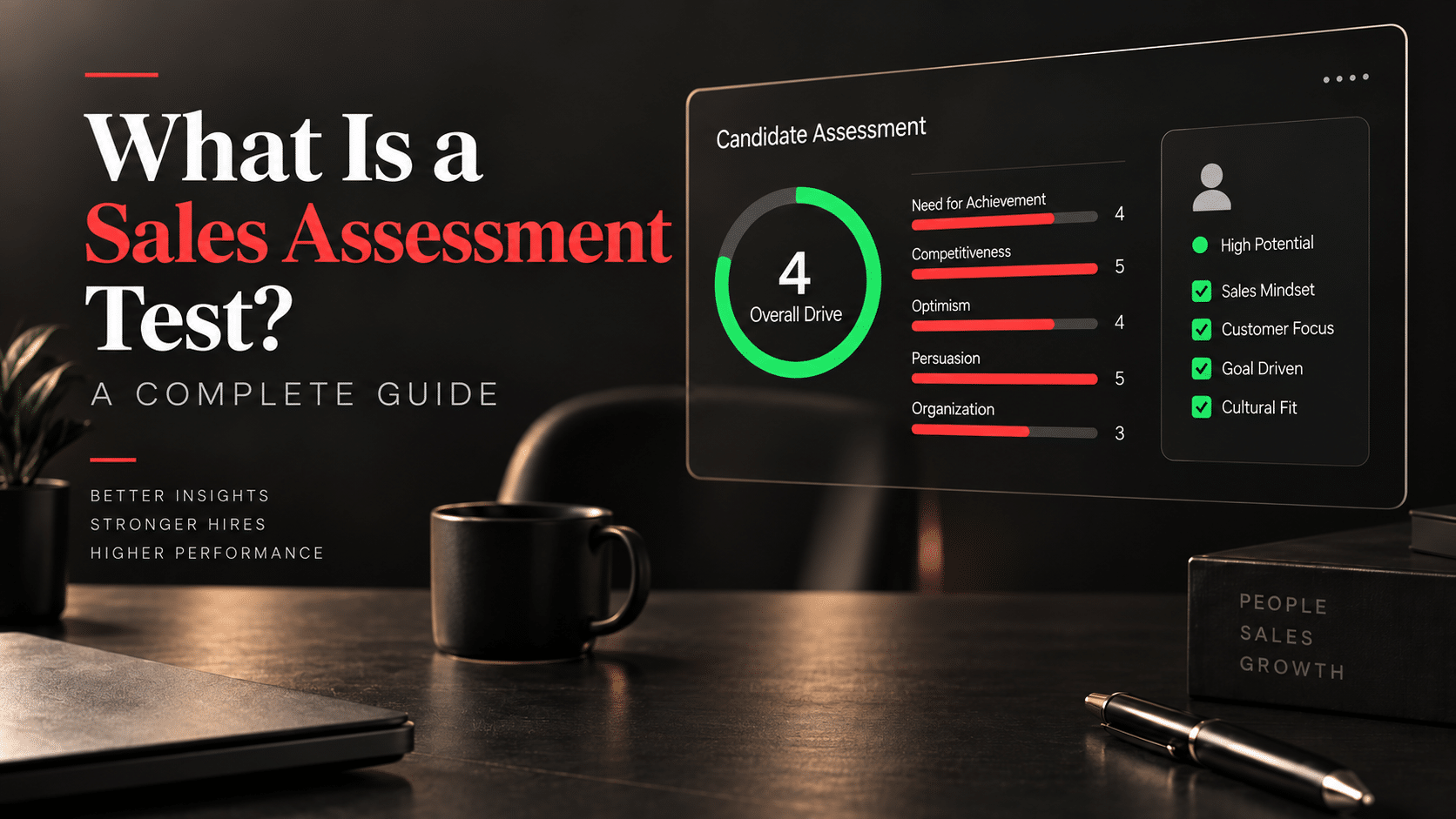
A sales assessment test is a standardized tool used during the hiring process to evaluate whether a candidate’s natural tendencies, motivations, or abilities align with what a specific sales role requires.
Depending on the tool, it might measure Drive and motivation, personality and behavioral style, existing selling skills, cognitive reasoning ability, or some combination of these. The output is typically a report that scores the candidate against traits research has linked to sales performance.
But before deciding which sales assessment to add to your shortlist, first ask yourself: “What am I trying to predict with this tool?”
Most companies skip that question. They buy “an assessment,” administer it to every candidate, and expect one score to tell them everything — whether the person can sell, will sell, fits the culture, and won’t quit in six months. That’s expecting too much one a single tool.
I’m Dr. Chris Croner, a clinical psychologist specializing in sales. I have studied salespeople and the research behind what makes top producers different from average or underperformers for decades. I also built and refined by own sales assessment, and the biggest mistake I see isn’t a company skipping testing altogether — it’s a company using the wrong kind of test for the wrong reason, then blaming the tool when the hire doesn’t work out.
This guide breaks down what a sales assessment test actually measures, the categories you’ll run into while shopping for one, when to use one in your hiring process, and — just as important — what no assessment should ever be asked to do on its own.
Why Companies Use Sales Assessment Tests
Hiring the wrong salesperson is expensive in ways that don’t show up on a single line item. Lost opportunities. Wasted training hours. A territory that goes cold while you start the search over. Turnover that quietly compounds.
Then sales assessments were invented — not to replace human judgment, but to add objective evidence to a decision that would otherwise rest almost entirely on résumé claims, interview charm, and gut feelings.
Used correctly, a sales assessment test helps you:
- Screen a large applicant pool down to a manageable shortlist before you invest time interviewing
- Apply the same evaluation criteria to every candidate, not just the ones you personally connect with
- Surface potential that isn’t obvious from a résumé — and red flags that aren’t obvious from a polished interview
- Focus your interview questions on the areas most likely to predict success in your specific role
- Build a defensible, consistent hiring process instead of one built on individual hunches and biases
Used incorrectly — as the sole factor in a hiring decision, or as validation for a choice you’d already made — an assessment adds cost without adding insight.
What Does a Sales Assessment Test Actually Measure?
Employers throw around “sales assessment” as if it’s one thing. It isn’t. Depending on the instrument, a sales assessment test might be built to answer any of these distinct questions:
- Motivation: What internal characteristics drive this person to initiate contact, chase a goal, and keep going after rejection?
- Behavioral style: How does this person typically communicate, structure their day, and interact with others?
- Existing skill: What does this person already know how to do — prospect, qualify, handle objections, close?
- Cognitive ability: How quickly can this person learn new information and reason through unfamiliar problems?
No single assessment answers all four questions equally well, and that’s not a flaw — it’s by design. A tool built to measure communication style was never meant to predict whether someone will make 50 cold calls in a day. A tool built to measure Drive (aka internal motivation) was never meant to test product knowledge.
The score only means something once you know exactly what it’s measuring — and whether that trait actually matters for the role you’re filling.
Types of Sales Assessment Tests
Here’s how most sales assessment tests break down, organized by the question each one is actually built to answer.
| Assessment Category | Core Question It Answers | Strongest Fit For | Watch-Out |
| Motivation / Drive-Based | Will this person consistently initiate and sustain selling effort, even through rejection? | Hunter roles: new business development, SDR/BDR, outbound sales | Doesn’t measure existing product or industry knowledge |
| Personality & Behavioral | How does this person naturally communicate and work? | Team-fit conversations, coaching, management style discussions | Communication style is not the same as sales performance |
| Skills & Competency | What selling techniques can this person currently execute? | Experienced hires who need to contribute immediately | A “correct” written answer isn’t the same as live execution |
| Cognitive Aptitude | How quickly can this person learn and reason through problems? | Technical or complex, longer-cycle sales | Says nothing about motivation to prospect or close |
| Structured Interview Scorecards | Are we evaluating every candidate against the same criteria? | Standardizing subjective interview impressions | Not a “test” in the traditional sense — a process tool |
A few things worth knowing before you pick one:
- Personality and motivation are not interchangeable. You can be introverted and highly Driven, or naturally outgoing and completely unmotivated to prospect cold. If your role requires relentless outbound activity, a personality profile alone won’t tell you who will actually do it.
- Skills assessments reward experience, not potential. They’re excellent for vetting an experienced hire who needs to hit the ground running, but they can unfairly screen out a high-potential candidate who simply hasn’t been trained yet.
- Cognitive testing matters more as sales complexity rises. A rep selling manufacturing software who needs to understand a prospect’s production process benefits from strong reasoning ability. A rep selling a simple, repeatable product may not need it nearly as much.
If cognitive and learning-ability testing specifically is what you’re evaluating, we go much deeper on that category — including sample task types and how to interpret scores — in our companion guide, What Is a Sales Aptitude Test?
What a Sales Assessment Should Never Be Asked to Do
This is the part most guides skip, and it’s the part that actually protects your hiring budget.
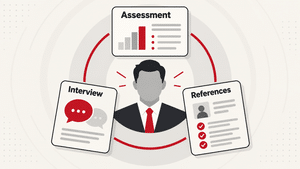
A sales assessment test should never make the hiring decision for you. No assessment — including ours — can guarantee that a candidate will become a top producer. The best hiring processes combine assessment results with structured behavioral interviews, reference checks, and a clear-eyed look at relevant experience.
A few specific misuses to watch for:
- Using it to confirm a decision you’ve already made. If you already “love” a candidate before results come in, it’s easy to read a report selectively. Evaluate every candidate’s results with the same scrutiny, favorite or not.
- Skipping the job analysis first. If you haven’t defined what the role actually demands — hunting new business versus farming existing accounts, short sales cycle versus long, technical versus transactional — you can’t know which assessment category would properly aid you in hiring.
- Treating a high score as a guarantee. A score is evidence about a specific trait. It says nothing about fit with your product, your management style, or your market.
- Letting it replace reference checks entirely. A strong assessment result paired with a lukewarm reference should raise more questions, not fewer.
A 2012 Robert Half survey of 1,400 CFOs found that managers spend nearly a full day a week — roughly 17% of their time — managing underperformers. That’s the cost an assessment is meant to help you avoid. It can’t do that if it’s used as a shortcut instead of a data point.
Think of a sales assessment test as evidence, not a verdict. It should narrow your uncertainty — not eliminate the need for judgment.
When Should You Use a Sales Assessment in Your Hiring Process?
Timing depends largely on how much hiring volume you’re running.
- If you’re hiring 20 or more salespeople a year, it often makes sense to place the assessment near the beginning of your funnel — using it to filter a large applicant pool before your team invests interview time.
- If you’re hiring 15 or fewer salespeople a year, the more common (and often more practical) approach is to review applications and run an initial phone screen first, then administer the assessment before the deeper interview stage.
Either way, here’s the sequence I recommend to clients regardless of company size:
- Define the role and its non-negotiable requirements before you write the job posting.
- Review applications and run an initial screening call.
- Administer the assessment(s) that match what the role actually demands.
- Review results and build follow-up interview questions around anything ambiguous or concerning.
- Conduct structured behavioral interviews and, where relevant, a live sales exercise.
- Check references — and compare notes against the assessment findings.
- Make the decision, then plan onboarding around what you’ve learned about the candidate.
This sequence puts objective data in front of your team before the interview stage, rather than trying to layer facts onto a decision your gut already made.
Can You Assess Your Current Sales Team, Too?
Yes — and plenty of companies do this well. The goal isn’t to replace a performance review; it’s to identify coaching priorities, understand why a top performer succeeds, and give you a benchmark to compare future candidates against.
The caveat: results should always be read alongside actual performance, tenure, and territory conditions — not as a standalone judgment about someone already doing the job.
Frequently Asked Questions
A sales assessment test is a standardized tool used to evaluate a candidate’s motivation, personality, skills, or cognitive ability as they relate to sales performance — typically administered during hiring to add objective data to a decision that would otherwise rely mostly on résumé claims and interview impressions.
The terms are often used interchangeably, but technically “aptitude” refers specifically to cognitive learning potential — reasoning speed, problem-solving, ability to absorb new information. “Sales assessment test” is the broader umbrella term that also includes personality, motivation, and skills-based tools. Check what any specific product actually measures rather than relying on its label alone.
No. A result provides evidence about specific traits or capabilities — it can’t guarantee performance against your product, market, management style, or customer base. Use results alongside interviews, references, and relevant experience, not as a standalone decision-maker.
It depends on the format. Forced-choice question formats make favorable self-presentation harder than simple agree/disagree scales, but no format is completely immune to manipulation. Ask any provider how their tool detects inconsistent or manipulated responses before you commit to it.
Most commonly after résumé review and an initial phone screen, but before the in-depth interview stage. This gives your team objective data to focus on before investing significant interview time.
Generally, yes — provided the tool is validated for the specific job and administered consistently to every candidate, consistent with EEOC guidelines on employee selection procedures. Ask any vendor for documentation on reliability, validity, and adverse-impact data before rolling a tool out company-wide.
Pricing varies widely by provider, scope, and volume — from free tools up to roughly $500 per candidate for individual assessments, or into five figures annually for subscription plans. Our full cost breakdown walks through the different pricing models in detail.
Where This Leaves You
You came into this article asking a fair question: what actually is a sales assessment test, and does it belong in your hiring process?
By now, the honest answer should be clear — it’s not one thing. It’s a category of tools, each built to answer a different question about a candidate, and each only as useful as your understanding of what it’s actually measuring.
The next step isn’t picking a tool off a list. It’s identifying which uncertainty is costing you the most in your current hiring process — motivation, skill, cognitive fit, or behavioral fit — and choosing a tool that helps solve that exact problem.
If you’re ready to compare specific providers side by side, our guide on how to choose the best sales assessment for your company walks through exactly what to look for before you buy.
About the Author: Dr. Chris Croner is a clinical psychologist and Principal at SalesDrive, LLC. He developed The DriveTest® sales assessment and is co-author of Never Hire a Bad Salesperson Again. He has helped more than 1,500 companies worldwide identify and hire top-performing salespeople. Connect with him on LinkedIn.