 866-972-5373
 Account Login

 866-972-5373
 Account Login

Have you ever interviewed a sales candidate who looked great in the interview — they really impressed you — sharp answers, great energy, a resume full of “President’s Club” awards — only to wonder, three months later, why they weren’t producing?
You’re not alone. Unfortunately, this is a far too common occurrence and what most hiring managers don’t realize is how much that hiring mistake is actually costing you. Combining salary and hiring costs with lost pipeline, wasted training hours, a damaged territory, a manager’s time spent coaching someone who was never going to make it — the number is almost always bigger than people expect.
I’m Dr. Chris Croner, co-author of Never Hire a Bad Salesperson Again and Principal at SalesDrive, where we’ve spent more than 20 years helping companies identify sales potential prior to hiring – saving them thousands in a costly hiring mistakes.
In this guide, I’ll walk you through the exact framework I recommend to hiring managers, VPs of Sales, HR teams and CEOs for evaluating sales candidates before making an offer. By the end, you’ll have a repeatable process you can use on your very next sales hire.
Why a Great Interview Doesn’t Guarantee a Great Salesperson
Here’s the uncomfortable truth about sales hiring: the people you’re evaluating are professional persuaders. Interviewing well is part of the job. That means the interview itself is the one place where a mediocre salesperson has the best chance of looking like a top performer.
So relying on gut instinct is risky. A candidate can walk in, read the room, tell you exactly what you want to hear, and leave you with a great “feeling” about them — a feeling that has almost nothing to do with whether they’ll build pipeline, survive rejection, or close business six months from now.
The strongest hiring decisions aren’t based on instinct. They’re based on a consistent process that layers multiple sources of evidence on top of each other, so no single data point (especially a charming interview) carries too much weight.
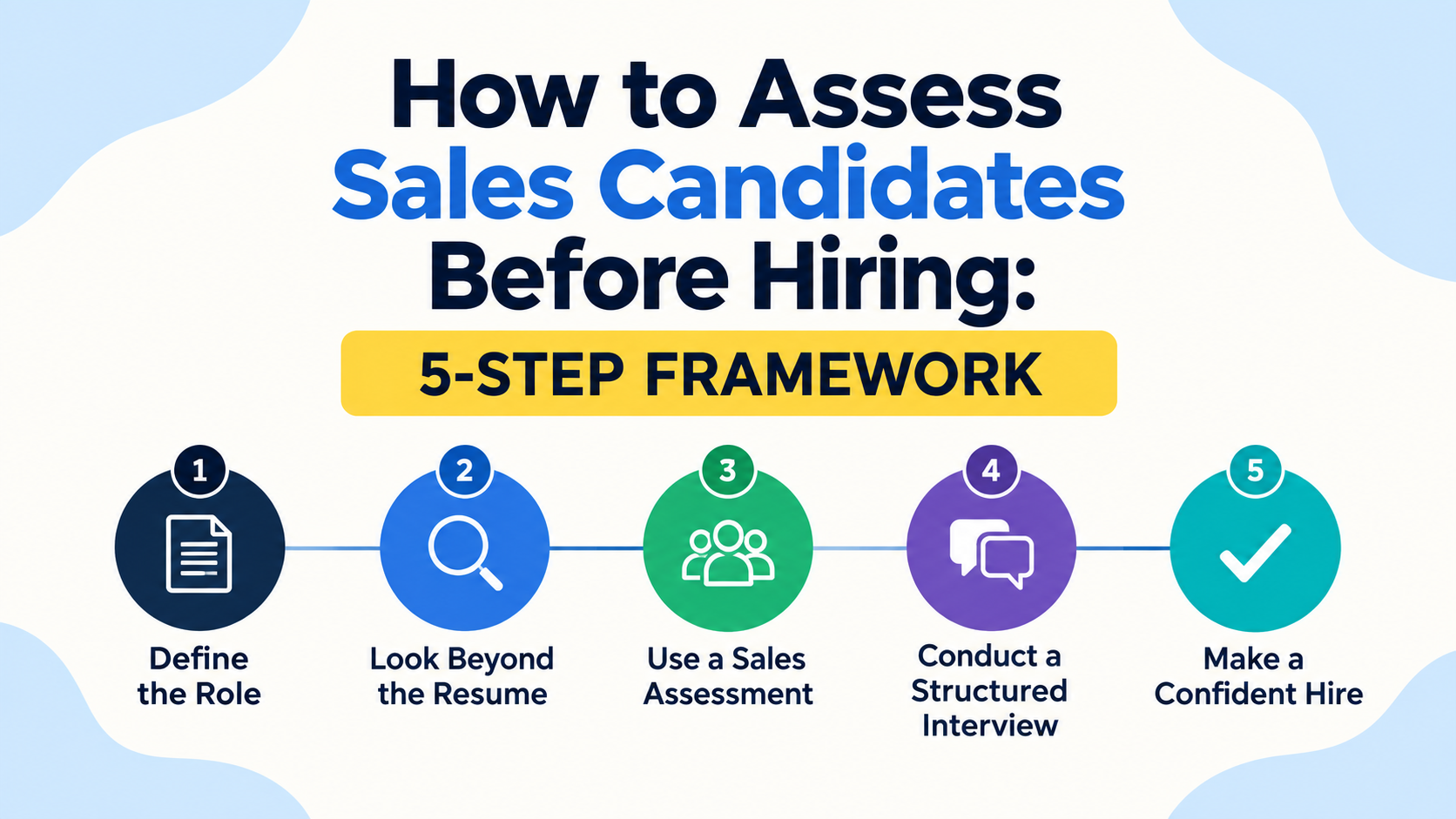
That process comes down to five steps.
The 5-Step Framework for Assessing Sales Candidates Before You Hire
Step 1: Define the Role Before You Review a Single Resume
Before you look at one candidate, get specific about what this job actually requires. Not every sales role calls for the same strengths, and “good salesperson” is too vague a target to hire against.
Ask yourself:
- Is this person hunting for new business, or farming existing accounts?
- Are they responding to inbound leads, or building a pipeline from outbound prospecting?
- Is the sales cycle short and transactional, or long and consultative?
- Are they selling to end users, or managing channel partners and reps?
A candidate who’s a phenomenal account manager can be a poor fit for a pure hunting role, and vice versa. When you define what success looks like before you start evaluating people, comparing candidates gets dramatically easier — and you stop accidentally hiring an excellent salesperson for the wrong job.
Step 2: Look Beyond the Resume for Patterns
A polished resume with recognizable logos tells you almost nothing about future performance. Instead of being impressed by where someone worked, look for patterns in how they worked.
Specifically, look for evidence of:
- Consistent production — did their numbers show up more than once, or was there one good year surrounded by mediocre ones?
- Longevity — did they stay long enough to actually build something, or is there a pattern of leaving every 12–18 months?
- Metrics — do they quantify their results (rank, quota attainment, deals closed), or is everything vague and unverifiable?
- Persistence — have they prospected from scratch, competed for a ranking, or stuck with a difficult goal rather than switching lanes when it got hard?
None of these factors guarantees success on their own. But together, they give you real clues about whether a candidate has a track record of doing the hard, unglamorous parts of sales — not just the parts they’ll happily tell you about in an interview.
Step 3: Use a Validated Sales Assessment Before the In-Person Interview
This is the step most companies skip, and it’s usually the most expensive mistake in the process.
One of the biggest hiring risks is becoming emotionally attached to a candidate after a great interview. Once that happens, every piece of information you gather afterward gets filtered through a bias toward confirming you made the right choice. This is a well-documented pattern in hiring psychology, called the halo effect, and it’s part of why so many “obvious hires” don’t pan out.
A validated, job-relevant sales assessment gives you an objective data point before that bias has a chance to take hold. It’s not meant to replace the interview — it’s meant to make the interview sharper. Use the results to:
- Identify strengths worth exploring further
- Flag potential concerns to probe directly
- Build more targeted, specific interview questions
Think of the assessment as one more piece of evidence in the case you’re building — not a final verdict.
If you want to see what this looks like in practice, I’ve written more about what a sales aptitude test actually measures and the ROI of using one before you hire.
Step 4: Ask Behavioral Interview Questions, Not Hypotheticals
Once you sit down face-to-face, resist the urge to ask “what would you do if…” questions. These situational or hypothetical questions are easy to prepare for, and any candidate who’s read an interview guide will have a polished, textbook answer ready to go.
Instead, spend most of your time asking what they’ve actually done. Behavioral questions are far harder to fake because they require specific, verifiable detail. A few I use regularly:
- “Tell me about a time you handled rejection. What did you do next?”
- “Describe a goal that required unusual persistence to hit.”
- “What’s the toughest sales challenge you’ve had to overcome?”
- “Have you ever had to build a territory or a book of business from scratch?”
The more specific and detailed the example, the more confidence you can have in the answer. Vague, general answers (“I always work hard”) are a signal to dig deeper, not a green light to move on.
Step 5: Combine Everything Before You Decide
Great hiring decisions rarely come down to one perfect signal. They come from weighing multiple sources of evidence together until the right answer becomes obvious.
| Evidence Source | What It Tells You | What It Misses |
| Resume & LinkedIn | Career patterns, longevity, industry fit | Actual selling ability, personality traits |
| Sales assessment | Objective read on Drive and core sales traits, taken before bias sets in | Real-world execution, references, culture fit |
| Behavioral interview | How the candidate has actually handled real situations | Can still be coached or exaggerated without probing |
| Reference checks | Third-party validation of performance and work habits | References are self-selected and often biased positive |
Before you extend an offer, ask yourself one final question: Do this person’s demonstrated strengths actually match the demands of this specific sales role? Not “do I like them,” not “did they interview well” — does the evidence, taken as a whole, support this hire?
“Great hiring isn’t about finding one perfect answer. It’s about gathering enough evidence that the right decision becomes obvious.”
Sales Candidate Evaluation Checklist
Use this quick checklist to keep every candidate evaluation consistent:
☐ Job requirements and success criteria defined before reviewing resumes
☐ Resume/LinkedIn reviewed for longevity, metrics, and production patterns
☐ Validated sales assessment administered before the first in-person interview
☐ Interview built around behavioral (not hypothetical) questions
☐ Specific examples probed for detail, not accepted at face value
☐ References checked and cross-referenced against interview claims
☐ Final decision based on combined evidence, not gut feel alone
Download the Free Sales Candidate Evaluation Scorecard
If you’d like a done-for-you version of this process, we put together a free Sales Candidate Evaluation Scorecard you can use to score every candidate consistently across resume review, assessment results, and behavioral interview responses. Download our free Sales Candidate Evaluation Scorecard — it’s built specifically to help you catch expensive hiring mistakes before they happen, not after.
And if you’re looking to add a sales assessment into your hiring process, request a free DriveTest® to use with your next sales candidate.
FAQ: Assessing Sales Candidates Before Hiring
The most reliable approach combines four sources of evidence: a clearly defined job spec, a resume/LinkedIn review focused on patterns rather than logos, a validated sales assessment administered before the interview, and a structured behavioral interview. No single method is reliable on its own.
Before, whenever possible. Administering the assessment first gives you objective data before you’ve formed an emotional impression of the candidate, which helps you interview more objectively instead of unconsciously looking for evidence to validate a gut feeling.
Situational questions ask what a candidate would do in a hypothetical scenario, which is easy to answer well without any real experience. Behavioral questions ask what a candidate has actually done, which is much harder to fabricate convincingly and far more predictive of future performance.
Enough time to gather real evidence, but not so long that strong candidates accept another offer. Most effective processes include an initial screen, an assessment, one to two structured interviews, and reference checks — typically completed within one to three weeks depending on the seniority of the role.
Where This Leaves You
You started this process wanting a reliable way to tell the difference between a candidate who interviews well and a candidate who will actually produce. Now you have a five-step framework — define the role, look past the resume, assess before you interview, ask behavioral questions, and weigh the data together — that you can apply to your very next sales hire.
The goal was never to find a perfect answer in a single conversation. It’s to build enough evidence that the right decision becomes obvious. If you’d like to see how a validated, Drive-based sales assessment fits into that evidence, you’re welcome to request a complimentary test or read more about why so much conventional sales hiring advice falls short.
About the Author: Dr. Chris Croner is a clinical psychologist and Principal at SalesDrive, LLC. He developed The DriveTest® sales assessment and is co-author of Never Hire a Bad Salesperson Again. He has helped more than 1,500 companies worldwide identify and hire top-performing salespeople. Connect with him on LinkedIn.


