866-972-5373
 Account Login

 866-972-5373
 Account Login

A sales aptitude test helps employers evaluate characteristics relevant to success in a sales role. Depending on the assessment, it may measure learning ability, behavioral tendencies, sales competencies, motivation, or a combination. Its value depends on whether those measures address the responsibilities of the job—and whether you interpret the results appropriately.
Most of us have hired someone who understood the product, delivered an impressive interview, and knew how to handle common objections. Everything suggested they would be a strong producer.
Then you found yourself reminding them to prospect.
Their abilities may have been real. But your hiring process may have left an important question unanswered: Does this person have the core personality required to consistently initiate new business?
In my work helping companies evaluate sales candidates, knowing if candidates have Hunter potential before hiring makes all the difference. But not all sales roles are equal, so before choosing a test, you need to identify what your hiring process needs to uncover.
“When companies ask me, ‘What’s the best sales aptitude test?’ My first question is always: What are you trying to predict?”
Understanding the different assessment approaches will help you choose relevant tools, interpret scores, and conduct more useful interviews.
What Does a Sales Aptitude Test Measure?
In a narrow sense, aptitude refers to the potential to learn or perform. Employers often use sales aptitude test more broadly to describe assessments of personality, motivation, and existing selling capabilities.
These measures answer different questions:
- Learning ability: Can the candidate absorb information and reason through unfamiliar problems?
- Behavioral tendencies: How does the candidate typically approach work and interact with others?
- Sales competencies: What does the candidate understand about selling, and what capabilities can they demonstrate?
- Motivation: What characteristics support the candidate’s willingness to initiate and sustain selling effort?
Some assessments cover several areas. Others specialize in one.
A score is useful only when you understand what it measures and how that relates to the job. A strong reasoning score does not directly establish prospecting persistence. Knowing the recommended response to an objection does not establish that someone can deliver it effectively in conversation.
Four Types of Sales Aptitude Tests
1. Cognitive Aptitude Tests
Cognitive aptitude tests examine capabilities such as reasoning, critical thinking, and learning new information. For example, Criteria’s cognitive assessments include measures of problem-solving and the ability to learn and apply information.
These abilities may be particularly relevant when a salesperson must understand a complex product, interpret customer requirements, or evaluate competing solutions.
Consider a salesperson selling manufacturing software. They may need to learn how a customer’s production process affects implementation and explain why a particular configuration makes sense.
Cognitive testing can contribute evidence about their capacity to handle that work.
It does not replace an evaluation of product knowledge, communication, or motivation. Those remain separate hiring considerations.
2. Personality and Behavioral Assessments
Personality and behavioral assessments examine patterns in how people tend to think, work, and interact.
Depending on the instrument, results may describe tendencies involving independence, structure, pace, or social interaction. For example, The Predictive Index Behavioral Assessment measures Dominance, Extraversion, Patience, and Formality.
These findings can help you investigate how a candidate’s preferred way of working relates to the position.
The danger is using a profile to confirm personal preferences rather than evaluate job requirements.
“I like outgoing people” is not a sufficient selection criterion. Ask what the salesperson must actually do: initiate conversations, listen carefully, coordinate decisions, challenge assumptions, or maintain detailed follow-through.
Then determine how the assessment informs those requirements.
3. Sales Skills and Competency Assessments
Sales skills and competency assessments examine areas such as prospecting, discovery, qualifying, objection handling, and sales judgment. Some also cover mindset and behavioral factors associated with execution.
For example, Objective Management Group’s Sales Candidate Assessment includes competencies organized into Will to Sell, Sales DNA, and Tactical Selling.
Pay attention to how the evidence is gathered.
Selecting an appropriate answer to a sales scenario demonstrates something different from performing well in a live role-play. A self-report about selling behavior provides another kind of information.
For an experienced hire expected to contribute quickly, current capability deserves close examination. For an entry-level candidate, distinguish the skills they need immediately from those your training program will develop.
4. Sales Motivation Assessments
Sales motivation assessments examine characteristics relevant to pursuing goals and maintaining selling effort.
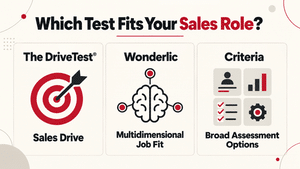
At SalesDrive, we focus on three characteristics we call Drive:
- Need for Achievement: The desire to pursue challenging goals and improve performance.
- Competitiveness: The desire to compete and win.
- Optimism: The tendency to remain resilient through setbacks.
The DriveTest® evaluates these characteristics in the context of sales selection. It also provides scores for Confidence, Persuasiveness, Relationship Skills, and Organization.
This specialization is particularly relevant when a salesperson must create opportunities through independent prospecting and new business development.
But motivation does not establish technical expertise or demonstrated selling skill. A motivated candidate may still need substantial development. Your hiring process must account for both their potential and the demands they will face immediately.
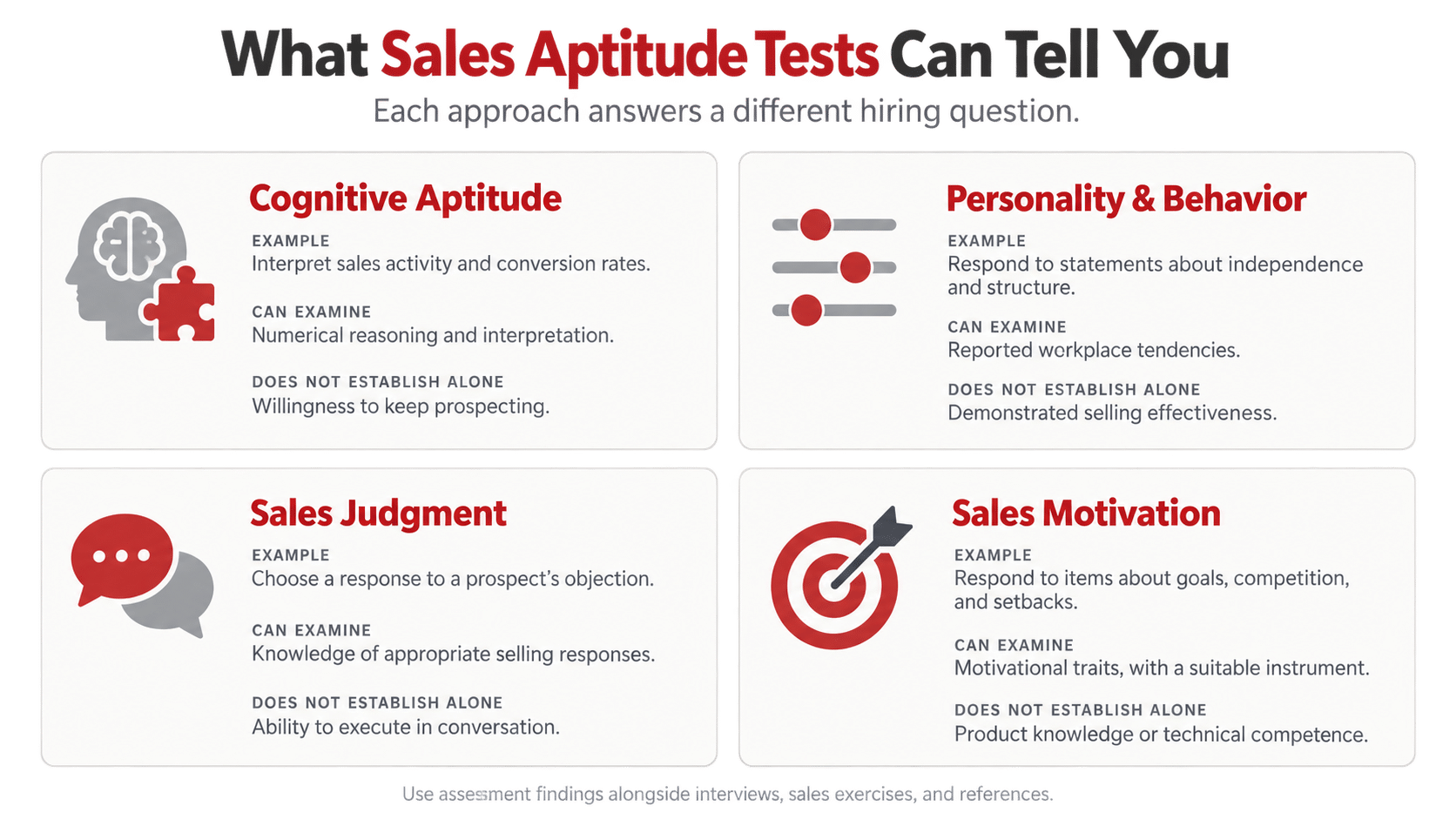
Sales Aptitude Test Examples and What They Can Tell You
The following examples illustrate different assessment approaches.
| Assessment approach | Illustrative task | What it can help examine | What it does not establish by itself |
| Cognitive aptitude | Interpret a table of sales activity and conversion rates | Numerical reasoning and interpretation | Willingness to maintain prospecting activity |
| Personality and behavior | Respond to statements about independence and structure | Reported workplace tendencies | Demonstrated selling effectiveness |
| Sales judgment | Evaluate possible responses to a prospect’s objection | Knowledge of appropriate selling responses | Ability to execute those responses in conversation |
| Sales motivation | Respond to items about goals, competition, and setbacks | Motivational characteristics, when measured with a suitable instrument | Product knowledge or technical competence |
Suppose a candidate correctly identifies when to follow up with an unresponsive prospect.
That provides some evidence of their judgment. It does not establish whether they will consistently make those follow-up attempts when other tasks compete for their attention.
Similarly, a candidate describing themselves as persistent is not enough. The interpretation depends on the assessment’s design, scoring, and supporting evidence.
Avoid turning a narrow finding into a broad conclusion about the person.
Why Use a Sales Aptitude Test in Hiring?
There are a number of reasons why a sales aptitude test can be useful during sales hiring. The main practical purpose is to add relevant evidence to a decision that might otherwise depend too heavily on résumé claims, interview impressions and candidate charm.
When used appropriately, an assessment within the hiring process can help you:
- Focus interviews on questions that require deeper investigation.
- Apply more consistent evaluation criteria across candidates.
- Identify potential that is not obvious from work history alone.
- Distinguish development needs from essential entry requirements.
- Make more informed decisions about where to invest interview time.
But remember, a test cannot compensate for an unclear role, weak onboarding, or an unrealistic sales assignment.
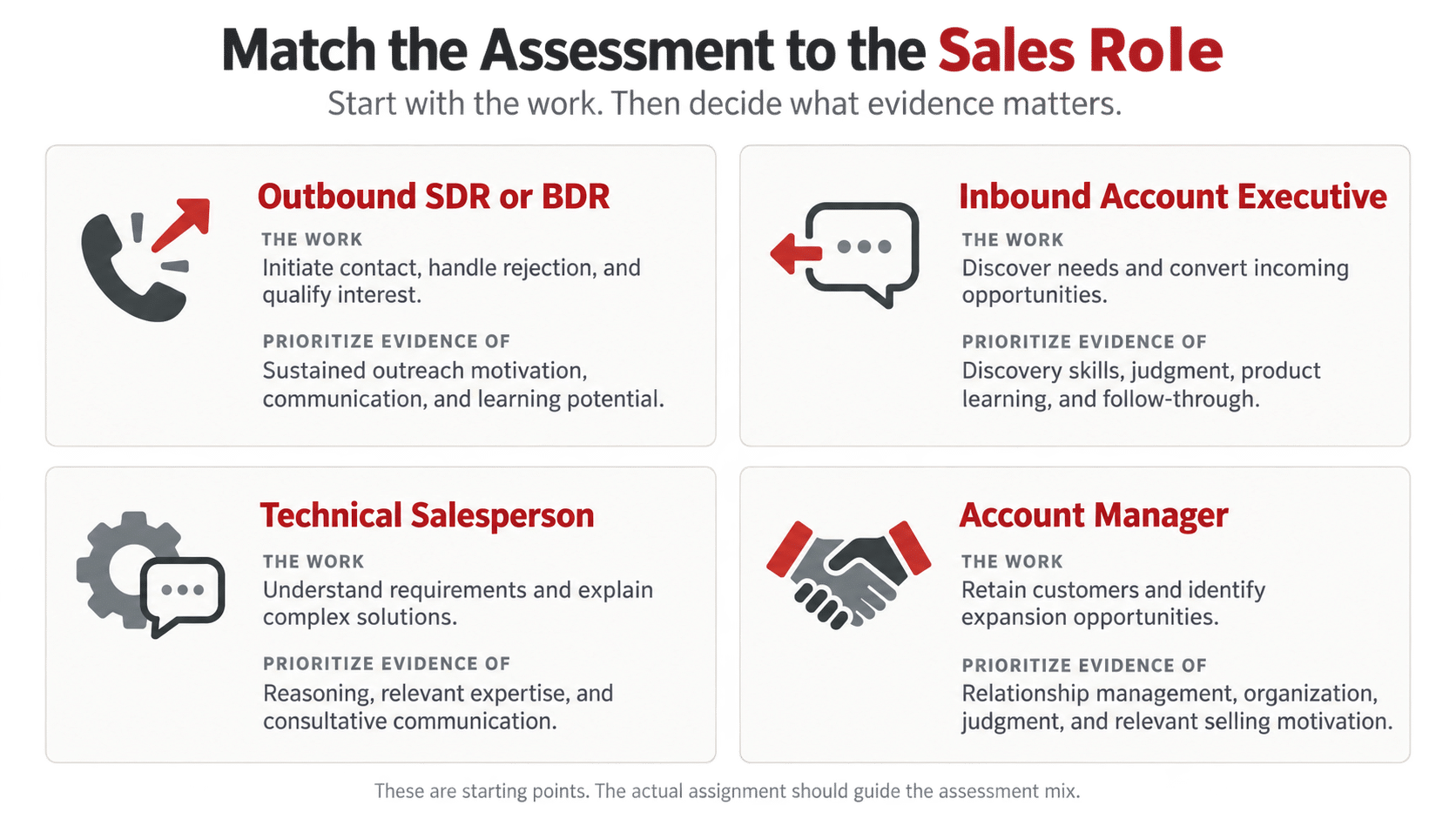
Match the Assessment to the Sales Role
Before selecting a test, finish this sentence:
“This person will succeed only if they consistently…”
Complete it with observable responsibilities. Those might include initiating contact, diagnosing problems, explaining technical trade-offs, coordinating renewals, or developing expansion opportunities.
| Sales assignment | Responsibilities to clarify | Evidence to prioritize |
| Outbound SDR or BDR | Initiating contact, handling rejection, qualifying interest | Motivation for sustained outreach, communication, and learning potential |
| Inbound account executive | Discovering needs and converting incoming opportunities | Discovery skills, judgment, product learning, and follow-through |
| Technical salesperson | Understanding requirements and explaining complex solutions | Reasoning, relevant expertise, and consultative communication |
| Account manager | Retaining customers and identifying expansion opportunities | Relationship management, organization, judgment, and relevant selling motivation |
These are starting points. An account manager with a demanding expansion target may need substantial new business motivation. An outbound salesperson may also need significant technical expertise.
The assignment should guide the assessment mix.
Recognize Potential Without Overvaluing Experience
A candidate with limited sales experience may still have relevant learning ability, motivation, and transferable capabilities.
Conversely, years in sales do not tell you how someone generated their results. An established account base, strong inbound demand, or substantial team support can change the nature of the work.
Evaluate experience in context, and assess potential against what you can realistically teach.
A promising first-time SDR and a senior technical salesperson should not face identical expectations.
When Should You Administer a Sales Aptitude Test?
The timing of an assessment is just as important as the test itself. For most sales hiring processes, a practical point is after résumé review and an initial phone screening, but before the deeper interview stage.
That allows you to establish basic suitability and explain the opportunity before asking the candidate to complete an assessment. It also gives you an under-the-hood look at the candidate’s potential and possible areas to investigate deeper in subsequent interviews.
I recommend the following sequence to my clients:
- Define the role and essential requirements.
- Review applications and conduct an initial screening.
- Administer relevant assessments.
- Review results and prepare follow-up questions.
- Conduct structured behavioral interviews and a relevant sales exercise.
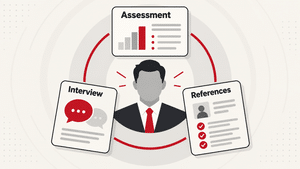
- Check references and review the data together.
- Make the hiring decision and plan onboarding.
This approach gives you the information you need to make a hiring decision based on fact, not merely on the candidate’s likeability.
Use Assessment Results to Strengthen the Interview
One of the most useful applications of testing is improving what happens afterward.
If you need to investigate self-directed prospecting, you might ask:
“Tell me about a period when you had to create pipeline without enough inbound leads. How did you organize your week, and what did you do when your first approach was not working?”
Follow up on specifics. Separate the candidate’s contribution from the team’s results.
For demonstrated capability, use a relevant exercise with a consistent brief and scoring criteria. In a discovery role-play, evaluate whether the candidate asks useful questions, listens, and adjusts their approach.
Avoid awarding most of the credit for confidence or presentation style.
Look for a coherent picture across assessment findings, behavioral examples, demonstrated skills, and references.
Can You Assess Your Current Sales Team?
Yes, provided the assessment and report are appropriate for development and you are clear about how the findings will be used.
For existing employees, interpret results alongside actual performance, territory conditions, tenure, and management support.
The purpose may be to identify coaching priorities, improve role alignment, or understand where additional support would help. At SalesDrive, the Production Builder report supports development conversations about current salespeople.
An assessment result should not substitute for a careful review of someone’s performance.
For more on this, read our guide to assessing your current sales team’s sales aptitude.
Frequently Asked Questions About Sales Aptitude Tests
Not necessarily. Employers use “sales aptitude test” for several assessment approaches. Some measure cognitive ability or selling knowledge; others examine personality, motivation, or multiple dimensions. Check the specific instrument rather than relying on its category label.
The risk depends on the assessment and administration method. Some formats make desirable responses more obvious than others.
Forced-choice questions can make favorable self-presentation less straightforward, but no format should be described as impossible to manipulate. Ask the provider how it addresses response consistency and test integrity.
No. A score provides evidence about selected characteristics or capabilities. It cannot guarantee performance with your product, territory, management, or customer base. Use results alongside other relevant data and feedback.
Pricing varies by provider, assessment scope, volume, reporting, and support. Providers may charge per candidate, sell packages, or offer subscriptions.
Our sales assessment cost guide explains the pricing models. For the business case, see the ROI of using a sales aptitude test before hiring.
Choose Your Assessment Around the Questions That Matter
Before your next sales hire, identify the most consequential uncertainties in your decision.
Can the candidate learn the offering? Can they conduct the conversations the job requires? What evidence supports their ability to sustain the necessary effort?
Choose assessment methods that help investigate those questions, and use the findings to guide the next stage of evaluation.
When you are ready to compare providers, explore our guide to the best sales assessment tools for hiring. Understanding what you need to measure will make that comparison far more useful.
About the Author: Dr. Chris Croner is a clinical psychologist and Principal at SalesDrive, LLC. He developed The DriveTest® sales assessment and is co-author of Never Hire a Bad Salesperson Again. He has helped more than 1,500 companies worldwide identify and hire top-performing salespeople. Connect with him on LinkedIn.