 866-972-5373
 Account Login

 866-972-5373
 Account Login

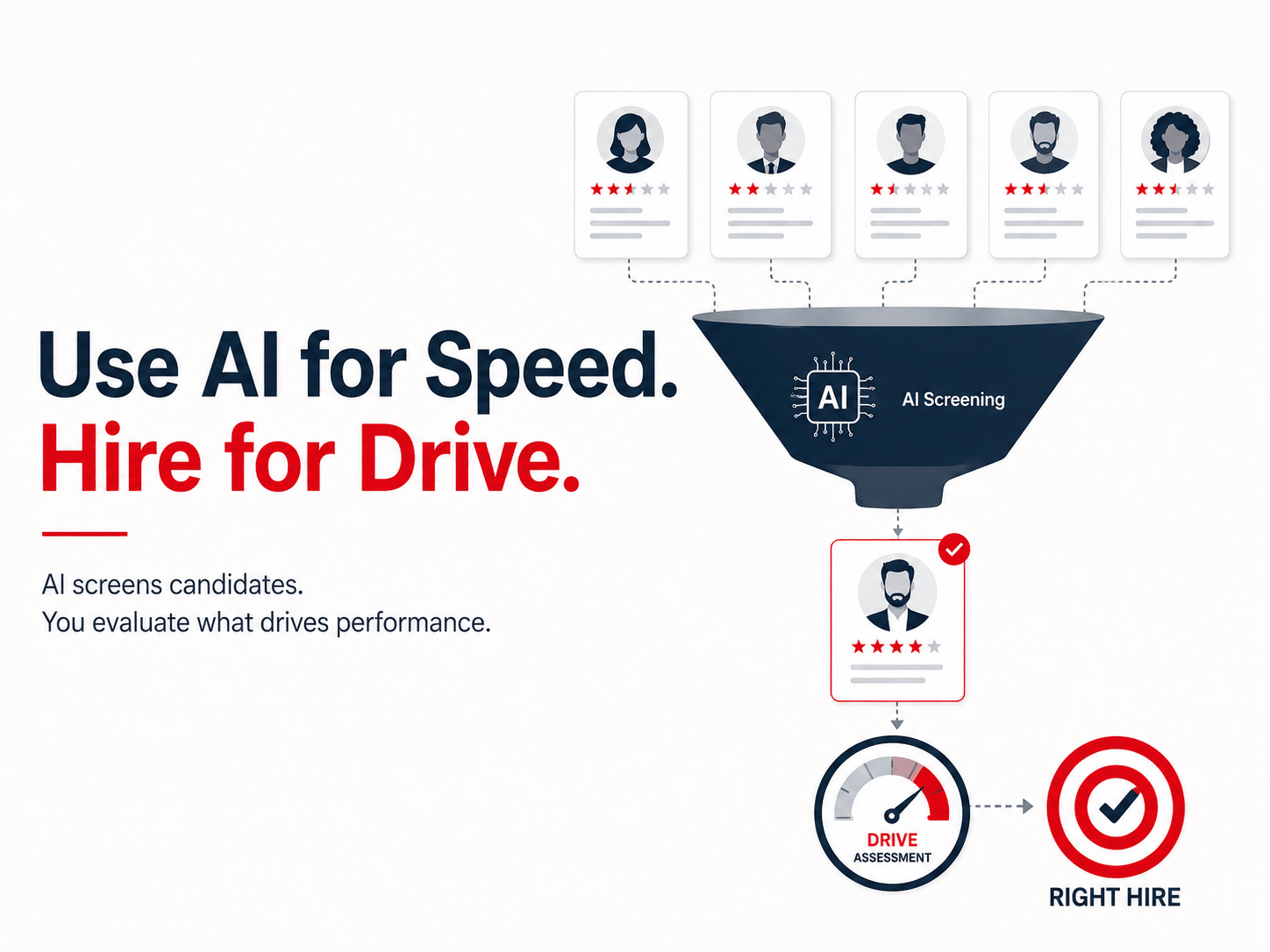
AI can make sales hiring faster. But faster does not automatically mean better.
That is the mistake many companies are at risk of making right now. AI can screen resumes, summarize interviews, rank applicants, organize candidate information, and reduce administrative drag. Used correctly, it can be a helpful top-of-funnel filter.
But AI should not be used by itself to hire salespeople.
Sales hiring requires more than speed. It requires evidence that a candidate has the traits needed to perform when the role becomes difficult. That is where a sales assessment becomes essential.
A candidate may look strong on paper. They may communicate well. They may give polished answers. They may even be ranked highly by an AI hiring tool. But none of that proves they will prospect consistently, handle rejection, compete for difficult business, or keep producing when pressure builds.
That is the difference between screening candidates and predicting sales performance.
AI Is Useful at the Top of the Sales Hiring Funnel
AI’s strongest role in sales hiring is early screening.
When a company has a large applicant pool, AI can help sort, organize, and prioritize candidates quickly. It can identify basic qualification matches. It can reduce bottlenecks. It can help hiring managers spend less time buried in resumes and more time evaluating serious candidates.
That matters because slow hiring can hurt growth. If a sales team needs to fill open seats and the process is clogged with manual review, AI can create speed and capacity.
AI can help with:
- Resume parsing
- Candidate sorting
- Keyword matching
- Application review
- Interview transcription
- Interview summaries
- Basic qualification checks
- Communication analysis
- Scheduling support
- Candidate pipeline organization
Those are useful functions. They can make the sales hiring process more efficient.
But they are not the same as determining who can actually sell.
A top-of-funnel filter can help you decide who deserves a closer look. It should not decide who gets the job. Confusing those two roles is where AI becomes dangerous in sales hiring.
“High-performers in sales don’t just look good on paper, they are different.”
What AI Actually Evaluates in Sales Candidates
The most important question is not, “Can AI evaluate sales candidates?”
The better question is, “What is AI actually evaluating, and is that tied to sales performance?”
Most AI hiring tools evaluate visible candidate inputs, including:
- Resumes
- Written answers
- Video responses
- Interview transcripts
- Application data
- Communication style
- Word choice
- Tone
- Structure
- Consistency
- Keyword matches
- Interaction patterns
Those inputs can be useful. They can show whether a candidate communicates clearly. They can help determine whether the candidate’s experience appears relevant. They can reveal whether the person answers questions in an organized way.
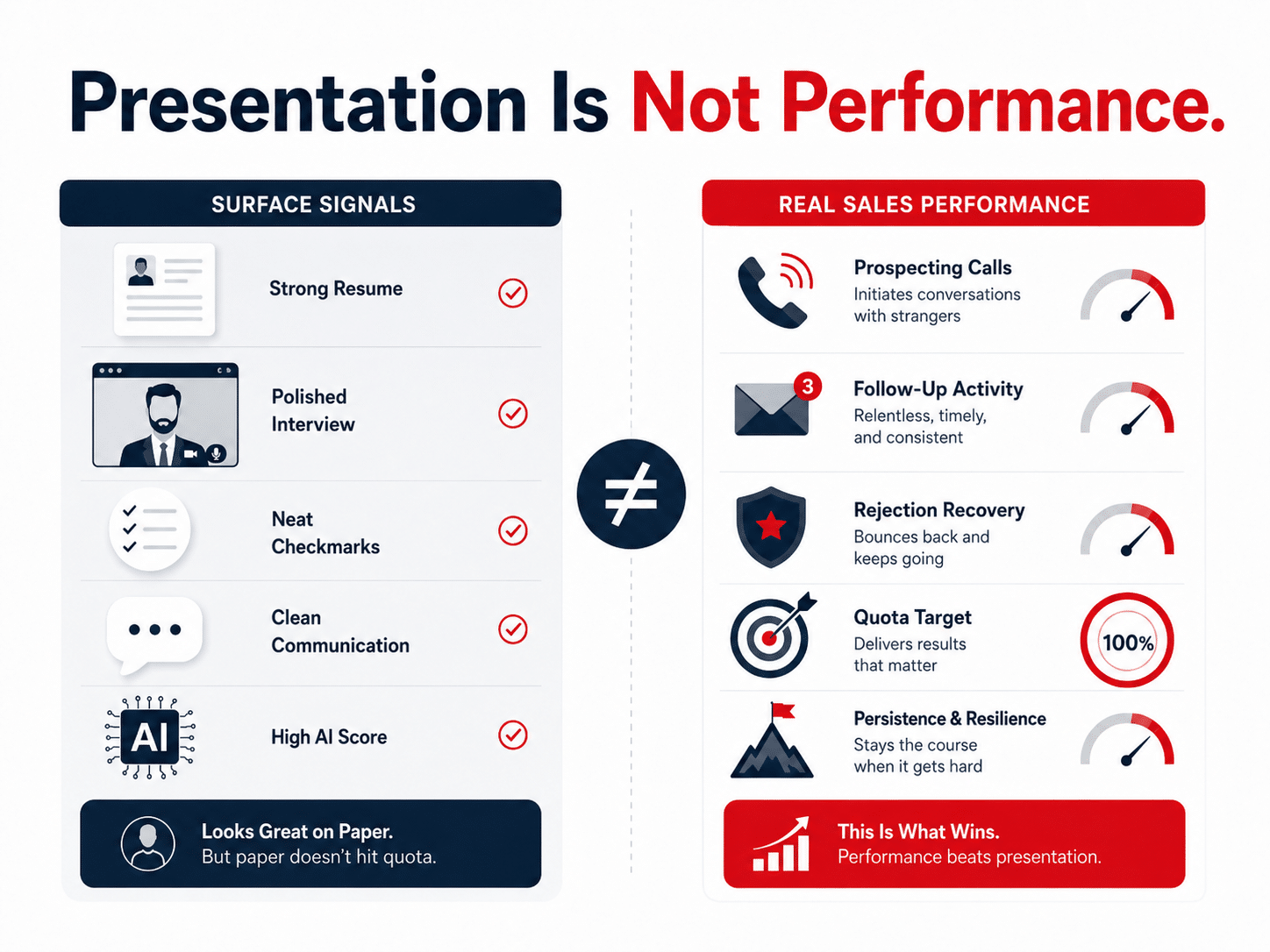
But those signals measure presentation.
Sales performance depends on something harder to see: what a candidate will do over time when the role becomes uncomfortable.
- Will they prospect when no one is pushing them?
- Will they keep following up after being ignored?
- Will they recover after rejection?
- Will they compete when the deal is difficult?
- Will they stay optimistic when the pipeline is thin?
- Will they keep pursuing goals when the quarter is under pressure?
An AI-generated summary cannot prove those things. That is the limitation.
AI can evaluate how a candidate presents. It cannot fully evaluate how that person will perform when the easy signals disappear.
Presentation Is Not Performance
Many sales hiring mistakes happen because companies confuse polish with production.
A candidate may have a strong resume. They may speak well. They may give structured answers. They may sound confident in a video interview. They may use the right sales terminology. They may appear to match the job description perfectly.
Then they get hired and fail to produce.
Why?
Because real sales performance shows up under pressure.
A salesperson has to keep moving after rejection. They have to create urgency when prospects stall. They have to compete for business. They have to stay active when results are uncertain. They have to pursue goals when no one is watching every step.
Those behaviors are not always visible in a resume, an AI-ranked application, or a polished interview answer.
This problem becomes even more serious as candidates use AI themselves.
A sales candidate can now use AI to improve resume language, prepare for interview questions, rehearse behavioral answers, research the company, and sound more polished than they may actually be. That does not mean the candidate is dishonest. It means the surface-level signals are becoming easier to manufacture.
AI can make candidates look stronger. That is not the same as making them more capable.
The Main Risk: AI Can Help You Miss Faster
AI does not automatically improve hiring judgment. It speeds up the process you already have.
If your sales hiring process is strong, AI can make it more efficient. If your process is weak, AI can accelerate the same bad decisions.
If your team already overvalues resume polish, AI may help you find polished resumes faster.
If your team already overvalues confident interview answers, AI may help you prioritize confident communicators faster.
If your team does not measure Drive, AI will not magically add that missing layer.
The most dangerous outcome is not that AI fails. The most dangerous outcome is that AI works exactly as designed inside a flawed hiring process.
That process may look something like this:
- You review more candidates.
- You screen faster.
- You schedule more interviews.
- You fill the role sooner.
- You still hire someone who does not produce.
That is not progress. That is accelerated mis-hiring.
AI can scale efficiency. But it can also scale poor judgment.
AI Sales Tools Handle the “How.” They Do Not Replace the “Who.”
AI is already useful in many areas of sales.
Sales teams use AI to write outreach emails, personalize messaging, automate follow-ups, summarize calls, update CRM data, analyze pipeline activity, and identify next steps. These tools can help teams move faster and operate with more consistency.
But there is a major difference between helping a salesperson work and determining whether that person has the underlying traits to succeed in sales.
AI can help write the follow-up. It cannot make the salesperson care enough to send it.
AI can suggest the next step. It cannot create the internal drive to take action.
AI can analyze a sales call. It cannot give a salesperson the resilience to recover after a difficult one.
AI can help with the mechanics of selling. But the salesperson still has to do the work.
That is why AI sales tools can improve efficiency, but they do not solve the deeper sales hiring problem. The wrong salesperson with better tools is still the wrong salesperson.
Tools do not close deals. People with Drive do.
“AI sales tools handle the “how,” they don’t replace the “who.”
What Actually Drives Sales Performance?
Sales success depends on more than communication skill, experience, or resume strength.
For hunter sales roles especially, performance depends on deeper traits that influence what a salesperson does after the interview is over.
At SalesDrive, we refer to those deeper, non-teachable traits as Drive.
Drive includes:
- Need for Achievement
- Competitiveness
- Optimism
These traits matter because sales is not a one-time performance. Sales is repeated behavior under pressure.
A salesperson must prospect, follow up, compete, recover, and keep going when the outcome is uncertain.
That is not just a skill issue. It is a Drive issue.
Need for Achievement: Will They Push Themselves?
ThNeed for Achievement is the internal desire to set and reach difficult goals.
This matters because managers cannot manufacture ambition for someone else.
You can give a salesperson a quota, training, a CRM, scripts, coaching, and a compensation plan. But you cannot make them care deeply about achievement if that drive is not already there.
AI may identify that a candidate says they are goal-oriented. But that is not enough.
The real question is whether the candidate has a history of pursuing difficult goals without needing constant external pressure.
A high-Need-for-Achievement salesperson wants to improve. They want to beat their own prior performance. They tend to set the bar higher after they reach it.
That is the kind of pattern your sales hiring process needs to uncover.
Competitiveness: Do They Actually Want to Win?
Sales is competitive by nature. Your prospects are comparing options. Your competitors are trying to win the same accounts. Your salesperson has to care about the outcome.
Competitiveness is not about being abrasive. It is about wanting to win badly enough to prepare, follow up, push through resistance, and keep fighting for the business.
AI may detect that a candidate uses competitive language. But saying “I love to win” is easy.
The real question is whether competition has shaped the candidate’s behavior over time.
- Do they keep score?
- Do they hate losing?
- Do they respond to loss by improving?
- Do they seek difficult environments?
- Do they push themselves against a standard?
Those answers require deeper evaluation than AI screening can usually provide on its own.
Optimism: Can They Recover After Rejection?
In sales hiring, optimism is not casual positivity. Optimism is the ability to recover emotionally after setbacks and reengage productively.
A salesperson without optimism often slows down after rejection. They may avoid follow-up. They may start believing the market is impossible. They may need constant emotional reinforcement from the manager.
A salesperson with optimism gets back into the work. They believe the next call can matter. They believe there is still a path forward. They do not let one lost deal poison the next opportunity.
AI may analyze tone. But optimism as a sales performance trait is deeper than tone. It shows up in behavior after disappointment. That is what sales hiring needs to evaluate.
“No amount of AI can teach or fake Drive.”
Why Sales Hiring Requires a Sales Assessment
A sales assessment is not just another hiring step. It is the part of the process designed to evaluate what resumes and interviews often miss.
AI can screen visible information. A sales assessment should evaluate deeper traits tied to sales behavior.
For sales roles, especially hunter roles, that distinction is critical. You are not simply hiring someone who can talk about selling. You are hiring someone who must generate activity, create opportunities, compete for business, withstand rejection, and sustain effort over time.
Those requirements are different from many other roles, which is why a general hiring process is not enough and AI alone should not be trusted as the deciding layer.
A sales-specific assessment helps answer questions AI may not reliably answer:
- Does this candidate have the Drive to pursue difficult goals?
- Are they naturally competitive enough for sales?
- Can they stay optimistic after rejection?
- Will they keep prospecting when the role gets uncomfortable?
- Are they likely to sustain effort without constant supervision?
- Do they show the traits associated with long-term sales success?
Without that layer, the hiring process is still exposed.
You may know who looks qualified. But you don’t know who will to produce.
How AI Should Fit into a Smarter Sales Hiring Process
AI should not be removed from the sales hiring process. It should be given the right job.
The mistake is expecting AI to do work it is not built to do. A stronger sales hiring process separates speed from prediction.
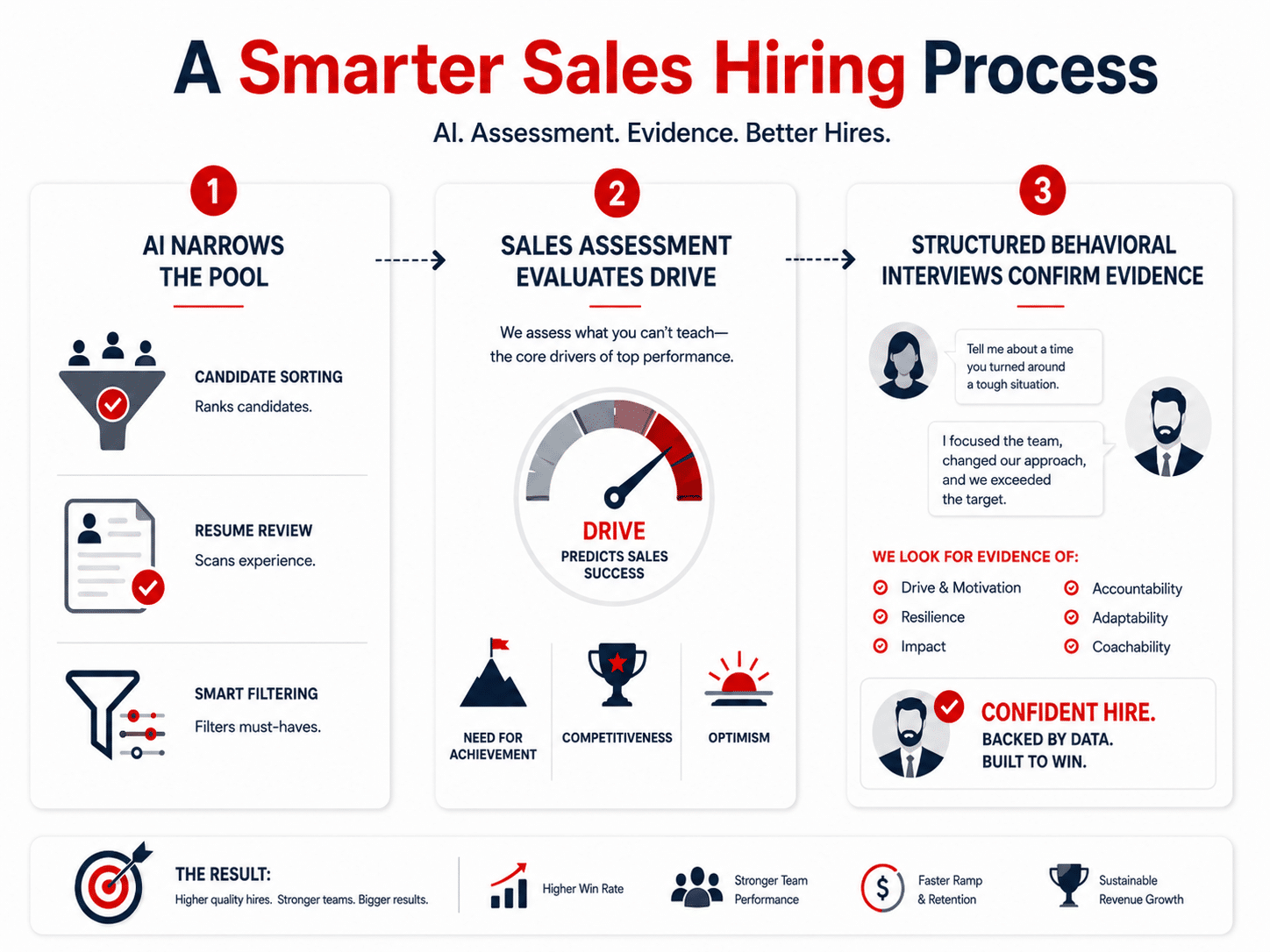
Step 1: Use AI to Narrow the Pool
Use AI to manage volume.
Let it help sort applications, organize candidate information, flag basic fit, and reduce administrative drag. This is where AI belongs: near the top of the funnel. But do not let an AI ranking become a substitute for evidence of sales potential. AI can help decide who gets evaluated next. It should not decide who gets hired.
Step 2: Use a Sales Assessment to Evaluate Drive
After AI narrows the pool, the process needs to evaluate what actually drives performance.
That is where a sales-specific assessment becomes important.
For hunter sales roles, the assessment should look beyond experience and communication style. It should help identify whether the candidate has the non-teachable traits associated with long-term sales success: Need for Achievement, Competitiveness, and Optimism.
This is the layer AI does not reliably solve. AI helps with speed. A sales assessment helps reduce hiring risk. Used correctly, the two tools are not competing with each other. They serve different purposes.
Step 3: Use Behavioral Interviews to Confirm How They Operate
The interview still matters. But it cannot be a loose conversation built around gut feel.
A strong sales interview should confirm how the candidate has behaved in real sales situations.
For Need for Achievement:
- Do not ask: “Are you motivated?”
- Ask: “Tell me about a difficult professional goal you set for yourself. What was the goal, what did you do, and what happened?”
For Optimism:
- Do not ask: “Do you handle rejection well?”
- Ask: “Tell me about a time you kept pursuing an opportunity after hearing no. What did you do next?”
For Competitiveness
- Do not ask: “Are you competitive?”
- Ask: “Tell me about a time you competed hard to win business. What made it difficult, and how did you respond?”
Weak interviews collect claims. Strong interviews collect evidence. That difference matters even more when candidates are becoming better prepared, more polished, and more capable of saying what hiring managers want to hear.
What Sales Leaders Should Ask Before Using AI to Hire Salespeople
Before relying more heavily on AI in sales hiring, map your process step by step.
Then ask: What is each step actually evaluating?
That question will expose weak spots quickly.
Ask:
- Is this step evaluating presentation or performance?
- Is it tied to real sales outcomes?
- Does it identify Drive?
- Does it tell us how the candidate behaves under pressure?
- Does it reduce hiring risk, or does it simply increase speed?
- Are we using AI as a filter, or are we letting it become the decision-maker?
- Where does a sales assessment fit into the process?
- What evidence do we have that this candidate can actually sell?
Most sales hiring problems are not tool problems. They come from relying too heavily on what is easiest to see.
Resume polish is easy to see. Interview confidence is easy to see. Communication style is easy to see. Drive is not.
But Drive is what matters when the salesperson has to prospect after rejection, compete for difficult business, and keep producing when no one is watching.
If your current process does not evaluate Drive, AI will not fix that. It will simply help you move faster with incomplete evidence.
Final Takeaway: Use AI for Speed, But Hire for Drive
AI can help you hire faster.
It can sort candidates, organize information, summarize interviews, and reduce bottlenecks at the top of the funnel.
But AI cannot replace the deeper evaluation required to identify salespeople who will actually produce. It cannot fully prove what a salesperson will do over time when they face rejection, pressure, uncertainty, and difficult goals.
That is where Drive matters.
AI needs to sit inside a stronger sales hiring system. A stronger process looks like this:
- Use AI to narrow the candidate pool.
- Use a sales assessment to evaluate Drive.
- Use structured behavioral interviews to confirm how the candidate operates.
That is how you move faster without hiring worse.
Because in sales hiring, the goal is not more candidates. The goal is more producers.
And that starts with Drive.
Hire Faster Without Hiring the Wrong Salesperson
AI can help you screen sales candidates faster. But before you make the hire, make sure your process evaluates what actually drives sales performance.
Frequently Asked Questions:
Yes, but AI should be used as a screening and efficiency tool, not as the final decision-maker. AI can help narrow the candidate pool, but companies still need a sales assessment and structured interviews to evaluate traits tied to actual sales performance.
AI typically evaluates visible candidate inputs such as resumes, written answers, video responses, interview transcripts, communication patterns, tone, structure, and keyword matches. These signals can be useful, but they mostly show how a candidate presents, not how they will perform under pressure.
The biggest limitation is that AI does not reliably identify the deeper traits that drive long-term sales success, such as Need for Achievement, Competitiveness, and Optimism. AI can speed up candidate screening, but it does not automatically improve hiring quality.
AI can identify patterns that may be associated with performance, but it should not be relied on alone to predict sales success. Sales performance depends heavily on Drive, behavior under pressure, and evidence from past performance.
A sales assessment helps evaluate traits that resumes, interviews, and AI screening tools often miss. For sales roles, especially hunter roles, companies need to know whether a candidate has the Drive to pursue goals, compete for business, recover from rejection, and sustain effort over time.
AI should be used near the top of the funnel to sort, prioritize, and organize candidates. After that, companies should use a sales-specific assessment to evaluate Drive and a structured behavioral interview to confirm how the candidate operates in real sales situations.
Drive matters because sales success depends on more than communication skills or prior experience. High-performing salespeople are achievement-oriented, competitive, and optimistic. Those traits help them prospect, pursue difficult goals, compete for business, and stay resilient through rejection.
No. AI can support screening and improve efficiency, but it should not replace a sales assessment. A sales assessment evaluates deeper traits connected to long-term sales behavior, while AI mostly evaluates visible candidate information and presentation quality.


