 866-972-5373
 Account Login

 866-972-5373
 Account Login

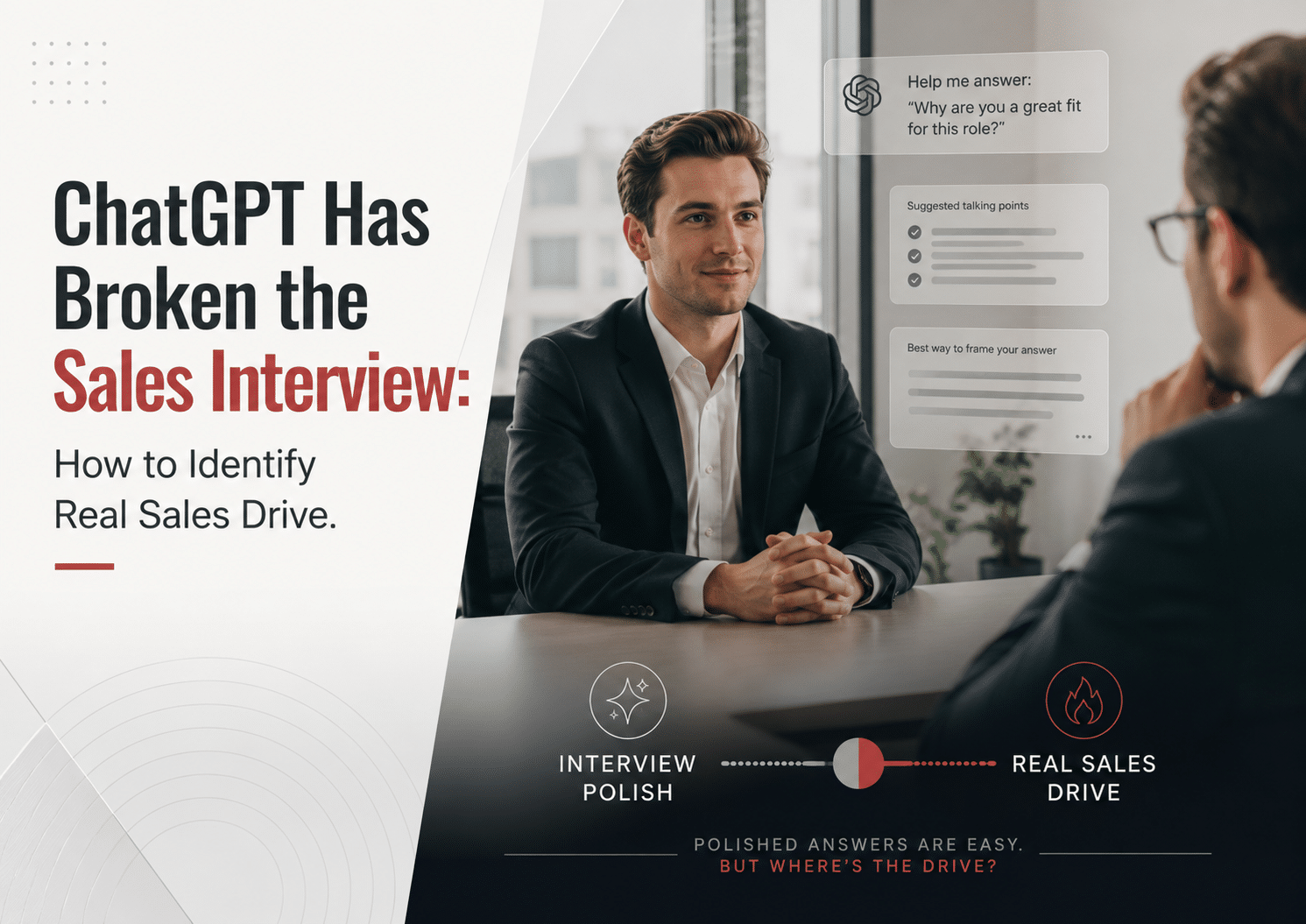
A sales candidate can now use ChatGPT to study your company, rehearse behavioral answers, prepare for objections, improve their resume language and practice sounding confident in a matter of hours.
That does not make them dishonest. It does make the traditional sales interview less trustworthy.
The question is no longer whether a candidate sounds prepared, strategic or confident. AI can help almost anyone sound that way. The question is whether that candidate has the internal Drive to prospect consistently, recover from rejection, compete for difficult business and keep producing when the job becomes uncomfortable.
For companies hiring hunter salespeople, that distinction matters more than ever.
ChatGPT has not created a new generation of great salespeople. It has created a larger group of candidates who can interview like great salespeople. Hiring teams now need to evaluate behavioral evidence, not verbal polish.
Interview Preparation Is Not the Problem
Candidates have always prepared for interviews. They have practiced answers, studied the company, rehearsed objections and tried to make the best possible impression.
There is nothing wrong with that.
A candidate who prepares seriously may be motivated, conscientious and ambitious. In some cases, extensive preparation may be a positive sign.
The problem is that AI has dramatically increased the quality of preparation without increasing the candidate’s actual ability to perform in the role.
A person with limited sales ability can now ask ChatGPT to:
- Develop polished answers to common sales interview questions.
- Create stories that sound structured and strategic.
- Suggest answers about persistence, competitiveness and resilience.
- Prepare responses to objections or mock selling exercises.
- Research your company, market and sales model.
- Improve tone, vocabulary and executive presence.
The result is a candidate who may sound considerably better than they would have five years ago.
That is useful to the candidate. It is dangerous for the employer when the interview process depends heavily on conversational impression.
AI Improves Presentation Faster Than It Improves Sales Performance
Sales hiring has always carried a basic risk: the qualities that impress interviewers are not necessarily the qualities that produce revenue.
- A candidate may be articulate without being persistent.
- They may be confident without being competitive.
- They may be likable without being willing to prospect.
- They may sound resilient without recovering well from rejection.
ChatGPT makes those distinctions harder to detect because it strengthens the surface-level qualities many hiring managers already overvalue.
A well-prepared candidate can now speak fluently about pipeline discipline, consultative selling, objection handling, relationship building and quota accountability. They may know exactly how to describe themselves as competitive, goal-oriented and persistent.
None of that proves they will make the next call after being ignored repeatedly. It does not prove they will continue building pipeline after losing a major opportunity. It does not prove they will maintain urgency when the quarter turns against them.
An interview is a short performance. Sales success is a repeated behavioral pattern.
That is the mistake hiring managers must stop making: confusing a convincing forty-five minutes with the capacity to produce month after month.
Why Sales Hiring Is Especially Vulnerable to AI-Assisted Polish
Some positions allow employers to observe clear technical output before making a hiring decision. A programmer can complete a coding exercise. A designer can show a portfolio. An accountant can demonstrate technical accuracy.
Sales hiring often depends on conversation.
The candidate walks into a meeting, builds rapport, answers questions smoothly and sounds persuasive. Because those abilities matter in sales, interviewers may assume that a strong interview indicates strong selling ability.
Sometimes it does.
Often it does not.
Some top-performing hunter salespeople are not especially polished interviewees. They may be blunt. They may be less rehearsed. They may not speak in perfectly organized corporate language. Yet when they are given a territory and a difficult target, they outperform everyone else because they possess the traits the job actually requires.
- They pursue hard goals.
- They want to win.
- They recover after rejection.
- They continue working when the early excitement of the role has disappeared.
Meanwhile, a polished candidate may win the interview and then struggle with the daily reality of prospecting, lost deals, silence from buyers and quota pressure.
AI does not create this hiring problem. It exposes the weakness of hiring processes that were already built around impression rather than evidence.
Generic Sales Interview Questions Are Losing Value
Questions such as these are now dangerously easy to prepare for:
- Tell me about yourself.
- Why do you want this sales role?
- What motivates you?
- What is your greatest weakness?
- Why should we hire you?
- How do you handle rejection?
- Are you competitive?
These questions invite rehearsed self-description. They give candidates an opportunity to present the version of themselves they know the employer wants to see.
With ChatGPT, a candidate can generate strong answers to every one of them before the interview begins.
That does not mean interviews are obsolete. It means lazy interviews are.
A hiring manager who asks a generic question, accepts a clean answer and moves on is gathering almost no reliable evidence about the candidate’s ability to hunt for new business.
What Sales Hiring Teams Should Evaluate Instead
A strong sales hiring process should focus on behavioral patterns that are difficult to manufacture during a short interview.
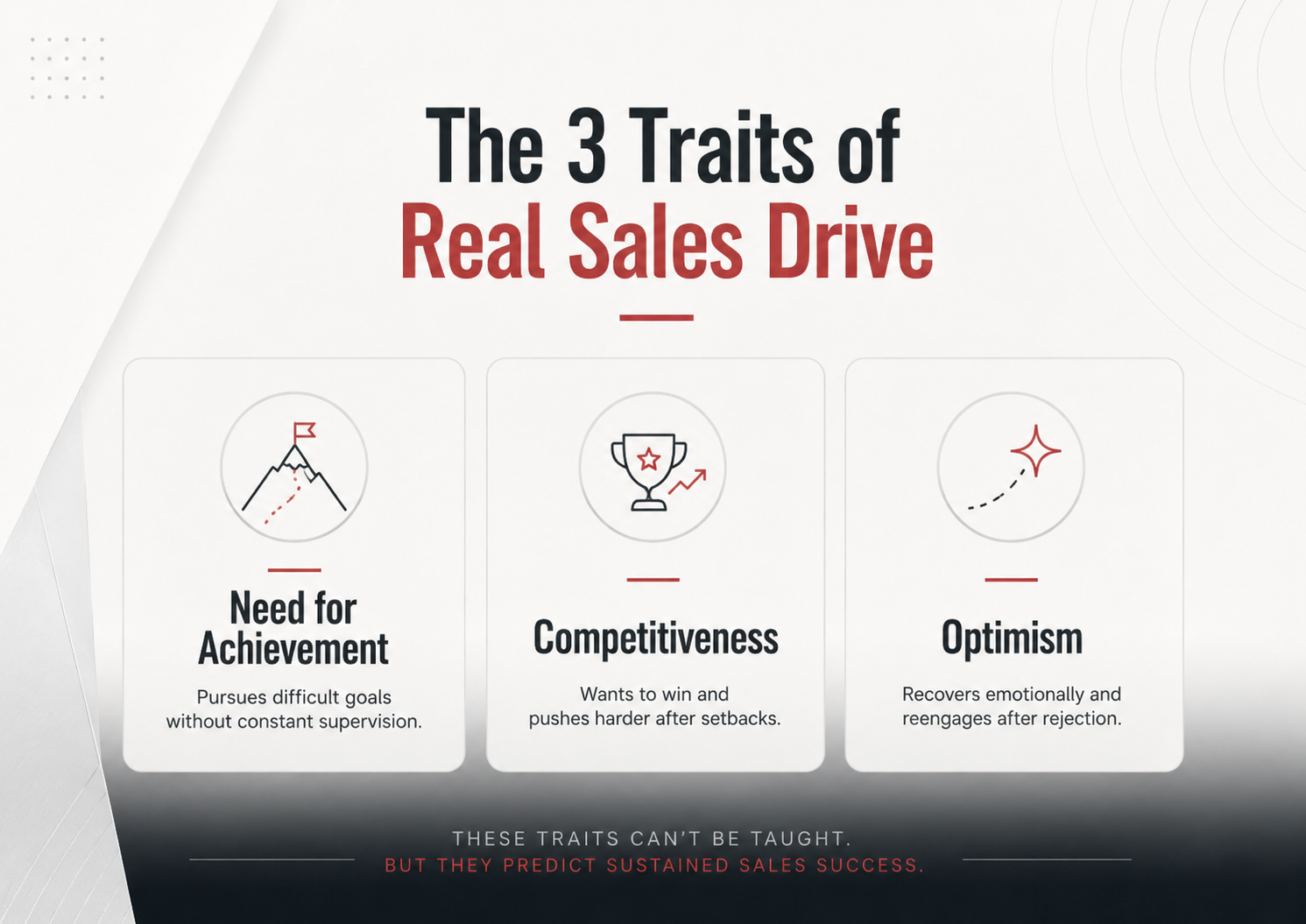
At SalesDrive, we refer to the three non-teachable traits behind sustained sales success as Drive:
- Need for Achievement
- Competitiveness
- Optimism
These traits matter because hunter sales roles are demanding in predictable ways. They require people to pursue difficult goals without constant supervision, compete for business, withstand rejection and continue believing the next effort can succeed.
Need for Achievement
Need for Achievement is the internal desire to accomplish difficult goals for the satisfaction of achievement itself.
A candidate high in this trait does not need a manager standing over them every hour to create urgency. They naturally set demanding standards and push themselves to reach them.
Do not ask, “Are you goal-oriented?”
Ask:
- What is the toughest goal you’ve ever set for yourself?
- How do you plan to top it?
- How do you know when you’ve truly succeeded?
- What do you do when progress toward your goal slows?
- What kinds of sacrifices have you had to make to be successful?
A rehearsed candidate may provide one polished achievement story. A candidate with genuine Need for Achievement usually reveals a repeated pattern across school, work, athletics, business, promotions, difficult assignments and/or personal goals.
Competitiveness
Competitiveness is not aggression or arrogance. It is the natural desire to win.
Hunter salespeople compete constantly: against other vendors, against indecision, against quota and often against their own prior results.
Do not ask, “Are you competitive?”
Ask:
- Tell me about a competition that mattered deeply to you.
- Tell me about a time you lost.
- Where do you rank in the sales team?
- Give me another example from earlier in your life.
The important evidence is not whether the candidate says they enjoy competition. It is whether competition appears repeatedly in their behavior and whether losing changes their effort.
Optimism
Optimism is the ability to recover emotionally after setbacks and reengage with the belief that success is still possible.
Salespeople hear no repeatedly. Prospects disappear. Deals stall. Competitors win. An opportunity that appeared nearly certain can collapse in a single meeting.
Do not ask, “How do you handle rejection?”
Ask:
- Tell me about a deal you expected to win but lost.
- How did you recover?
- Tell me about a time when you remained persistent, even after others gave up?
- What has been the most challenging situation you have faced in your present/most recent job?
A candidate can rehearse a statement about resilience. It is much harder to fabricate a consistent history of recovering, returning to action and continuing to pursue difficult outcomes.
The Interview Must Become More Difficult to Fake
The answer is not to interrogate candidates about whether they used ChatGPT. That would be a distraction.
A motivated candidate should prepare. Preparation is not the issue.
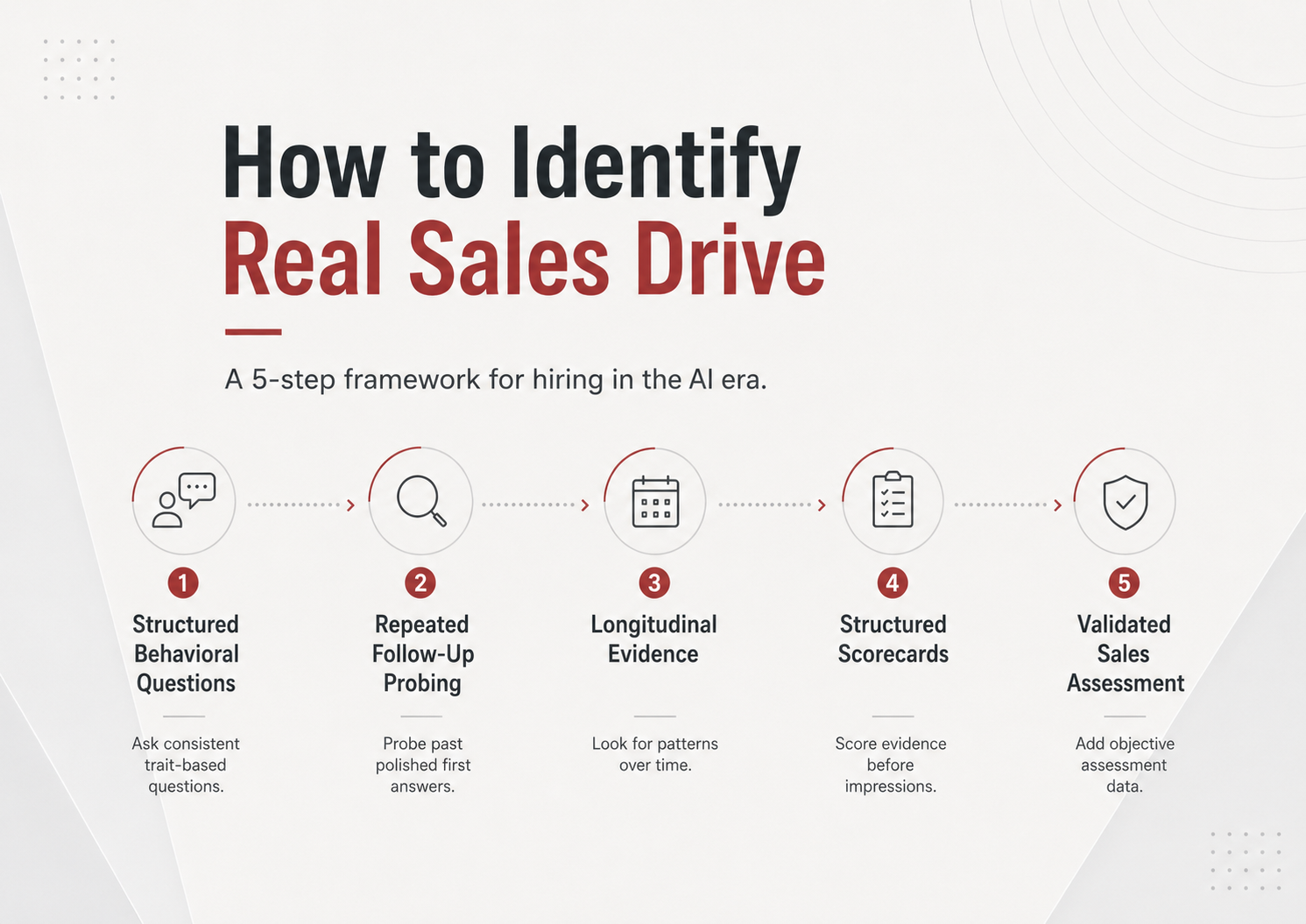
Your responsibility is to build a process that distinguishes preparation from capability. That process should include:
1. Structured Behavioral Interview Questions
Ask every finalist questions tied to the same traits and performance requirements. Do not improvise based on whether you like the candidate.
2. Repeated Follow-Up Probing
Never accept the first attractive story as proof. Ask what happened, what the candidate personally did, what the measurable result was, how they responded emotionally and whether the same pattern appears elsewhere in their life.
Specificity creates signal. Generalities create risk.
3. Longitudinal Evidence
Look across the candidate’s history. High-Drive people tend to leave evidence over time: unusually difficult goals, competitive choices, persistent effort, achievement patterns, rapid recovery after setbacks and a consistent attraction to environments where performance can be measured.
4. Structured Scorecards
Record evidence against defined hiring criteria before the team discusses overall impressions. A candidate’s charm should not erase weak evidence of Drive.
5. A Validated Sales Assessment
An interview should not carry the full weight of determining whether a candidate possesses the non-teachable traits needed for sustained sales performance.
A validated sales assessment can provide another source of evidence, especially when the interview environment has become increasingly vulnerable to AI-assisted polish.
No process is perfectly protected from manipulation. That is not the standard. The standard is whether your process is materially better than relying on a polished conversation and a confident handshake.
What This Means for Sales Leaders
The wrong lesson is that AI has ruined hiring.
The right lesson is that AI has made weak hiring methods easier to expose.
Candidates who sound impressive are no longer unusual. Candidates who continue pursuing new business through rejection, pressure and uncertainty are still unusual.
That is why the best sales hiring systems will place less weight on prepared language and more weight on evidence of Need for Achievement, Competitiveness and Optimism.
The costly mistake is not hiring someone who used ChatGPT to prepare. It is hiring someone because ChatGPT helped them sound like the salesperson you hoped they were.
Do Not Hire Interview Polish
A candidate who interviews beautifully may still lack the Drive to prospect, compete, persist and produce. The DriveTest® helps hiring teams evaluate the non-teachable traits that polished answers can hide.
Frequently Asked Questions
Yes. Candidates can use ChatGPT to research a company, rehearse answers, practice objections and improve how they present their experience. Preparation alone is not a reason to reject a candidate. The employer’s challenge is determining whether the candidate’s history supports the qualities they describe in the interview.
It makes unstructured, surface-level interviews less reliable. Generic questions and impression-based evaluation are easier for candidates to prepare for with AI. Structured behavioral interviews, persistent follow-up questions, scorecards and validated sales assessments provide stronger evidence for better decision making.
For hunter sales roles, employers should evaluate the underlying Drive required for sustained production: Need for Achievement, Competitiveness and Optimism. These traits influence whether a salesperson will pursue difficult goals, compete to win and recover after rejection.
Look for repeated behavioral evidence over time. Ask candidates about difficult goals, meaningful competition, losses, rejection and what they did afterward. Require specific examples, probe beyond prepared answers and use a structured sales assessment alongside the interview that measures Drive.
About Author: Dr. Chris Croner is a clinical psychologist, who specializes in sales, and is Principal at SalesDrive, LLC, an organization dedicated to helping companies identify, assess and hire high-performance salespeople. He is co-author of the book, Never Hire a Bad Salesperson Again, and the developer of the DriveTest® sales assessment.


