 866-972-5373
 Account Login

 866-972-5373
 Account Login

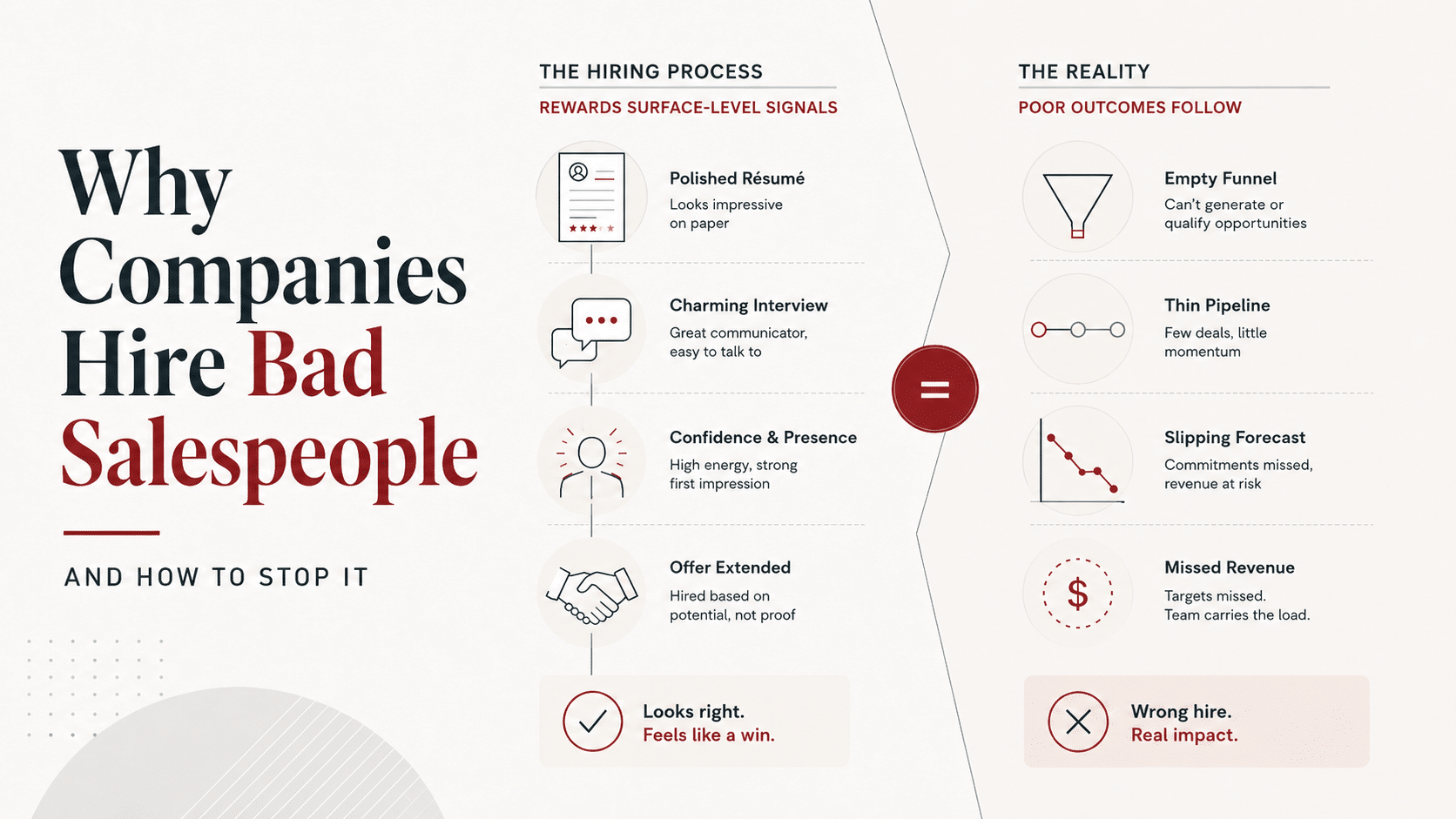
Most companies do not hire bad salespeople because they are careless. They hire bad salespeople because their hiring process rewards the wrong evidence.
A résumé looks strong. The candidate sounds confident on the phone. The interview feels comfortable. The hiring manager likes them. The company needs the seat filled.
Then three months later, nothing is happening.
The pipeline is thin. Activity is inconsistent. Forecasts keep slipping. The manager is spending too much time coaching effort instead of skill. Eventually, the company admits what was becoming obvious: this person is not going to produce.
That mistake can easily cost $50,000, $100,000, or more once you count salary, training, lost pipeline, missed opportunities, management time, and replacement cost.
The expensive part is not always what you pay the bad hire. It is the revenue they never create.
TLDR; Why Do Companies Hire Bad Salespeople?
Companies hire bad salespeople because they rely too heavily on surface-level signals: résumés, industry experience, likeability, interview polish, confidence, and gut instinct.
Those signals may show whether a candidate can present well, but they do not prove whether the person will prospect consistently, compete under pressure, recover from rejection, and produce revenue over time.
A better sales hiring process must answer one question: “Will this person actually produce revenue here?”
Not whether they sound good. Not whether they have held a similar title. Not whether the hiring manager enjoys the conversation.
Will they produce?
That is the question most sales hiring processes never fully answer.
Why Bad Sales Hires Keep Getting Through
Bad sales hires usually get through because the hiring process is too easy to fool.
Most companies overvalue:
- Résumés
- Industry experience
- Likeability
- Interview polish
- Confidence
- Easy conversation
- A quick need to fill the role
None of those prove a salesperson will prospect when no one is watching, keep going after repeated rejection or is internally motivated enough to create opportunities instead of waiting for them.
Sales performance depends on behavior under pressure.
That is why sales hiring has to look beneath presentation and find evidence of Drive.
At SalesDrive, we define Drive as the combination of three non-teachable traits commonly found in top-performing salespeople:
- Need for Achievement
- Competitiveness
- Optimism
These traits influence whether a salesperson will pursue difficult goals, compete for business, stay resilient after setbacks, and keep producing without constant supervision.
When companies fail to evaluate Drive, they often hire candidates who can talk about selling but cannot consistently do the hard parts of the job.
Mistake #1: Treating the Résumé Like Proof
A résumé is not proof of sales ability. It is a record of what the candidate wants you to notice.
It can show where someone worked, what titles they held, and how long they stayed. It may show accomplishments. It may give you useful clues.
But it does not tell you enough.
A résumé does not prove the candidate built their own pipeline. It does not prove they handled rejection well. It does not prove they were internally motivated. It does not prove they will sell in your environment.
Anyone can describe experience in a way that sounds impressive. That is why companies need to become better detectives.
Look beneath the résumé. Look for patterns that suggest Drive, not just employment history.
Useful clues include:
- Evidence of consistent achievement
- Sales metrics tied to actual production
- Longevity after the first few early-career moves
- Competitive activities
- Work history that required persistence
- Signs the candidate pursued difficult goals voluntarily
One warning: do not confuse job stability with Drive by itself.
A candidate can stay in one role for years and coast. Another candidate may have moved early in their career for legitimate reasons. The point is not to worship tenure. The point is to look for patterns.
The résumé should start your questions. It should not answer them.
Mistake #2: Assuming Experience Means Performance
Experience tells you what someone has been around. It does not tell you what they caused.
A candidate may have worked for a well-known company with strong brand recognition, warm leads, mature sales collateral, and a market that already trusted the product. That background may help them. But it may also hide how much of their success came from the system around them.
Then they come into your company, where the brand is less known, the leads are colder, the sales process requires more initiative, and suddenly they struggle.
When this happens, it’s typically because of a lack of Drive.
You have to determine whether the candidate can create opportunity, not just manage opportunity that already exists.
Ask:
- How much of their pipeline did they personally generate?
- What percentage of their business came from inbound leads?
- What did they do when lead flow was weak?
- How did they perform against quota over time?
- What changed in their behavior after a bad month?
- What did they do that an average rep would not have done?
The issue is not whether they have sold before. The issue is whether they will sell for you.
Mistake #3: Forgetting That Sales Has No Universal Certification
Lawyers pass the bar. CPAs pass rigorous exams. Physicians go through years of formal training and licensing.
Salespeople do not have one universal credential that proves they can sell.
A candidate can claim they produced. They can claim they exceeded quota. They can claim they were a top performer. But in most sales hiring processes, it is up to the company to uncover whether those claims are true.
That creates risk.
Sales attracts people from many backgrounds. Some are naturally suited for the demands of the role. Many are not. Because there is no standard certification for sales ability, companies must build their own evidence-based process.
That process should not depend on whether the candidate can speak confidently for 45 minutes.
It should include structured screening, objective assessment, behavioral interviewing, reference checks, and clear performance expectations.
Without that discipline, companies end up hiring based on claims instead of proof.
Mistake #4: Using a Soft Phone Screen
Many companies waste the phone screen.
They ask comfortable questions:
- What interested you in our company?
- Tell me about your background.
- What are you looking for in your next role?
- Why are you leaving your current company?
Those questions are not useless. But they are too soft if you are hiring for a demanding sales role.
A strong salesperson should not be scared away by high standards. In fact, high-Drive salespeople are often attracted to them.
The phone screen should test appetite for the actual environment.
Try language like this:
“This role is demanding. We set high standards, track activity closely, compete hard, and expect people to keep pushing even when prospects say no. Does that kind of environment energize you, or does it sound like too much?”
Then listen carefully.
A low-Drive candidate may retreat, soften the answer, or try to avoid the pressure of the question.
A high-Drive candidate often leans in. The answer may not be perfectly polished. That is fine. You are not grading polish. You are looking for energy, conviction, and comfort with challenge.
The phone screen should not be hostile. But it should reveal whether the candidate is drawn to the real job or only the idea of the job.
Mistake #5: Skipping a Sales Assessment
A company that hires salespeople without a sales assessment is relying too heavily on human instinct. And, that is dangerous because sales candidates are often very good at presenting themselves.
They know how to build rapport. They know how to sound confident. They know how to talk about goals, persistence, and customer relationships. Some are excellent interviewers.
That does not mean they will produce.
A sales-specific assessment gives you another source of evidence before you invest more time in the candidate.
It should not be the entire decision. No assessment should be.
It can help identify whether the candidate has the non-teachable traits associated with high sales performance.
But if you wait until after the hiring manager has already fallen in love with the candidate, assessment results become easier to rationalize away. That defeats the purpose.
Assess first. Interview smarter.
Mistake #6: Running Weak Sales Interviews
Most sales interviews are too easy to pass.
The candidate talks about experience. The manager asks a few predictable questions. The candidate gives polished answers. The conversation feels good. Then everyone mistakes comfort for evidence.
A strong interview should not be built around whether you like the person. It should be built around what the person has actually done.
The best predictor of future behavior is previous behavior. That means your interview should focus on real examples, not claims.
Do not ask: “Are you competitive?”
Ask: “Tell me about a time you lost a deal you badly wanted. What happened next?”
Do not ask: “Are you self-motivated?”
Ask: “Tell me about a difficult goal you pursued without anyone requiring you to do it.”
Do not ask: “How do you handle rejection?”
Ask: “Tell me about a period when you were hearing no repeatedly. What did your activity look like during that stretch?”
Then keep digging. Weak interviewers accept the first answer.
Strong interviewers ask for the second example, the details, the numbers, the emotional response, and the behavior that followed.
That is where the truth usually appears.
Mistake #7: Hiring for Likeability Instead of Drive
Likeability is one of the most expensive traps in sales hiring.
A likable candidate can make the hiring manager feel confident without offering much real evidence of future production.
They may be articulate. They may be warm. They may ask good questions. They may seem easy to manage.
That does not mean they will hunt.
Some excellent sales hunters are not the smoothest interviewees. They may be direct. They may be intense. They may even be a little rough around the edges.
But once they get into the field, they do what average salespeople avoid. They prospect. They compete. They recover. They keep moving.
If your process overvalues polish, you will miss some of those people.
Worse, you will hire candidates who are good at being interviewed but weak at generating revenue.
The question is not: “Do I like this person?”
The question is: “Will this person do the hard parts of the job consistently?”
Mistake #8: Mismanaging the First 90 Days
Hiring the right salesperson is not enough. The first 90 days can either reinforce Drive or bury it under confusion.
Many companies bring in a salesperson and assume they will figure it out. That is not onboarding. That is wishful thinking.
High-Drive salespeople still need structure, tools, expectations, and management discipline. They need to understand the market, the message, the activity standards, the CRM process, the sales cycle, and how success will be measured.
But they also need room to run.
Managing a high-Drive salesperson is a bit like handling a Ferrari. The engine is powerful, but it still needs the right road, the right handling, and the right maintenance.
During the first 90 days, define:
- Activity expectations
- Pipeline goals
- Messaging standards
- Prospecting requirements
- Product knowledge milestones
- Manager check-ins
- Coaching cadence
- Early performance indicators
Do not smother them. Do not abandon them.
Give them structure, then watch how they respond to it.
A high-Drive salesperson usually wants clear standards. They may even push you for more resources, better tools, or a sharper process.
That is not a problem. That is often the sign you hired someone who wants to win.
The Real Cost of a Bad Sales Hire
The cost of a bad salesperson is not limited to payroll. The larger cost is missed production.
A weak salesperson may fail to build pipeline, avoid hard prospecting, lose competitive deals, mishandle opportunities, and consume management time that should be spent developing stronger performers.
You may not see the revenue they failed to create.
But you will feel it.
You will feel it in missed quota. You will feel it in slow growth. You will feel it in constant recruiting. You will feel it in managers who spend too much time trying to coach effort.
That is why sales hiring has to be treated as a revenue decision.
Because it is.
How to Avoid Hiring Bad Salespeople
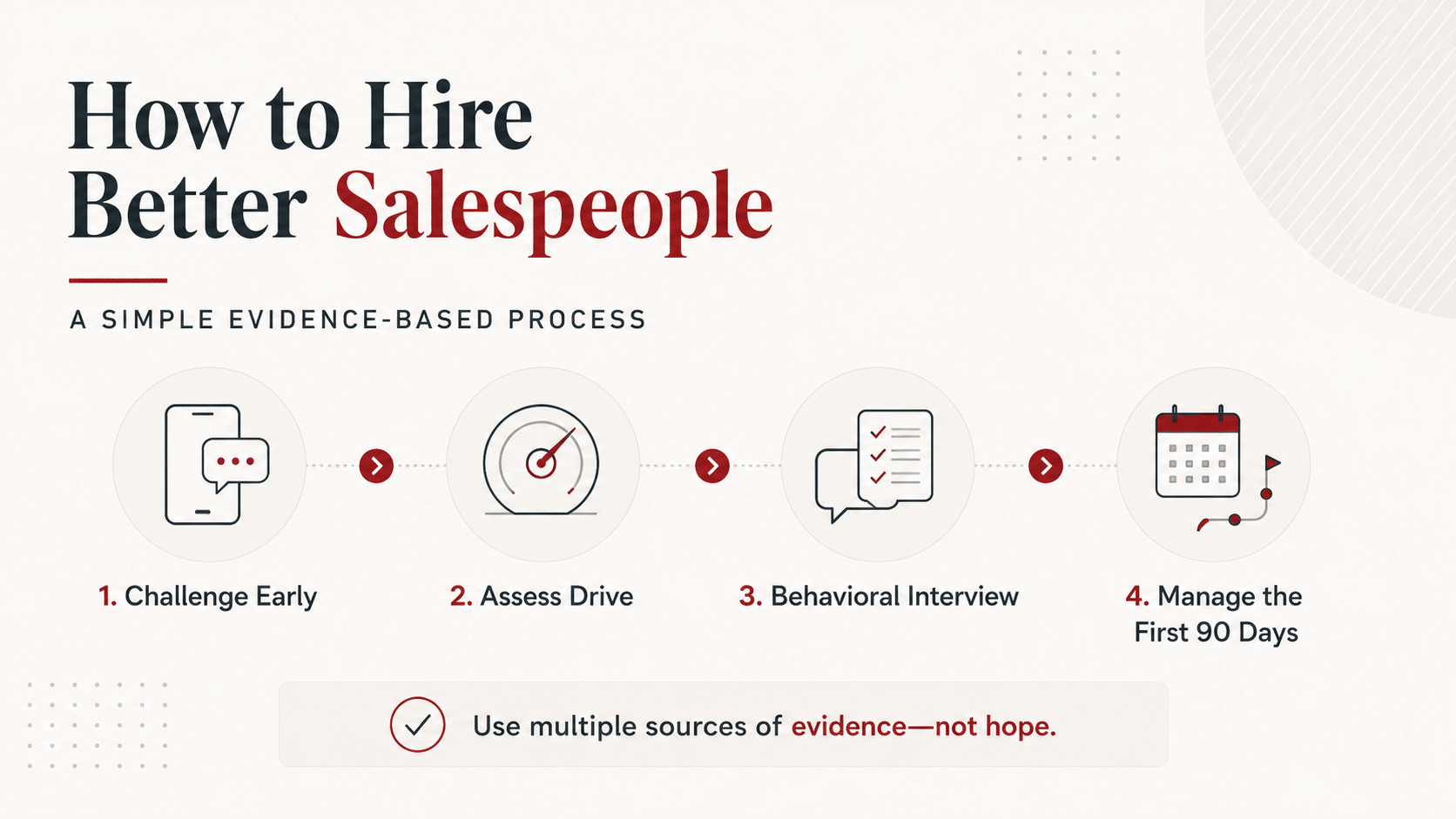
A better sales hiring process does not rely on one signal. It uses multiple sources of evidence to reach a more accurate decision.
1. Use the Résumé for Clues, Not Conclusions
Look for achievement patterns, measurable results, competitive history, initiative, and signs of persistence. Then use the résumé to build better questions.
2. Challenge Candidates Early
The phone screen should reveal whether the candidate is attracted to a demanding sales environment or simply looking for another job.
3. Assess for Drive
Use a sales-specific assessment to evaluate the non-teachable traits that influence production: Need for Achievement, Competitiveness, and Optimism.
4. Conduct a Behavioral Sales Interview
Ask about past behavior. Push for examples. Look for consistency. Do not reward polished claims without proven behavior patterns.
5. Manage the First 90 Days Deliberately
The hire is not finished when the offer is accepted. Early onboarding determines whether the salesperson builds the right habits fast.
That process is not complicated. But it does require discipline.
Most companies do not have a talent problem. They have a sales hiring process problem.
Final Takeaway: Stop Hiring on Hope
Bad sales hires usually do not happen because no one cared. They happen because the process was too easy to fool.
The résumé looked good. The phone screen was comfortable. The interview felt right. The candidate seemed likable. The company needed someone quickly.
No one measured Drive. No one challenged the candidate early enough. No one pushed past polished interview answers. The first 90 days lacked discipline. Then the company paid for it.
If you want fewer bad sales hires, stop relying on surface signals.
- Look for evidence.
- Assess Drive.
- Interview for past behavior.
- Challenge candidates before you hire them.
- Manage the first 90 days with intention.
That is how you stop hiring people who can talk about selling and start hiring people who will actually produce.
Stop Guessing Who Can Sell
The DriveTest® helps companies identify the non-teachable traits found in top-performing salespeople: Need for Achievement, Competitiveness, and Optimism.
Before you spend months managing the wrong salesperson, find out whether your candidate has the Drive to succeed.
Frequently Asked Questions
Companies hire bad salespeople because they rely too heavily on résumés, soft phone screens, weak sales interviews, likeability, confidence, and gut instinct. Those signals may show whether a candidate can present well, but they do not reliably prove whether the person has the Drive to produce revenue consistently.
Companies can avoid hiring bad salespeople by using a more evidence-based hiring process. That includes reviewing résumés for clues, challenging candidates during the phone screen, using a sales-specific assessment, conducting structured behavioral interviews, setting clear expectations, and managing the first 90 days deliberately.
Companies should look for evidence of Drive: Need for Achievement, Competitiveness, and Optimism. Strong sales candidates usually show patterns of goal pursuit, measurable success, persistence after setbacks, comfort with competition, and the ability to stay productive under pressure.
Yes. A sales-specific assessment should not replace interviews or judgment, but it gives companies another source of evidence before they invest in a candidate. The right assessment can help identify whether a candidate has the non-teachable traits that influence long-term sales performance.
A bad sales hire can cost $50,000, $100,000, or more once you include salary, training, missed pipeline, lost opportunities, management time, and replacement hiring. The largest cost is often the revenue the salesperson never creates.


