 866-972-5373
 Account Login

 866-972-5373
 Account Login


Most bad sales hires do not look bad in the interview. That is the problem.
They are often confident. Personable. Well-spoken. They know how to talk about relationships, quota, pipeline, and closing deals. They may have years of industry experience. They may even come with a resume that makes everyone around the table think, “This person can sell.”
Then the real work begins.
The prospecting gets uncomfortable. Rejection piles up. Deals stall. The pipeline gets thin. Follow-up becomes inconsistent. And slowly, the truth becomes clear: the person had the appearance of a salesperson, but not the internal Drive to perform like one.
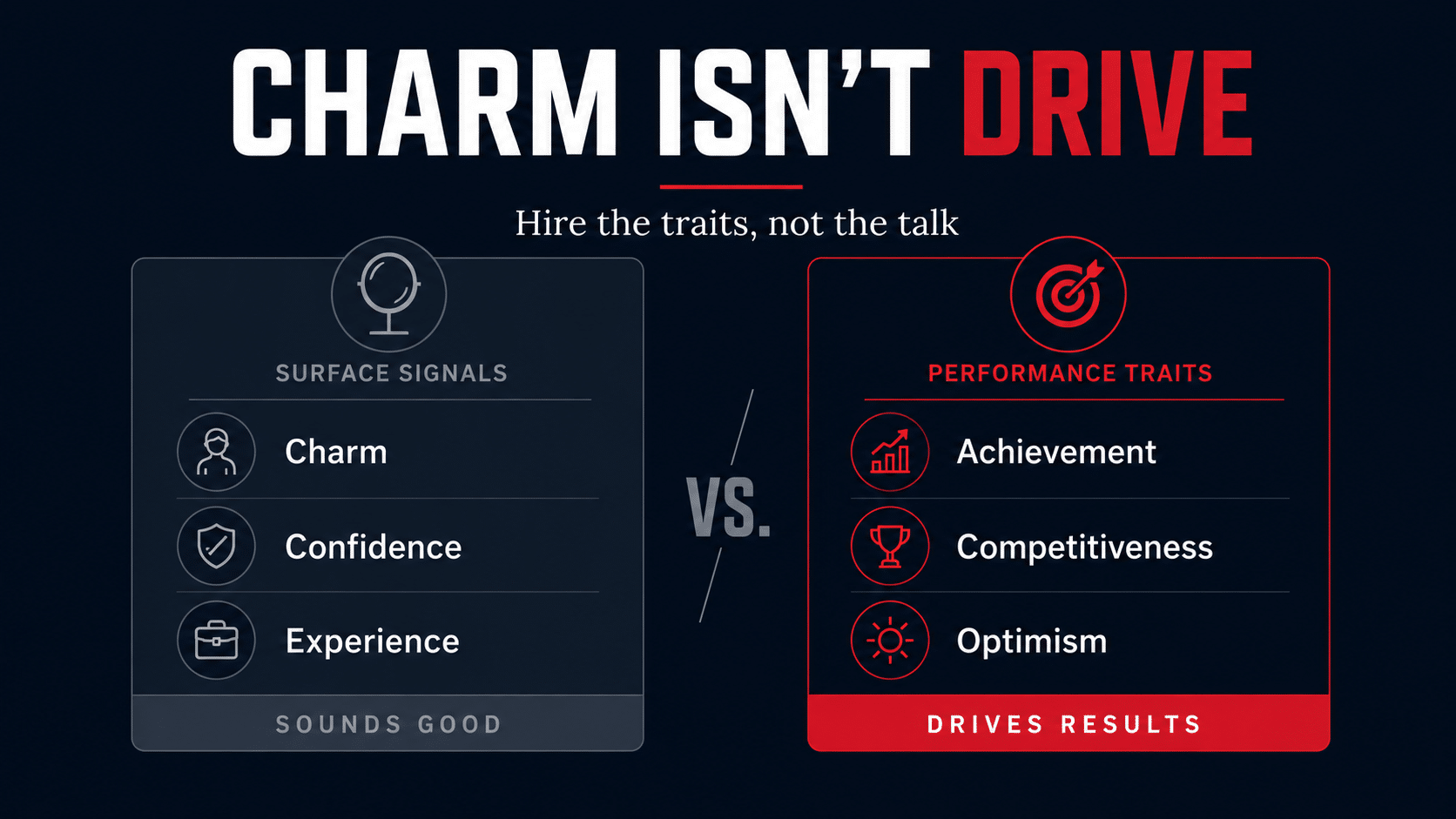
This is why great salespeople are so hard to hire. The traits that predict sales success are rare, difficult to spot in interviews, and often confused with surface-level qualities like charm, confidence, communication style, or industry experience.
A candidate can speak well. They can seem motivated. They can even have prior sales experience. But none of those things automatically mean they have the psychological makeup to handle rejection, pursue difficult goals, compete to win, and stay optimistic when the sales process gets hard.
The best salespeople are not simply better talkers. They are not just more charismatic. They are not just people who have been through more sales training.
They have a unique combination of traits that push them to keep going when others stop.
Why Sales Hiring Breaks Down So Often
Most sales hiring processes are built around the wrong question. Companies usually ask, “Does this person look like they can sell?”
That is a dangerous question because plenty of people can look the part. They can carry themselves well. They can speak with confidence. They can tell a good story in the interview. They can say they are competitive, persistent, and goal-oriented.
But sales performance is not determined by how someone performs in an interview. It is determined by what they do when the work becomes uncomfortable.
- Will they make the next call after five people ignore them?
- Will they pursue a difficult goal without needing constant pressure from a manager?
- Will they compete to win when the prospect is also considering three other vendors?
- Will they stay optimistic when a deal they were counting on suddenly goes quiet?
Those are the questions that matter.
The hard truth is this: many hiring managers are evaluating presentation, not performance potential. They are reacting to what is visible in the room rather than measuring what will matter in the field.
That is how companies end up hiring people who are charming but passive, experienced but unmotivated, polished but fragile, or knowledgeable but unwilling to prospect.
The better question is: “Does this person have the psychological makeup to succeed in sales?”
That question is harder to answer, but it is the one that determines whether the person is likely to produce once the pressure of the role begins.
A Common Sales Hiring Story
Here is a common pattern I have heard from many companies over the years and you may have also experienced this:
A candidate comes in with a strong resume. They have worked in the industry. They know the language. They interview well. The sales manager likes them. Leadership likes them. Everyone feels good about the hire.
For the first few weeks, things seem fine.
Then activity starts to slip. Prospecting is inconsistent. The rep talks about needing better leads. They spend more time preparing than selling. When deals stall, they blame pricing, timing, marketing, the market, or the product.
The manager tries to coach them. They work on scripts. They review the CRM. They talk through objection handling. They role-play follow-up.
But the real issue was never technique.
The issue was Drive.
This is the painful lesson many companies learn too late: you can train sales skills, but you cannot coach someone into wanting to work badly enough.
High-Performing Salespeople Are Psychologically Different
A strong hunter salesperson possesses a rare psychological foundation.
They must be willing to pursue new business, face repeated rejection, compete against alternatives, and continue believing success is possible even when prospects say no.
That is not normal workplace psychology.
Many capable, intelligent, professional people do not enjoy that kind of environment. They may prefer stability, collaboration, clear instructions, predictable outcomes, or work where effort leads to more immediate feedback. There is nothing wrong with that. It simply does not translate into high-performance sales behavior, especially in a true hunter role.
High-performing salespeople tend to push harder. They want to win. They set a higher bar for themselves. They are often not satisfied with average results. They may even push managers, owners, and leadership teams because they want the resources and freedom to perform at a higher level.
That intensity is part of what makes them valuable.
It is also part of what makes them harder to find and, if a company does not understand what it has hired, harder to manage.
The 3 Traits Behind Great Sales Performance
At SalesDrive, we collectively refer to the three non-teachable traits behind sales success as: Drive.
Drive includes Need for Achievement, Competitiveness, and Optimism.
These are not decorative personality traits. They are performance traits. They influence whether a salesperson will pursue difficult goals, compete for the win, and continue moving forward after rejection.
1. Need for Achievement
Need for Achievement is the internal desire to do well for the sake of doing well.
This is the person who sets a high bar and then wants to exceed it. They are motivated by accomplishment. They want to improve. They care about excellence even when no one is watching.
In sales, this matters because no manager can manufacture ambition for someone else.
You can assign a quota. You can create a compensation plan. You can provide coaching and training. You can review the pipeline every week. But you cannot force someone to care deeply about reaching difficult goals.
High need for achievement salespeople tend to ask questions like:
- How can I beat my last result?
- What is the next milestone?
- How do I get better?
- What does excellence look like here?
That internal pressure is one of the major differences between top producers and average performers.
Average reps often wait for direction. Those reps with a high need for achievement are already looking for the next mountain to climb.
2. Competitiveness
Competitiveness is the desire to win.
In sales, healthy competitiveness does not mean being rude, reckless, or overly aggressive. It means the salesperson enjoys the contest. They want to beat the competitor. They want to win the prospect. They want to be one of the best performers on the team.
This matters because sales is inherently competitive.
Your prospects are comparing vendors. Your competitors are trying to win the same business. Your market is crowded. Your buyer has alternatives.
A salesperson who does not care deeply about winning will often lose to someone who does.
Without competitiveness, a salesperson may be pleasant and knowledgeable, but passive. They may maintain relationships without creating enough movement. They may accept rejection too quickly. They may fail to push for the next step. That is a problem in a true hunter sales role.
Competitiveness is the difference between, “Let me know when you are ready,” and, “Let’s talk through what is holding this decision up.”
3. Optimism
Optimism is the belief that success is still possible, even after setbacks. This trait is essential because rejection is built into sales.
Prospects ignore emails. Deals stall. Buyers delay decisions. Competitors undercut pricing. Decision-makers go silent. The opportunity that looked certain last Friday suddenly looks questionable on Monday.
Without optimism, rejection becomes personal. The salesperson starts to believe the opportunity is gone, the market is too hard, or the effort is not worth it.
A naturally optimistic salesperson responds differently.
They believe the next call can work. They believe there is still a path forward. They are able to handle difficulty without letting it destroy their effort.
That is why optimism is not fluff. It is a sales survival trait.
Why These Traits Are So Hard to Spot in Interviews
The problem is not that hiring managers do not care about these traits. The problem is that these traits are difficult to evaluate through a traditional interview alone.
Sales candidates are often good at presenting themselves. Many can sound confident, motivated, and competitive for an hour. Some can say exactly what a hiring manager wants to hear.
But the real test of sales performance is not whether someone can talk about persistence.
The real test is whether they will actually persist when prospects reject them, deals stall, and the work becomes uncomfortable.
That is why interviews alone create so much hiring risk. They often capture how well the candidate performs in the interview, not how well the candidate will perform in the sales role.
This is also why relying too heavily on “gut feel” can be dangerous.
A gut feeling may tell you that someone is likable. It may tell you they are comfortable in conversation. It may tell you they would fit in well with the team.
But it will not reliably tell you whether they have the non-teachable traits that drive sales performance.
How to Improve Your Sales Hiring Process
A stronger sales hiring process should combine structure, evidence, and scientific data.
The goal is to stop guessing based on polish and start identifying whether the candidate has the underlying Drive to succeed.
A more predictive process should include:
- A structured resume review
- A focused phone screen
- A validated sales assessment
- A behavioral interview
The sales assessment helps identify whether the candidate has the non-teachable traits associated with sales success. The behavioral interview helps confirm whether those traits have shown up in past work behavior.
That combination is much stronger than instinct alone.
It also gives hiring managers a more disciplined way to separate what a candidate says from what their history suggests. Remember: the best predictor of future behavior is past behavior.
Interview Questions That Reveal Sales Drive
The best interview questions do not ask candidates to describe who they think they are. They ask candidates to prove what they have done.
Instead of asking, “Are you competitive?” ask:
“Tell me about a time you were intensely competitive at work. What happened, and what did you do?”
Instead of asking, “Are you motivated?” ask:
“Tell me about a difficult goal you set for yourself professionally. Why did it matter, and how did you pursue it?”
Instead of asking, “Do you handle rejection well?” ask:
“Tell me about a sale or opportunity where you stayed persistent even after other people thought it was over.”
Strong candidates can provide specific examples. They can tell you what happened, what was at stake, what they did, and what the result was.
Weak candidates tend to answer in generalities.
Listen for clear goals, personal sacrifice, persistence, competitive energy, resilience after rejection, measurable outcomes, and a desire to improve or top a previous achievement.
The details matter. Specifics are evidence. Generalities are not.
A Useful Hiring Clue: Working Through School
One additional clue worth exploring is whether a candidate worked to put themselves through school.
This is not a guarantee of sales success. It should not be used as a shortcut or a standalone hiring rule. But it can be a meaningful signal of Need for Achievement, sacrifice, work ethic, and self-motivation.
If that experience appears on a resume or comes up in conversation, ask follow-up questions:
- What did they do?
- Why did they do it?
- How did they balance competing priorities?
- What did they learn from the experience?
- What did they have to give up to make it work?
You are looking for evidence of internal drive, not just a biographical detail.
The same is true for athletics, entrepreneurship, military service, demanding academic programs, family responsibilities, or any other experience that required discipline, resilience, and sustained effort.
The key is not the experience itself. It is what the experience reveals about the person.
Hired High Performers, Don’t Manage Them Like Average Reps
Hiring high-Drive salespeople is only the first step. Once you have them, you need to manage them correctly.
This is where many companies create a new problem. They finally hire a strong salesperson, then suffocate that person with the wrong management style.
High-performing salespeople usually do not want to be micromanaged. They want freedom, support, and focused mentorship. They need clear expectations and accountability, but they also need room to operate.
1. Do Not Overmanage Them
High-performing salespeople need space to move. This does not mean they should be unmanaged. It means they should not feel collared.
Micromanagement slows them down, frustrates them, and often sends the message that leadership does not trust them. This is especially true for experienced high performers.
Give them the target. Give them the scoreboard. Give them accountability.
But do not watch every step as if they are incapable of managing themselves.
2. Give Them the Tools and Support to Win
Freedom does not mean neglect. High performers still need support. In fact, they often become frustrated when the company creates unnecessary friction that prevents them from producing.
That support may include better technology, stronger lead flow, better collateral, clearer messaging, faster internal response times, better product training, and clearer compensation structures.
If a high-performing salesperson has the Drive to produce, do not limit them with weak tools, slow support, or unnecessary internal obstacles.
A Diven salesperson will tolerate difficulty in the market. They will not tolerate preventable friction inside the company forever.
3. Replace Long Meetings With Focused Mentorship
High-performing salespeople usually do not enjoy meetings for the sake of meetings.
They are wired for movement and results. Sitting through long, unfocused meetings can feel like wasted selling time.
That does not mean communication is unimportant. It means the format matters.
Use focused mentorship instead:
- Short pipeline reviews
- Deal-specific coaching
- One-on-one strategy conversations
- Post-call debriefs
- Targeted guidance around key opportunities
The rule is simple: mentorship beats meetings.
The Real Reason Great Salespeople Are So Hard to Hire
Great salespeople are hard to hire because the traits that make them great are rare, easy to miss, and nearly impossible to develop after the fact.
Most hiring processes overvalue what is visible in the interview and undervalue what determines performance after the hire.
The best salespeople are driven by achievement. They compete to win. They remain optimistic through rejection. And when they are hired and managed correctly, they can become some of the most valuable people in the company.
But you have to identify those traits before you hire.
Then you have to manage those people in a way that helps them thrive.
Because in sales, performance does not start with charm, experience, or interview polish. It starts with Drive.
Don’t Get Fooled By Charm
A polished interview does not prove a candidate has the Drive to prospect, compete, persist, and win. Use the DriveTest® to see what matters before you hire.
Frequently Asked Questions
Great salespeople are hard to hire because the traits that drive sales success are rare and difficult to spot in interviews. Many candidates can appear confident, polished, or experienced without having the Need for Achievement, Competitiveness, and Optimism required for consistent sales performance.
The three non-teachable traits most closely associated with sales success are Need for Achievement, Competitiveness, and Optimism. Together, SalesDrive refers to these traits as Drive.
Use a structured hiring process that includes a validated sales assessment and behavioral interview questions. Look for specific examples of achievement, competitiveness, persistence, sacrifice, and optimism under pressure.
Do not micromanage them. Give them clear goals, room to operate, strong tools, useful support, and focused mentorship instead of long, unfocused meetings.
About Author: Dr. Chris Croner is a clinical psychologist, who specializes in sales, and is Principal at SalesDrive, LLC, an organization dedicated to helping companies identify, assess and hire high-performance salespeople. He is co-author of the book, Never Hire a Bad Salesperson Again, and the developer of the DriveTest® sales assessment.


